
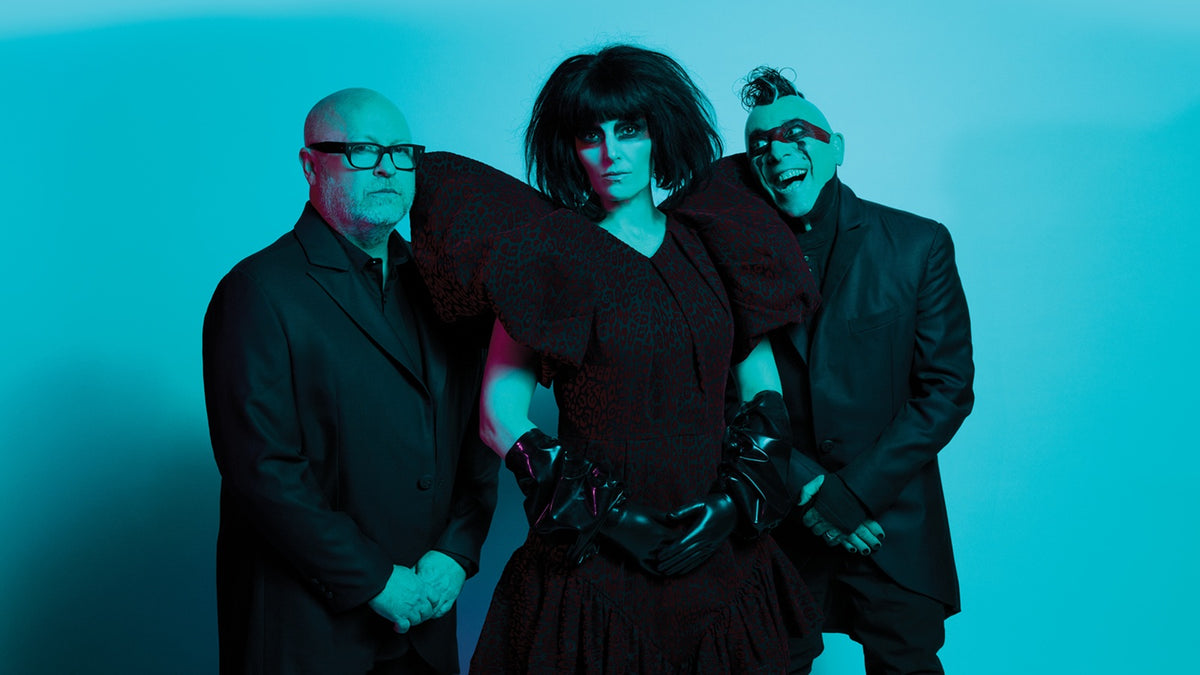
“There are no shortcuts,” says Maynard James Keenan, one-third of the slippery, enigmatic,experimental rock project Puscifer. “You have to wax-on/wax-off and be frustrated with wax-on/wax-off, while Mr. Miyagi keeps shaking his head: ‘No, you’re fucking this up.’ That’s just part of the path.”
He’s reflecting on the requisite sweat of the creative process — and rejecting the idea that being an artist is simply sitting around “with your antenna up,” waiting for grand inspiration to strike. It’s a meaningful philosophy for this dude, who seems to cram every inch of his life with purposeful “puzzles” to solve: how to weave his distinctively cinematic vocals into the psych-prog mazes of TOOL and the atmospheric landscapes of A Perfect Circle; how to oversee the complicated winemaking process at his own Merkin Vineyards in Arizona; how to map out tours and train in jiu-jitsu during the increasingly fleeting gaps in his schedule.
But that quote is especially relevant to the making of Puscifer’s aggressive and pointed fifth LP, Normal Isn’t, which — arguably more than ever — finds Keenan “observing, interpreting and reporting” on the insanity of a society divided by pettiness and brainwashed by algorithms. It just might be their most purpose-built album yet, one that pushes deeper into the Pusciverse while reaching back toward their early goth DNA to make something sharp-edged enough for these abnormal times. But for Keenan, there are no cheat codes — and it all begins and ends with the work.
The album, crafted with his longtime creative partners Mat Mitchell and Carina Round, marked a notable shift in their songwriting process, with Keenan helping plant many of the initial song seeds in his personal recording software. And the ideas he brought in this time carried a different charge, pulling from the goth, synth-punk and early industrial sounds he grew up on — from Killing Joke to Bauhaus to Siouxsie and the Banshees — blending dark romanticism with a twitchy, dance-floor punk undercurrent that runs through the record.
As with their previous LP, 2020’s Existential Reckoning, the tracks were sculpted through endless ping-ponging and cross-pollination via Dropbox folders, with everyone tweaking and layering and rearranging — one person’s initial influence may have been unrecognizable by the time everyone got their paws in the honey pot. Still, even if the songs were as collaborative as ever, pitching out these skeletal fragments was big for Keenan — who, as part of an ideation ritual, would deny himself his morning coffee until he got something cooking. No shortcuts.
“I kind of needed to digest everything that happened on the last album, and I needed Mat to show me how to use Logic better than I’d understood it,” he says. “Part of it was just responding to the logistics of [the software]. I’m not a shredder bass player, so it’s not like I’m gonna do that. I’m not a drummer. I’m just coming up with simple keyboard-and-drum-pattern stuff, just to inspire some vocals or ideas. Then Mat completely runs with that. I need him to put it through his filter.”

There’s an important lesson here, too: Even Keenan — the dynamic voice powering heavy-music classics like Lateralus and Thirteenth Step — was intimidated at first by this act of putting himself out there. “Of course! You mean me putting stuff in the folder and crossing my fingers that Mat wasn’t going to just delete it? Yeah, it was scary,” he says. “I didn’t take anything too far with vocals. I just wanted to hear what [Mat] was going to do before that. Once I hear the vocal, now I’m fucked because I can’t get it out of my head. I had to wait until he ran it through the meat grinder and showed me what inspired him. That’s really what it comes down to. We’re not trying to do cover songs of each other’s ideas — we’re trying to listen and respond honestly and do the work to make them better than you found them.”
That’s been the M.O. for years now, as Puscifer have evolved into a bona fide band with a clear chemistry — albeit one with a shit ton of guest players, a circus-like stage show and an extended universe of comedic characters and question marks. The project has, of course, always defied categorization. At its core, Puscifer dates all the way back to the early Nineties, as TOOL were emerging and while Keenan integrated himself within Hollywood’s alt-comedy community. (Most fans remember that the Puscifer moniker appeared in a sketch from the first episode of David Cross and Bob Odenkirk’s iconic HBO comedy series, Mr. Show, with Keenan joined by TOOL guitarist Adam Jones.)
On the first album, 2007’s “V” Is for Vagina, the singer worked with a versatile crew of musical journeymen, including Primus drummer Tim Alexander and Queens of the Stone Age guitarist Alain Johannes, as he ventured into unsettling, darkly comic grooves and industrial-rock drones. The idea was clear: I can make Puscifer whatever the fuck I want, and if you buy a ticket to this freaky carnival, you should expect the unexpected.

Mitchell, who played on and co-produced the debut, stuck around for the follow-up, 2011’s Conditions of My Parole, which ventured even deeper into full-bodied electronica and dust-blown art-rock — and also introduced Round as both a crucial second vocalist and frequent co-writer. From there, even as their cast of characters continued to expand on the two following records, 2015’s equally ambitious and surprising Money $hot and 2020’s Existential Reckoning, it felt like they’d cracked some kind of code.
“What makes this project unique from a creative side — and probably from a fan side — is that we don’t have any explications or a definitive set of rules about what this band is and what’s appropriate and not appropriate,” Mitchell says. “We just leave it open-ended, leave our egos, and trust that everyone has the same goal of making great art. Then just let it guide us to what the result is. With some of the early stuff, we would do a record and then come up with three versions that we would play live. We were always reinventing the songs and what the parts were. We learned to never be too precious about anything, and that’s really allowed this project to be free of that.”
Round sees Puscifer as a “free outlet” for all the things Keenan can’t do in his other bands, given that TOOL and A Perfect Circle are “more specific” in what they do. But is Puscifer even a “band?” “I don’t fucking know,” she says with a laugh. “We’re not like, ‘Let’s all sit in a rehearsal room and jam!’ Is that what a band is? I know bands like that that don’t create as much as we do. So yes, it feels like a band. And no. It just is what it is. It’s non-definitive.”
Whatever Puscifer is, it’s generated a real sense of momentum. Mitchell says that for Normal Isn’t, the trio started tossing around ideas “pretty much as soon as we delivered the last record.” They worked on material during off-days from touring, including their stage-stuffing Sessanta package shows featuring Puscifer, A Perfect Circle and Primus. And as their deadline began to loom, they grabbed studio time wherever they could, even setting up backstage recording sessions.
They had a mountain of ideas to work with in the shared group drive — and Keenan estimates roughly 40 percent of the finished tracks started from his “silly napkin ideas,” which reminded him of his days back in art school, when many of his friends were experimenting with early keyboard-sequencer technology.
“They could just do patterns,” he says. “You’re looping and playing to yourself. I had a four-track. [These days], any time I can loop things and get into a groove, that’s where it starts for me: a simple, weird sound from some digital synth in Logic, with a drum beat. And then the ability to change those drum beats by dragging my finger across the screen to adjust how many snare hits and the time signature and all that. Rather than trying to force an idea I had into the machine, just rolling the dice and coming up with something and then tearing it apart…
“Once you’re in the groove, all of the sudden Mat would go, ‘Hey, I threw this in a folder,’ and you go, ‘Oh, I already hear that song!’ That’s something I wasn’t even thinking of, and then you run with it, and it’s almost a song 24 hours later. And then there are others that we struggled with forever.”
One example of the latter: the snarling “Self Evident,” which pairs some deliciously fuzzed-out riffs with Keenan and Round singing in a head-spinning counterpoint of fury — “You’re an idiot/God damn idiot” becomes a rallying cry, and hats off to the team for twisting “You’re a Bunghole” into a singable phrase with real impact.
“I’ve been in this band for almost 15 years — nothing could shock me,” Round says. “I just chuckled a little bit [when I heard that line] and got on with it. He gives you a song with the word ‘bunghole’ in it, and it’s undeniably great. But my challenge at that point was: I don’t want it necessarily to be funny or a joke song, so what can I add to this to make it even heavier, or more serious, and focus on the intent rather than the word he’s using?”
Keenan, meanwhile, says he was “ready to burn that [song] up and toss it into the garbage,” having struggled for a long time to find his voice in it. Now, in its final form, it feels like a future setlist staple. No shortcuts.

Normal Isn’t sounds leaner and more rabid than its predecessors, with Mitchell’s guitars taking a more prominent lead. “I’ll set boundaries on myself to make it a game,” he says, “and one of the things here is that most of the distortions are all fuzzes instead of overdrives and amp distortion, so that’s the nerdy puzzle side of me.” Round says Mitchell has a tendency to “fixate” on particular instruments — in this case, an array of synthesizers that includes the Moog One. “I feel like Mat just nerds out in [his] world,” she says, “and comes up with sounds that inspire [him]. Every sound is heinously curated.”
As part of that process, they talked early on about leaning into a heavier vibe. “I think it was just the world we’re living in and the input we’re all getting,” Mitchell says. “It just felt more appropriate, and I think we were on the same page when we started having those discussions.”
“We’re big fans of early Big Black and Killing Joke,” Keenan notes. “There’s a big guitar-punk [influence]. I don’t know what people consider Killing Joke, I think of them as just raging techno-punk rock.” Everyone in the band is pulling from different places on any given song — part of the fun for all of them, really — but for Keenan, much of the album nods back to his roots in goth and its related offshoots.
“I was in the middle of the one-and-a-half wave when it was full-on punk rock,” he says. “And then MTV and ‘new wave,’ but I was into the synth-punk industrial stuff. It was like [Time Zone’s] ‘World Destruction’ with John Lydon and Afrika Bambaataa. It was Bauhaus leaning into Tones on Tail, some of the Smiths stuff. The Cure, of course. But it wasn’t just synths. We were out there with our stupid outfits dancing to Tones on Tail and the Smiths and the Cure and, most importantly, Siouxsie and the Banshees. That’s a [live] drummer! There’s stuff happening. Yes, there are synths in a lot of those early things, for sure, but I think that’s where the glue is.”

That goth aesthetic is all over the record, including the pulsating vocoder, creepy vocal interplay and stark drum rhythms on “Bad Wolf.” Round truly shines here, slithering around Keenan’s static vocal. “The melody he had on the chorus was just one note, but I liked it so much,” she recalls. “I liked the simplicity of it so much that I didn’t want to fuck it up. It took me a while to figure out what I was going to do to enhance it, but I’m really proud of what I did.”
The track also spotlights Mitchell’s knack for arrangement. He played the bass line on an extended-range Chapman Stick, the instrument widely popularized by legendary bassist Tony Levin — who guests here on both the title track (playing the same bass he used on Peter Gabriel’s 1986 classic “Sledgehammer”) and the prog-funk workout “Seven One” (the latter opposite TOOL drummer Danny Carey).
“Tony Levin was literally playing music back when they invented fire and the monkeys saw the monolith from 2001: A Space Odyssey,” Keenan jokes. “He’s just been around forever. The changes he’s gone through and the way he’s been able to adapt to whatever songs he’s hearing — he’s listening. Listening is so key. That was the inspiration [for recruiting him]. Yes, he played with King Crimson and with Danny on the BEAT tour [which also featured Crimson alumnus Adrian Belew and guitar virtuoso Steve Vai]. But more importantly, some of the earlier stuff he did with Gabriel and everyone — it was just tasty. It made sense to bring him in because it brought that [Bauhaus/Love and Rockets’ bassist] David J [vibe]. It just fit.”
“We have our punk sensibilities — the four-on-the-floor, scream out of tune into a shitty mic that was peed on,” Keenan continues. “That’s my background, too. We did that years and years and years ago. But with that kind of goth movement, you still have that energy of the hardcore sound, but also the dark romanticism of it. Having somebody who gets that romance play rhythmically — to have [drummers] Gunnar Olsen and Sarah Jones and Danny Carey play on these things, they bring their personal feel, their ability to listen and respond, but they also bring that romance. Now I can sing everything! Whatever rhythm they’re laying down, I can find some footing and dig into all of that.”

That romance shows up brilliantly through the swirling analog synths, disco-punk drumming and lush vocal harmonies of “The Quiet Parts,” which may contain Keenan’s most poetic and disturbing lyric on the record: “Soon as The Quiet Parts were trumpeted & bellowed/We should have listened then/& shored up to keep from/Drowning beneath the ugly/Tidal wave of the True Believers,” he sings. “Too late. Told you their name/Said just who they were/Should’ve believed them.”
“There’s a phrase that’s been thrown around since the beginning of time: ‘When somebody shows you who they are, you should probably believe them the first time because they’ll probably show you that again,’” Keenan says. “I feel like nowadays that’s tough with an education system that’s broken and you’re just being kept ignorant. You can go down the rabbit hole of all of those things about limiting your frame of reference — it actually tends to heighten you showing who you are, because you don’t really have as much of a well-rounded education, a well-rounded physical [experience].
“Everybody’s sitting behind a keyboard. They’re not out doing: working in a garden, working with chickens, reconnecting with what makes you live. We’re just getting watered-down, manipulated information. I don’t know if people show you who they are sooner, or were they manipulated to be that person? Sorry, I’m going in circles, but that’s the frustration of the song, right?”

Like with previous Puscifer projects, Keenan delivers these themes through an array of original characters — including newcomers Bellendia Black and Fanny Grey. But at least for now, he’s unwilling to spill the beans on their backstories. “We’re probably going to put it into a graphic novel to give you the entire history of them,” he says. “Lean into that one. I’m not gonna answer it — but make a mental note that I did mention that there’s something to them for sure. They have a backstory, and it involves Mat Mitchell.”
It’s also tied to their ongoing concept of “The Briefcase,” a recurring symbol woven throughout Puscifer’s branding, visuals and merchandise. “We did a rewind on all of that stuff,” Keenan continues. “People were asking, ‘What the fuck is The Briefcase?’ Well, The Briefcase is Puscifer, and Puscifer is The Briefcase, and what is Puscifer is what Puscifer is, and that’s what’s in The Briefcase…which is Puscifer. What is Puscifer? What’s in The Briefcase? Puscifer. What is Puscifer? What is Puscifer is what Puscifer is.
“It’s circular. It’s just creative force. There are no lines to it, and it’s absolutely chaotic and frustrating. Because that’s life. That’s the process of creativity. So we did a whole graphic novel trying to explain the origins of The Briefcase, and by the time you’re done reading the graphic novel, you’re like, ‘I still don’t get it.’” He laughs.

Puscifer have a lot of other equally interesting — and decidedly less cryptic — plans in the pipeline, including a 2026 tour and the release of a concert film previously excerpted for their “Self Evident” and “Pendulum” videos. “We found a venue in L.A., the old stock exchange building,” Mitchell says. “Very cool, 1920s, lots of marble. The trading floor looks like an oval, really high ceilings — never seen a rock show there, so we thought we would put one in there. We were looking for a very distinct look and feel. It’s a fairly small venue, and we couldn’t have a lot of people in there, so we did two performances in one day, which also gave us more footage for an edit. We’ll have a full-length of the whole record that will come out with the [studio album].”
Like Normal Isn’t, the live album will present another opportunity to delve into the strange, enveloping, multitiered Pusciverse — one that, even when it’s sprawling, feels like the product of a fully-formed band. “I think once Mat introduced Carina, that was the triangulation we needed,” Keenan reflects. “If you’ve ever been into map-making or any kind of survey work, you can have a point, but it’s going to be hard to figure out where you’re going with one point. Having two, you have two possible intersections within your two radiuses intersecting. With three, it’s that point. That’s the solidifying piece, so you can drive a stake into that part of the ground and know where you are.”
Whatever Puscifer is, it’s the product of their collective work — endless tinkering, putting themselves out there, hitting creative brick walls and pushing through them. That’s part of what makes it so rewarding. “I love being in this band,” Round says. “It’s fucking fun, man.”

“You can have that moment where you have your antenna up and write a cool song, but you’re never gonna write another one — usually, if that’s how that works — because you didn’t really put the work in to understand how to process sound, how to process a moment, how to process what words work better here, literally writing hundreds of poems in high school, just understanding how words go together,” Keenan adds.
“I did a lot of that earlier, so all of a sudden, cut to years later — ‘TOOL came out of nowhere, and their success was easy and fast.’ No, no! The hours that Gunnar put in as a drummer, [as well as] Sarah and Danny. The hours Mat put in just trying to make a Synclavier work, to make this ancient piece of equipment, the Fairlight, actually function. You don’t get it and assume you’re gonna flip the switch on and do it. You’re literally gonna have to become a welder. The hours of trial and error that Carina put in led to her ability to come up with flawless vocals and harmonies. No skipped steps. There are all these things that come along with the work. And you hope to have someone around you who can let you make the mistakes but guide you back on track.
“Being a martial artist, being a wrestler, somebody is literally trying to force their will on you while you’re trying to force your will on them,” he continues. “[It’s] failing and succeeding. It’s trial and error. I feel like it’s the same thing with the music. These days, people just seem to… get handed this success because they skip some steps. And maybe they did have an observation, but they didn’t put the time in to be able to go back and figure out how to repeat that. I don’t mean ‘I had a video that went viral!’ No. That’s not what I’m talking about. It’s being Stephen Colbert and being consistent, being Jimmy Kimmel and being consistent with your comedy and your wit. You’re not born with that. There’s a thing in you you’re born with — you have an aptitude toward that. But they literally had to develop that. Being a stand-up comedian — oh, my god! The absolute vomiting, I’m sure, in a dressing room after the first couple times it went wrong in front of the Cowpoke in Oklahoma. It’s [that experience] not going well for you and wanting to give up — and not giving up.”
No shortcuts.