
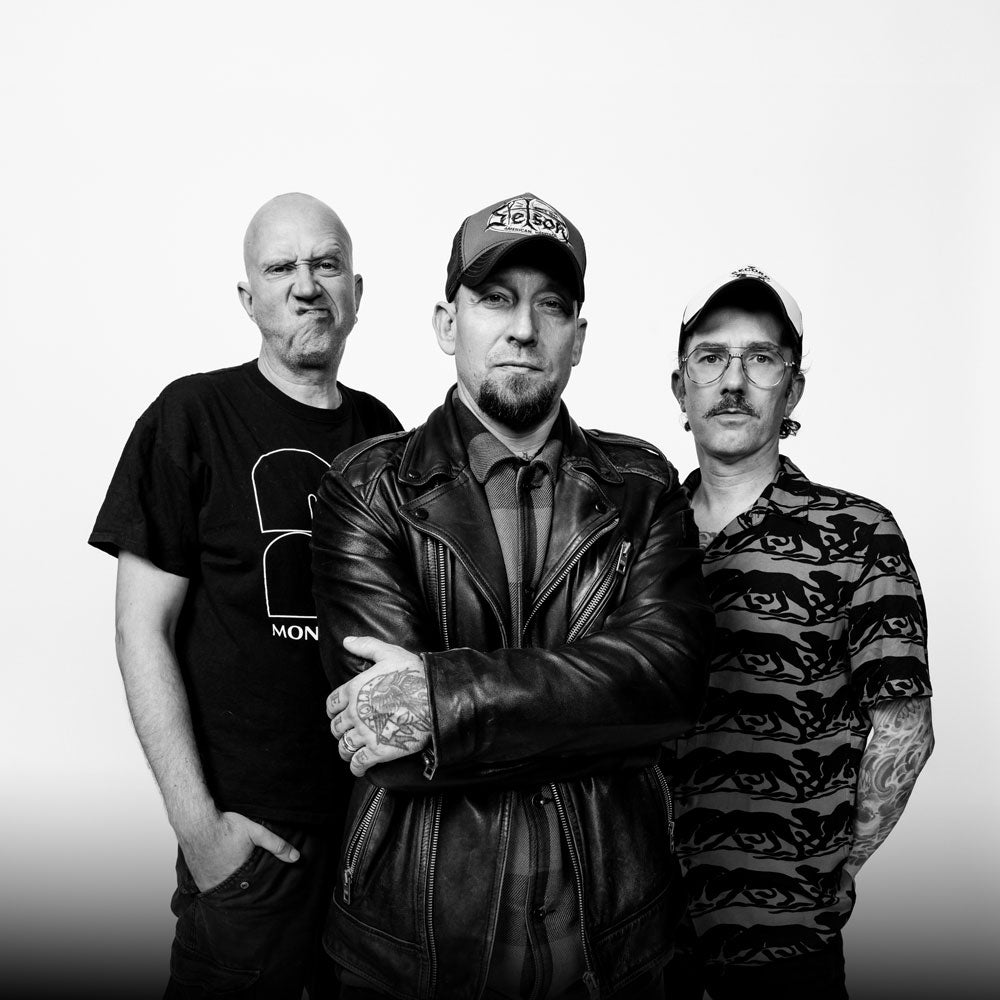
Volbeat are refreshed and ready to raise hell around the globe, and they’re bringing their GOAT with them.
When Revolver catches up with the Danish metal veterans’ founding vocalist-guitarist, Michael Poulsen, the musician is taking a quick break from watching Formula 1 races at home with his kids. In about a week’s time, he’ll be gearing up to hit the road with the rest of Volbeat to promote the band’s new, horns-raising album, Gods of Angels Trust.
As across Volbeat’s quarter-century of work together, the record cranks it up with the act’s signature blurring of Black Album-huge ‘Tallica riffage, Man in Black-lovin’ country, arena-made hard-rock choruses and more. It’s peak Volbeat, but Poulsen explains that he and the rest of the group had to completely step away from their longtime project for a while — they took a beat, if you will — before they could contemplate adding more cuts to their crunchy canon.
The break did not feel natural for Poulsen.

“For the first time in our career, we had a year off — a sabbath year, which was very weird for us,” he says. “[We’re] used to being on the road constantly and playing a lot of live shows all over the world. Friends and family have told us, ‘Come on, just take a year off,’ but we love what we’re doing. And we’re always inspired.
“If you pass the window [of a pet store] with all these animals, you see a mouse running around in the wheel and you think, ‘Oh, my God, that’s so bad for this little mouse to keep on running,’” Poulsen continues through an animalistic analogy, “[You] go into the store and pull this mouse out of the wheel, and then the mouse will just look at you [like you’re] stupid and run back [into the wheel]. That was really us. We did that all the time… we just went into the wheel again and went on another tour.”
Part of the pause was practical. A while back, Poulsen discovered he had once again grown polyps on his vocal cords, which necessitated his third throat surgery. While he was put on intense mandatory vocal rest, the musician focused his energies riffing out pure carnage with his old-school death-metal band, Asinhell — who released their debut album, Impii Hora, in late 2023.
After wrapping an Asinhell tour last summer, it became time for Poulsen to start writing new Volbeat tunes. And as he was whipping their GOAT into shape, getting back into the Volbeat mindset reminded Poulsen of what it was like to make music with his bandmates — currently consisting of founding drummer Jon Larsen, longtime bassist Kaspar Boye Larsen, and live guitarist/album soloist/Asinhell member Flemming Lund — back when they were, well, just kids.
“We wanted to recapture the innocence of what we were doing in the very beginning, where we definitely didn’t have any ideas about structure,” Poulsen posits. “So, we said, ‘Let’s just play a lot of riffs and put some vocals on top of it.’ That’s how we did it back in the day, and it worked… There was something very refreshing about that [process].”
That’s not to say Gods of Angels Trust is lacking tight songcraft. The record rallies itself around ironclad metal stomps (“Devils Are Awake,” “By a Monster’s Hand”) and heart-swelling arena anthems (the grief-channeling “Time Will Heal”).
Then there’s “In the Barn of the Goat Giving Birth to Satan’s Spawn in a Dying World of Doom.” The irreverently titled cut begins as a clean-driven, goth-country yarn about a bunch of animals making hay with an ominous ritual. Then the GOAT single rams into a hard-headed chunkiness punctuated by Poulsen evilly crooning out its evocative, 17-word song title. His bandmates asked him where the chorus was. Poulsen said they were missing the point.
“Just imagine a whole stadium… singing that [title] with the band. That’s gonna be great fun.”
Speaking with Revolver, Poulsen details the hidden evils that inspired the record, and why their GOAT just may be the greatest Volbeat album of all time — at least until their next one.

What drew you towards reverse engineering the acronym of the GOAT as Gods of Angels Trust?
Michael Poulsen Well, when it comes to heavy [music] or metal, you know how it is — the darker subject has always been something that goes hand in hand with metal music. Sometimes it’s just a horror flick. Other times it’s just… reflecting on the darker side of life, or religious beliefs, or whatever. And you know, since I was a very young kid, I’ve been very spiritual, and [I’ve been] digging deeper into the unknown.
But with this album, God of Angels Trust… the goat became a scapegoat —and kind of a cover up for the real monsters out there. And that’s mankind. I use the [likeness of the] goat as a mask, or as a cover-up for the evilness that’s going on in this modern world.
That plays right into the themes of a song like “By a Monster’s Hand,” which gets into the mind of a killer…
Well, just to finish what I was talking about before we go into “Monster’s Hand,” if you look at the album cover, you have this goat staring into a bedroom that you assume is a child’s room. I’m a parent, so I use a lot of time every day [thinking about] how I can protect my young kids for the future.
We wake up every day with a lot of rules and regulations and laws and religious directions, just to see them being broken by the creators [of those same rules], which is a very, very scary thing. So, what do you put your trust into? There’s a lot of things that we put our trust into… that’s why I came up with the title God of Angels Trust. So, the goat is not really symbolizing the animal, but more the human beings covering up themselves [with] scapegoats, not taking responsibility for their agenda and manipulation and evilness. And I think we all know who those people [are] — just turn on the news.
[With] a song like “Monster’s Hand” … Obviously, people will rewind back in time and say, “Oh, this guy [seems] like this serial killer.” I will not mention any names — because I don’t want to give them credit for anything, [and] there are victims that we need to think about — but [the song] is [based in] reality.
Back in the day [we] managed to put these people away, lock them up and throw away the key. I think a lot of people all around the world [are] still waiting for somebody or something to clean up those truly powerful serial killers out there.
Your “Barn” is themed around the idea of seeing this wild, late-night, satanic hoedown. What can you tell us about the storytelling behind this one?
First of all, I’d just like to say Volbeat is not satanic. We don’t support any kind of religious beliefs. We’re spiritual, but we’re not religious. But like everybody else in this genre of heavy music, we can be inspired by a horror flick and have a little bit of fun with it.
There are so many different ways to analyze a lyric like that, but one of them is pretty much [that it’s about] this guy walking somewhere in the desert, and suddenly he looks up to the sky and God’s fallen angels are falling down [as they’re] being outcast from heaven.
The guy who walks the desert with this wagon hears a call that he’s supposed to gather all those lost souls [and] bring [them] to this barn. He’s not really sure of what’s going on in the barn. He just knows that he has to bring these damned souls in, as this ritual is going on.
He decides to bring his lady with him instead of inviting her out for a night at the movies. “Let’s go to the barn and see what’s going on!” And you have this massive ritual going on where the outcast of God is being sacrificed to the devil spawn, and for him to feed off the leftovers. Just as the spawn becomes alive, the world explodes and ends.
It’s not really romantic, but it is what it is.
It’s not a one-for-one comparison, but just with the idea of bringing together all these outcasts and having this explosive midnight ritual… Is there a metaphor to be found in there about how this could speak to people getting together for a Volbeat concert?
I love that. I’ll use that, sure. Why not?
Were you concerned at all about the character-count of the song title? Like, that’s not something that’s going to fit easy on a 7-inch record…
It’s not my headache, you know? I have management: You go figure out how to promote that one.
I’m just a writer, [and] we’re just having fun. We knew that would probably be a little bit of a challenge here and there. But again… we wrote the song… and then we just moved on to next one.
There’s an interesting flow to the album in that “Barn” and “Time Will Heal” kind of work in tandem. One’s irreverent, and the other is tender. You’ve got the goat giving birth in one song, and then you’re dealing with the concepts of death and grief in in the next track. How intentional was that?
Just as much as we’re mixing all these different styles together in the music, and you cannot really put us in any specific box with what we’re playing, I also like the idea of coming up with very different lyrics. But somehow you can read [that] it comes from the same writer.
And I like that there’s a lot of questions [in] the lyrics. It’s human nature that [we’re] curious about what comes after life, because we want to have an answer [for] everything that we’re doing.
I dealt with the terrible loss of my father, which made me fall into a deep, black hole of sorrow, and all the sad things that comes along with it. I also fell into an even deeper black hole [by] trying to ease the pain with a lot of alcohol, which is definitely not the right way to do it. I became a raging alcoholic for some years. Lucky me, [though,] I had the right friends to get me out of that problem. But it is also something
you have to want to do yourself, and you have to see the writing on the wall.
Today I’m a very happy guy. I have my kids — they gave me all the reason [I needed to get sober]. I have a great wife. A great career. [But] I’m still a very spiritual guy who likes to write these lyrics [about the] fine balance of accepting the dark moments just as much as the moments where everything shines. And it’s beautiful.
I accept that I have those days where I fall into these black holes, but today [I’m also] very quickly getting up again.
With these lyrics, a lot of people have said, “This is probably our darkest album,” and I’m like, “Is it?” Maybe it is, but I’m not really looking at it as something dark.
What can you tell us about the symbolism of the crows you refer to in your “Lonely Fields?” Crows are likewise spiritual creatures to a lot of people…
When I was a very young kid, me and my father would always go out on his moped during the weekends to pick corn for his birds. He had a big wooden birdhouse that he built next to the house where he [had] a lot of different birds, and on the ground there’d be turtles walking around.
Very interesting… [and] it was just something great to do with your father. It was always something that I looked forward to during the weekends in the summers.
In this home where I live right now, my bedroom [looks] out to a cornfield. One night I had this dream where all these crows are tapping at the window and trying to wake me up. I [get] up and start communicating with these crows and ask them, “Well… what is it you’re trying to tell me?” They point their wings out to the cornfield, and I see this silhouette of my dad standing with an empty bag… and I sense that he wants me to pick corn for the birds.
So, in my dream I leave the room and go [out] to the cornfields and embrace my dad, and we start picking the corn for the birds. The crows are flying around us. When the bags are full, [my dad] is telling me, “Time to go home now, Michael. You have to go back to bed.” I decide [I want] to [stay] with him… [but then] I wake up [in real life].
Have you tried picking the corn and feeding the birds outside of your place, to connect to that dream?
No, because my father was always 100 percent aware of [whether] the corn was good. These days they spray it with… [well,] I don’t know what it is they spray it with, I’m not going to make a judgement out of that. So no, I haven’t.

Thinking on some other songs on this record, “Better Be Fueled Than Tamed” has a lot of [musical] ideas coursing through it… there’s that almost Slayer-ish breakdown there…
It’s quite funny you say, “Slayer breakdown,” because before it had a title, we just called it our “Slayer song.” There’s a lot of that stuff going on where we will have certain riffs in certain songs where we know where we got the inspirations from. That one was a Slayer song. One was a Sodom song. It could be anything.
But with [“Better Be Fueled”], I was always a very active child. [My father] was a hardworking man. When he came home, the last thing he wanted to see was any of his kids just [laying] in bed doing nothing after school. He wanted everybody to do something. And he always said, “While you’re awake, be useful.” That’s has been stuck in my head ever since.
So, “Better Be Fueled” is just another way to express that. While we’re here, let’s do something. Let’s create something. Let’s do something for ourselves, or for each other, instead of just letting life pass us by. That’s pretty much it.
Not to just pick out the influences, here, but “Enlightening the Disorder” has a lot of these Dick Dale, run-and-gunning guitar lines in it. Do you have an interest in surf music at all?
Yeah, I love Dick Dale. I can’t help it. My parents were constantly playing Fifties and Sixties music. And I love that Quentin Tarantino [was] using so much of that surf music [in his films]. It has a great energy that I really love. On this album, maybe [I] incorporate a little bit more [of that] between the riffs. So yeah, you’re totally spot-on [with] that.
You mentioned that you had another throat surgery. Was it something like you had a nodule on your vocal cords?
Yes, this was the third operation that I had, and this one was done a little differently than the others — [the procedure] was called blue laser system. But yeah… blood vessels [in my throat] explode, and then polyps start to grow You have to remove them before something bad takes over.
I’ve been through two operations where they pretty much just cut them off, and then [the surgeons cauterize the area] back together again. Then it’s a long period of months where you have to heal, and learn how to talk and speak [again]. It takes time before you’re actually allowed to sing.
I was doing really good [after the first two operations] … but I was probably a little bit too [eager] to go out on the road afterwards, and I paid the price for that.
This has something to do with this break that management [called for] — they were taking care of me and said, “Do it right this time. Let it heal and learn the right techniques to get back in vocal shape.” I have a very good singing coach, Melissa Cross, and I’ve been working on certain techniques. She’s been a great help.
And I’m not singing as much [on this album] as I’d been doing on past records, which is good because it makes room for a lot of guitars and a bit more riffing. When I looked back at some of the older records, I was thinking, “Shut up! You’re singing constantly, and you cannot even sing.” [Laughs].
So, for this album, there’s been more room for guitar riffs.
This interview has been edited and condensed for flow and clarity.