
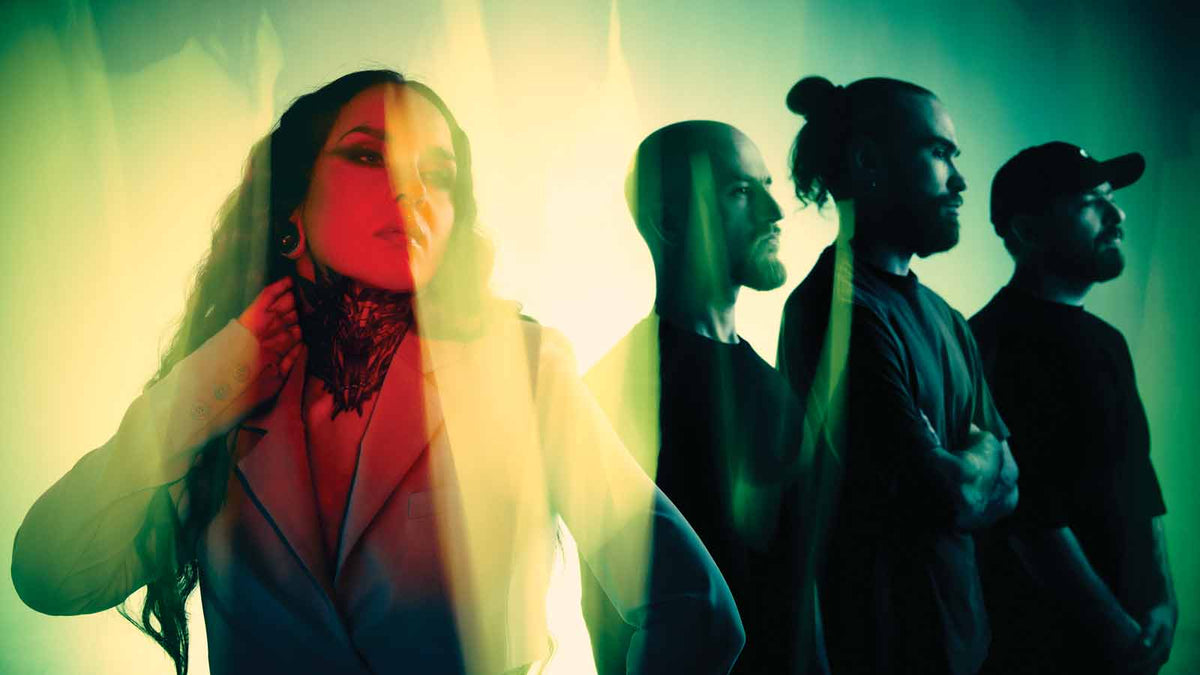
It’s three hours before showtime in Las Vegas and Jinjer singer Tatiana Shmayluk desperately needs some rest.
Inside the House of Blues, machinery cranks in overtime. The crew tends to the gear, while the technicians rehearse the blood-red stage lighting. Outside, fans are already beginning to queue in front of the iconic venue. It’s the final night of the Ukrainian metal band’s fall headline North American tour, a coast-to-coast trek marked by sold-out shows before thousands of fans and many unforgettable live moments. The journey also featured some notable festival stops, including Kentucky’s Louder Than Life festival. It was there that Shmayluk made a surprise appearance alongside Spiritbox, joining forces to deliver an explosive duet of the Canadian outfit’s hit song “Circle With Me.”
The towering performance has now been viewed well over a million times on YouTube, with thousands of commenters hailing it as one of the greatest live moments they’ve ever seen. Vocal coaches have recorded their reactions to it, their jaws dropping when Shmayluk unleashes her primordial volcanic screams over Courtney LaPlante’s cleans.
Shmayluk is a force of nature onstage, perfectly assured and awe-inspiring. It’s a riveting energy that she’ll bring to tonight’s Vegas show — and one that likewise fuels Jinjer’s forthcoming Duél, their new and highly anticipated album that is sure to further cement their position as one of the biggest acts in the metal scene. So why, then, is Shmayluk feeling so depleted?
Backstage, we find the singer sitting alone in her own personal greenroom. The clock quietly ticks toward showtime. She appears tired. Her throat is hoarse. She reveals that her ears still ring from soundcheck — and she doesn’t know how on Earth she got to this place. “Sometimes I look back at my life and think, What the hell?” she reflects with subdued wonder. Tonight, the audience will recharge and revitalize her. But when she waves goodbye to the thousands of adoring fans, unplugs her in-ears, rests her chafed vocal cords, and transitions from the gleaming stage to her Christmas lights-strewn bunk in the tour bus, she’ll hardly be able to say a word to her bandmates — nor will she be able to sleep.
“My emotions will be too high and my blood circles around too much,” she says. Instead, Shmayluk will stay up for hours on her phone, doomscrolling through Instagram reels. “I need distraction from reality, otherwise I’ll go into panic,” she explains.
Tucked inside that claustrophobic bunk above the grinding wheels of their tour bus, Shmayluk can’t escape the thought that soon she’ll be at home — facing the void of uninterrupted free time, with its potential for high anxiety and panic attacks. As the hours and reels bleed together, and her own blood slows its frantic pace, Shmayluk will eventually get a fleeting glimpse of rest. One blink of aloneness, darkness. And then: Noise. Light. Panic! She’s awake. The blood in her body will resume its frenzied cycle.
For months now, Shmayluk has been asking herself: How did I get here? The roots of this restlessness seem to be 15 years in the making — a steady ascent fueled by cock-eyed chords and a relentless, sleepy-eyed tour schedule that has shot Jinjer to the top tier of modern metal. Along the way, they’ve earned hundreds of millions of cross-platform streams, a growing international audience and respect from their heroes, including Disturbed, Slipknot and DevilDriver (who have each invited them on tours). To Shmayluk, it often feels like one very loud, very blurry dream.
Between the constant performances, one of metal’s — and perhaps all of music’s — most fearsome vocalists has been dreaming of grandiloquent quiet. These daydreams have been recurring. In them, Shmayluk imagines herself as a 19th century duchess, sauntering about her palace without a single responsibility. In these fantasies, she does nothing but read books while sipping coffee or tea. Sometimes it’s wine — though she is sober in her waking life. “I want to exist in this palace, just floating, like a ghost. I want to feel the stillness of life,” she says. “Sometimes I feel like I’m not strong enough for this life… I’m tired of always having to be so strong.”
Shmayluk knows these serene, leisure-class dreams are not reality. She is a rock star in the streaming age — a job that demands constant travel, touring and overstimulation. At 37 (“Is that how old I am?”), she feels like she’s finally accepted her reality and “surrendered to life.” Between the ceaseless touring and meet-and-greets, these daydreams are really the only sense of rest she gets. In them, there’s no one to answer to. But real life is full of questions. And lately, she’s being asked the same one over and over: Where’s the new Jinjer album?
“It’s right around the corner,” she confirms. Duél, the band’s fifth record, is lifted right from Shmayluk’s daydreams. Most of the songs are set sometime in the 1830s, among a blood-dripping extravaganza of masquerades, balls and high-society soirées. Sonically, the band — which also includes guitarist Roman Ibramkhalilov, bassist Eugene Abdukhanov and drummer Vlad Ulasevich — take 19th century symphonic music and channel it through their premier, hypercharged djent sound.
They take some big swings on Duél, tapping further into their proggier and headier whims on tracks like “Rogue.” While most Jinjer compositions aim straight for the solar plexus, “Rogue” is a little more oblique. The band has previewed the song on tour to, Shmayluk admits, “a mixed reaction.” It darts around and melts through your fingers just when you think you’re about to clasp it. It’s one of the band’s more experimental songs, as well as one of their more technically challenging to pull off. There are no clean vocals on the track — just Shmayluk screaming, pummeling air and shaking the wind out of her own throat.
“Someone’s Daughter,” a melodically dense battle anthem, might be the album’s most forthright track, as well as the one that’s currently resonating most with Jinjer’s audience. Dedicated to Joan of Arc, Frida Kahlo, Marie Curie and Cleopatra, the song celebrates all the “strong women throughout history,” says Shmayluk. It began when she looked through her stash of notes and pulled out one that read: “She’s a hero underneath her skirt.”
Shmayluk began writing the album’s lyrics in May of 2024, during a week alone in her California home while her husband, former Suicide Silence and recent P.O.D. touring drummer Alex Lopez, was out on the road. While isolation is her ideal state of being, she’s still yet to find sanctuary alone in her home. Any sense of rest is inevitably disturbed by the anxiety surrounding the abrupt changes and relocations that have undergirded her adult life.
Shmayluk joined Jinjer in 2009 (replacing original singer Maksym Fatullayev), and since the 2014 release of their debut album, Cloud Factory, she’s been bouncing around from city to city and country to country. As soon as she thinks she’s found a stable place to catch her breath, band life requires her to move somewhere else. She’s been living in America for a few years now. But as the fourth anniversary of her move approaches, she’s noticed a growing sense of anxiety. “It’s a past trauma that’s coming up,” she says. “I tend to be moved every four years… So now the bad thoughts are coming back.”
Shmayluk is tired of running. “I just want to stay in my shell,” she says. She has no strength left to try and adapt to yet another environment, especially when she’s still yet to truly acclimatize to the back-slapping States. Her stoic Ukrainian ways remain at odds with the overfriendliness of the Yanks in California. “I’m still trying to get used to them,” she says. “They always think they’ve done something wrong just because we Ukrainians don’t tend to smile so much.” She also says the constant panic circling through her body already makes it hard to breathe in the air, let alone take in the gray gumminess of the West Coast smoke.
Earlier this year, in her shelter from the smog, she felt a sense of camaraderie and reprieve while watching a documentary about the famous Czech writer Franz Kafka, a hypersensitive artist like herself, who was at odds with his environment. Shmayluk had a particularly strong reaction to a letter Kafka had written to his abusive father: “I have always hidden from you, in my room, among my books, with crazy friends, or with extravagant ideas,” he wrote.
Shmayluk says she cried a lot after reading the letter, and almost immediately set out to write a song named after the late writer. The resulting “Kafka” is dedicated to its namesake — and to other introverted artists like Shmayluk herself, who have sought refuge from the world in their own imaginations or in the creations of others. “Whom to wake up in the morning?/A Gregor or a Josef will it be?/Neglected and abused or wrongfully accused,” Shmayluk laments on the addictive and abrasive track, comparing herself to the writer’s most famous characters. Like Gregor, the cockroach of Kafka’s The Metamorphosis, she says she has often felt “neglected, like a bug.”
From there, she wrote about one-and-a-half songs each day, closing out the week with an album’s worth of lyrics that were literary, poetic and rich in history and mythology. She worked at an unprecedented pace, challenging herself to remain laser-focused on the task at hand. “If you make yourself do it, you just poop it out,” she says.
Duél is also the first record Shmayluk ever wrote sober. On December 15th, she will celebrate her two-year anniversary of sobriety. “It’s one of the best decisions I’ve ever made,” she says. “Green Serpent,” a song on the proggier end of the album’s spectrum, is her ode to addiction. “Shame hurts more than headache,” she sings in a standout lyric that resounds as trenchantly as a mantra.
“I felt so ashamed of the things I did when I was drunk,” she recalls. “I told myself I had to stop, otherwise one day someone might tell me I’d committed a crime, that I’d killed someone.” She feared she might wake up like Kafka’s Josef K. in The Trial, police guards at her bed ready to take her away for a crime she didn’t remember committing. “So, I had to take control of myself,” she asserts. Shmayluk still daydreams about wine, of course. She tells herself she’ll resume drinking when she’s 60, “to cope with the boredom of getting old.”

Shmayluk may still contend with anxiety issues, but she says her moods have been tempered since getting sober. Her days now unfold with predictable, if sometimes exhausting, routine — rather than unexpected drama. Reacquainting herself to life without the ebbs and swings of addiction, and all the turmoil therein, has been a challenge at times. How difficult, almost punishing, it can feel to simply stay still and just be. (Hence the penchant for late-night Instagram doomscrolls.) Recording the album sober was, needless to say, a completely different experience for the singer. “I didn’t have the mood swings I used to when something went wrong,” she says. “I used to get so angry, now I’m learning just to be chill.”
But whether she’s drinking or not, Shmayluk admits that propensity for drama is part of her character. She’s had to combat that side of herself with ruthless self-discipline — and by living vicariously through others’ tippling habits. She enjoys watching her friends drink, and likens herself to a conductor steering an orchestra when she’s at a bar with them. “Come on, one more shot!” she’ll say, before the sozzled symphony reaches its climax.
Screaming, she says, doesn’t abate the need for drama. (“Swearing in Russian helps for that kind of thing instead,” she jokes.) Most metal vocalists describe screaming as a kind of emotional catharsis. Not Shmayluk. She treats it as unsentimentally as a construction worker handling a tool. “My screaming isn’t hysterical, it’s not like a girl getting stabbed in a horror movie,” she says. “It’s just another instrument.” When she screams, the “demon inside” of her simply pops out — and then immediately jumps right back in when she closes her mouth.
Perhaps the narrative of “purging” we ascribe to screaming obscures the amount of control and work it requires to execute well. It’s not just some spontaneous expulsion of emotion, but one of the most technically sophisticated things a singer can do with their vocal cords. And there may not be a scream on this planet more advanced than Shmayluk’s. It sounds capable of shaking the angels awake, shifting all the world’s tectonic plates.
But to Shmayluk, it’s simply a matter of employing her tools — breath, tongue, vocal cords — to achieve the desired result. She scarcely realizes its power. That performance with Spiritbox earlier this year? Possibly 2024’s greatest vocal display? That didn’t come from a sense of tenacity, but from sheer fear. “I was panicking so much,” she reveals.
Typically, Shmayluk likes to rehearse as much as a marathon runner prepares for a race. But Jinjer and Spiritbox’s tight schedules only allowed for a swift practice run. “Most people are fine with having to learn a song in just three days,” she says. “But I was so nervous that the lyrics kept flying out of my head.”
Of course, none of these nerves registered to the audience. Yet she still left the stage shaking, the tremors refusing to subside from her body until well into the evening. Today, she remains typically hardboiled when looking back on one of her greatest vocal performances, avoiding any lingering emotional reflection: “I was glad to have the chance to listen to what the other musicians had in their monitors,” she says matter-of-factly. “I got to analyze everything.”
Cerebral, calm, candid. Boisterous, powerful, gifted. Nervous, sleepless and exhausted. Rising heavy-metal icon. Tatiana Shmayluk is all of these things and more. She’s fought hard to get Jinjer this far — and is powering up to face the next challenge or milestone, no matter how daunting they may seem.
“Everything makes me stronger,” she concludes. “I learn a lot from it but sometimes it’s so overwhelming. Sometimes, I just want to say, ‘Hey, give me a break. Whoever is up there — whether it’s the universe or God or whoever — just give me a break for a little while.’”
She sits alone in the greenroom. The wheels grind on. It’s showtime.