
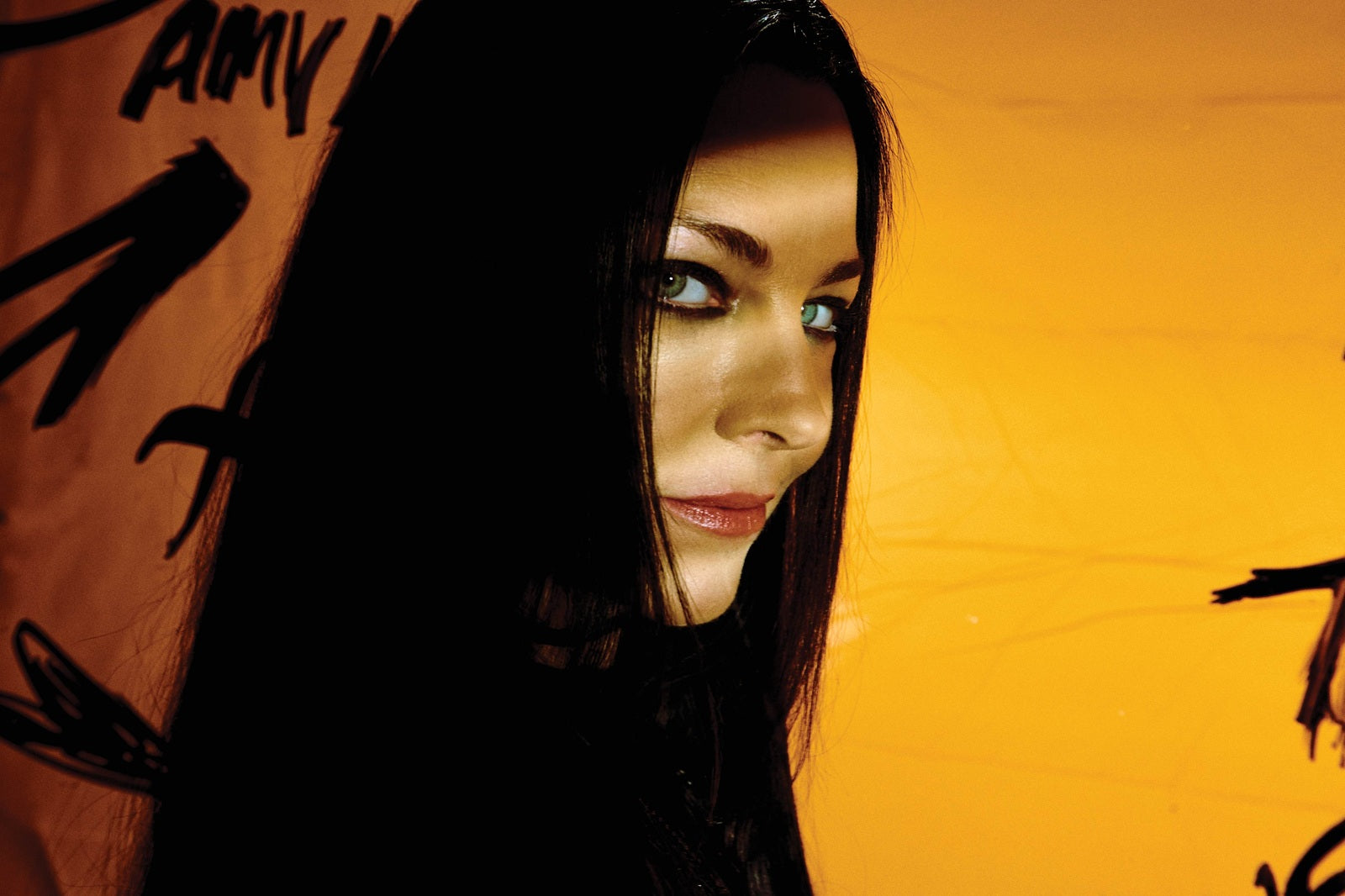
While researching for this Evanescence interview, I came across a video of Amy Lee singing alongside a daughter I didn’t know she had.
The girl looked just like her: the satin-black hair, alabaster skin, even a matching eyebrow piercing. They sang together in perfect harmony. Strange, I thought. I knew she had a young son, but had I somehow missed a daughter? Was this how Lee was introducing her long-hidden child to the world?
Only later did I realize that the very convincing video wasn’t real. It was just one of many Lee deepfakes making the rounds online. Here was that generation-defining voice, stripped from its source and used however people wanted, without her consent. More than 20 years into her career, Lee is now experiencing a timeline in which artists like her can be customized and controlled like video game characters.
“Nothing is creepier to me than scrolling and seeing an AI version of myself,” Lee says while speaking over Zoom from her home studio in early May. “It’s really disturbing. It’s like people want to correct me — they take the lines out of my face. They even changed the Sanctuary album cover.” She pauses.
“And fuck that cover,” she adds with real emphasis. Her cheeks are flushed with flowing blood, the flesh and veins of a real human being, her neck weighed down by a heavy chain. This is the opposite of the airbrushed and uncanny avatar she keeps seeing online.

Cedrick Jones
The unreality of our current digital age has become the animating force behind Sanctuary, the band’s first full-length since 2021’s The Bitter Truth. On that album, Lee sang openly about racism, voter suppression and #MeToo, making it one of the band’s most furious and politically direct statements.
But where The Bitter Truth confronted reality head-on, Sanctuary feels more like a desperate search for humanity in a post-truth world. In 2026, when we see an actor onscreen, how do we know it’s really them? When we hear a new song by an artist online, how can we be sure it isn’t a deepfake? And to say nothing of the day-to-day truths we’re asked to swallow: How, exactly, are we supposed to believe anybody promising to lower the price of gas?
The word “honesty” surfaces repeatedly during my conversation with Lee, and throughout Sanctuary itself. Honesty has always been her aesthetic credo. Across Evanescence’s career, Lee has returned obsessively to the question of who “Amy” actually is beneath the projection. On Sanctuary, that search burns hotter than ever, as Lee looks inward at herself and outward at a world that feels increasingly unreal. There is fight and grit in nearly every note on the record — the songs pumped full of iron, as if they’re running on pure adrenaline.
“In so many ways, music is my sanctuary,” she says of the album title. “But it’s also a sanctuary from all the lies, from what isn’t actually real.”
That earnest plea for authentic human connection has always been at the heart of Evanescence’s music. It was there when the Little Rock, Arkansas, band first broke through in the early Aughts amid the height of hyper-manufactured pop celebrity — another kind of deepfake, really. That same hunger for something emotionally real has come roaring back in the age of AI slop. You can hear it in the broader resurgence of alt-metal and nu-metal: raw sounds rooted in alienation and catharsis. That renewed appetite has brought Evanescence back to the center of a conversation they helped ignite in 2003, when their debut album, Fallen, reshaped mainstream rock through its cinematic collision of metal, piano balladry and classically romantic composition.
The success was staggering. Fallen produced era-defining singles like the Grammy-winning “Bring Me to Life” — arguably one of the greatest debut singles of all time — and “My Immortal.” The album itself went on to sell more than 17 million copies worldwide, making it one of the best-selling albums of the century. Two decades later, the band is as big as ever.

Alex Bemis
To date, Evanescence have sold more than 31 million albums, placing them among the best-selling hard rock and metal artists of all time. They’ve also survived repeated disruptions to the music industry, masculinist gatekeeping and rapidly shifting cultural trends without ever calcifying into nostalgia or irony. They remain a vital creative force: unjaded, fueled by restless ambition and untouched by cynicism. They’re still pushing forward, deeply relevant to the new generation of alt-metal, nu-metal and goth-leaning heavy artists carrying Evanescence’s influence into the present — and to the Gen Z fashion culture that has made Lee’s dark, romantic aesthetic feel current all over again.
Evanescence’s first show of 2026 was in April at Sick New World Las Vegas, a festival where that lineage was on full display as foundational acts including System of a Down, Korn, Deftones, Incubus, Kittie and Flyleaf threw down alongside new-school leaders like Knocked Loose, Sunami, Speed and more. A week after Sanctuary dropped on June 5th, they kicked off a massive, two-year world tour beginning in West Palm Beach, Florida. It ends late next year in South America. For the North American and European legs, they’re joined by a lineup of shape-shifting artists including Spiritbox, Poppy, Nova Twins and K.Flay.
The momentum had been building all through 2025. Evanescence opened for Metallica in stadiums across Australia and New Zealand — a daunting prospect for a group that, as guitarist Troy McLawhorn puts it, feared “getting bottles of piss thrown at us for not being heavy enough.” Instead, he says, they “were pleasantly surprised by how much the crowds embraced us.” Evanescence also opened for My Chemical Romance and Halsey, the latter of whom Lee collaborated with on “Hand That Feeds” for the John Wick spin-off Ballerina, whose end credits also featured Evanescence’s collab with K.Flay, “Fight Like a Girl.”
That March, the band released “Afterlife,” the first teaser of Sanctuary, written for Season One of Netflix’s animated series Devil May Cry. The song became Evanescence’s first No. 1 on Billboard’s Mainstream Rock Airplay chart and the fastest-rising single of their career, with more than 160 million streams globally and counting. The album’s official lead single, the surging anthem “Who Will You Follow,” would arrive a year later, in April 2026, and hit No. 1 on three of Billboard’s charts: Hot Hard Rock Songs, Rock & Alternative Airplay and Mainstream Rock Airplay.
Lee also teamed up with Poppy and Spiritbox vocalist Courtney LaPlante for “End of You,” Revolver’s 2025 Song of the Year. Produced and co-written by former Bring Me the Horizon member Jordan Fish, the track debuted at No. 1 on the Hard Rock Digital Song Sales chart, replacing “Crazy Train,” and later topped the Mainstream Rock Airplay chart, becoming the first collaboration among three women to reach that peak.
“‘End of You’ feels especially important,” Lee says, “because it put me directly alongside two of the most important voices in modern heavy music.” As of this interview, the three still haven’t performed it live together. “I was literally just thinking before our call about what I should do with Courtney and Poppy on tour,” she says. “We’ll figure it out. My real wish is that all three of us could have toured together as a trio.”
Lee says she doesn’t yet have any other recorded material with Poppy and LaPlante, but it’s something she would “definitely like to revisit.”
“It’s not on the agenda right now, but I loved that experience so much,” she adds. “So yes, I’d love to work together again.”
All of the collaborations Lee has done over the past year have been with women, and that’s not by accident. “Women’s rights are being ripped away, and that wouldn’t be happening if they didn’t realize that we’re a threat. And good: be afraid of us,” she says. “When we get together, I feel the strongest. Women being in it together is what feels most powerful to me.”
“And then there’s Emma,” adds Lee. “She and I have talked about how completely fated this moment is.”

Cedrick Jones
Lee is referring to bassist Emma Anzai, also a founding member of the Australian band Sick Puppies, which toured with Evanescence in 2007. Lee had been trying to recruit Anzai ever since. In 2022, the timing finally worked out. Longtime bassist Tim McCord shifted to guitar, allowing Anzai to join the rhythm section with drummer Will Hunt. “I was nervous going into the band, wondering if it’d work and how I’d feel,” says Anzai. “But it’s been amazing, playing bass has actually felt really freeing.”
Anzai, who is a vocalist as well as a bassist, also serves as the group’s backup singer, harmonizing so closely with Lee that their voices seem to move as one.
“It’s funny,” Anzai says, “in the past, when I’d sing bits and pieces for Sick Puppies, there were times when I would unknowingly emulate Amy.”
“Emma just came in and kicked ass,” McLawhorn says. “She did a great job emulating what Tim did [on bass] while also bringing her own thing, adding that extra sauce.” There was a brief adjustment period while the band figured out their new dynamic, but the lineup quickly fell into place.
McCord has remained a resource on bass, occasionally offering ideas from his years on the instrument. “Every now and then, I’ll suggest something bass-wise,” he says, “and she’ll listen to it and be open-minded about it and try it, but she’ll make it her own.” Anzai’s bass playing sounds more percussive than McCord’s. It can be heard all over the album, with moments of funk and slapping — a first for Evanescence — foregrounded in the mix. “It feels like how Evanescence has always felt, but there’s a little more personality in the bass and guitar now,” says McCord.

Cedrick Jones
Sanctuary marks a series of Evanescence firsts: moments with 7/8 time signatures, guitars pushed more aggressively to the center and a stripping away of what Hunt calls their typical “everything and the kitchen sink” approach. “We had programming and electronics and strings all going on at the same time,” he recalls of past records. “So sometimes there wasn’t really space to hear everything.”
It was also the first time the band brought multiple producers into the project. Among them were Zakk Cervini and Jordan Fish — two architects of modern heavy music who grew up on Fallen before helping to shape the sound of artists like Bring Me the Horizon, Bad Omens and Spiritbox.
“They get us from a level of being influenced by us,” Lee says. “I feel like there’s something really cool about working with younger people, because they dipped into the culture at a later point and you’re getting this feedback loop from an era where we were already doing it.”
She adds that they “hooked up with them as a sort of experiment.” Fish and Cervini had both worked on Bring Me the Horizon’s 2020 release POST HUMAN: SURVIVAL HORROR, which included the band’s collaboration with Lee, “One Day the Only Butterflies Left Will Be in Your Chest as You March Towards Your Death.” Lee then took a semi-formal meeting with Fish and ended it by saying: “We have to make music together. We’re supposed to do this.”
Fish went on to produce Lee’s Halsey collaboration, “Hand That Feeds,” and her Poppy and LaPlante team-up, “End of You.” By the time Evanescence began work on Sanctuary, the creative chemistry was already there.
The Sanctuary sessions became some of the most obsessive of Evanescence’s career. Over six days in Los Angeles, the band immersed themselves in a constant state of experimentation, trying things out and chasing whatever felt right. Everyone arrived at the studio at 10:30 in the morning, left at 11 at night, and still heard the songs ringing in their ears as they tried to sleep. “There wasn’t a thought in my head other than the music. Nothing like, ‘Who wants lunch?’ We skipped meals,” Lee says. “This was one of those things where we were like, ‘I will do whatever it takes to grab this thing and put it into a bottle.’”
Fish and Cervini brought a digital abrasiveness that runs through the album: Nine Inch Nails-style electronics, glitchy programming and distorted textures constantly pressing in at the edges. Opener “Beautiful Lie” begins with deceptively pretty, post-EDM synths before collapsing into something much gnarlier.
And then it pummels. “Don’t tell me what to do,” Lee snarls through clenched teeth as Anzai’s slap bass detonates underneath.

Cedrick Jones
But the tension on Sanctuary isn’t only musical. For Lee, the album’s urgency comes from the world she’s trying to make sense of in real time — as an artist, a woman and a mother raising a young son in today’s political and technological climate. After all the talk of artificial children, fake voices and digital distortions, Lee becomes most visibly emotional when the conversation turns to her actual child.
“It’s hard to explain the world to him right now,” she says, her face crumpling. “Because right is right. So why is everything wrong? Why aren’t the grown-ups obeying the rules?”
Lee’s son is now 11. “He’s a good kid,” she says, brightening suddenly. “We love video games, cartoons and anime. I’m a big kid, too. I’m a rock star for a living — what can I say?”
He has also become one of her most trusted sounding boards. “When I come up with a line, I run it by him,” she says. “He’s at the same age I was when I started falling in love with music. It’s really sweet, because he’s at that stage when music hits you on a different, deeper level. Seeing him experience that really reminds you of how powerful music is.”
His favorite band, she adds proudly, is Evanescence. “He wants us to get this album to double-diamond.” She laughs. “I’m like, dude, the fact that we even have a diamond record is insane.”
Through her son, and through her music, Lee has found herself looking back on her life from a new, wiser perspective. She wrote much of Sanctuary around the time of Fallen’s 20th anniversary, working on new material while revisiting old demos, photographs and sheet music for the album’s remaster and re-release.
“I had to fully go back,” she says. “Stuff I hadn’t seen or heard in such a long time. Hearing the beginnings of songs I wrote when I was 16. It took me back to all the tiny little details you forget. I was processing the same stuff again, just from a different point in my life.”
Lee has developed a much clearer separation now between herself and the icon the world projects onto her. “When I was 21 and Fallen first came out, it was a lot harder not to feel judgment and criticism as a personal attack,” she says. “But there’s also a power in having a persona. When I’m onstage and I flip the switch and start singing, it is still 100 percent true and from my heart. But I’ve gotten to a point where I can recognize that as something bigger than myself. That is me — and so is me going to the school PTA meeting.”
Noticing her eyebrow ring, I ask whether some part of her consciously leans into her own iconography now. She laughs. “I’m not trying to copy the album cover,” she says. “I was the album cover.” Lee re-pierced her brow during the 20th anniversary. It suits her current state of mind: “Sanctuary was all about coming full circle.”

Alex Bemis
I hear that circle closing with a trembling breakthrough on the album’s spare piano ballads, “How Do I Heal” and “Forever Without You.” Both songs feel like bird’s-eye views of Lee’s life at its most vulnerable, as though she’s lifting heavy boulders and examining what crawls underneath: grief, forgiveness and the long work of living with what can’t be undone. Lee becomes quiet when I mention them, crumpling slightly again. I will never fully know how much those songs mean to her. Maybe no one else will either. But it’s clear, just from the expression crossing her face over Zoom, that they probably mean everything.
I ask Lee whether the songs were her way of processing things she had never truly dealt with before.
“Yeah,” she replies, somberly, quieter than she has been for the entire call. “‘Forever Without You’ is that song.”
It is a confrontation with her own ghosts: the young woman who once sang from inside the codependent desperation of “Bring Me to Life” now trying to forgive herself on the other side of survival. “And though you left that night/You’re still here ’cause I’m still in the fight/To live or remember/Forgive and forget her,” she sings.
“These songs are the roots of me,” she says. “Some of the writing on this album was about coming full circle and not feeling any kind of cringe toward that old stuff that I used to feel like I had something to prove against.”
On the new “Wide Open Heart,” too, there is a startling post-rage clarity. “It’s about things you thought you processed,” Lee says. “Feeling like, OK, I forgive you. But there’s another aspect that gives it depth: You can’t truly be hurt by somebody unless you really love them first. It took getting past 20 years of anger to admit that. To get the full picture of myself.”
“No matter how we change/Echoes of us remain/Untouched by time/In my mind,” she sings with mournful tenderness on “How Do I Heal.” The song ultimately became a reflection on everything Lee and Evanescence have ever been. “That song’s about my journey and the band’s journey. It was hard and beautiful to write it.”
She’s circling back, but there is still so much ahead. Revisiting Fallen brought Lee back to the girl in Arkansas dreaming big. With Sanctuary, her ambitions have only grown.
After that stadium run with Metallica, Evanescence came away newly invigorated and ready to think even bigger. “It’s time to level up,” Lee says, hinting at the band’s forthcoming headlining tour. “There’ll be plenty of pyro on tour. I want to do justice to the music because it’s the best we’ve ever made. And I want to embrace my son in the process, because production is his favorite thing.”
But for Lee, the scale of the live show is not about spectacle for its own sake. In a cultural moment increasingly shaped by airbrushed perfection and people selling immaculate lies, she speaks about live performance as proof of human existence — something lived and experienced between bodies in real time, with no editing involved.
“A live performance is real,” Lee says. “We’re going to try our best to go up there and recreate this album with our hands and bodies. Sing along with us — let’s live in it, this one pure moment. It doesn’t have to be perfect. If you want perfection, the album’s right there.”

Cedrick Jones
While touring, Lee will also be thinking about the forthcoming feature film The Legend of Zelda. The long-running video game series that inspired the movie, she says, is one of her “very favorite things.”
“It’s so special to me,” she adds. “It’s been a part of my life since high school.”
Lee’s been campaigning hard to score the film. “Please put that in there so they can see me obsessing and trying so hard.” She laughs. Lee has already recorded a scratch demo of “Zelda’s Lullaby” and sent it to the director. There is also the question of what to do for the 20th anniversary of Evanescence’s second album, 2006’s The Open Door. “We gotta do something,” she says.
The past is alive for Lee right now, but not as nostalgia. It is something to carry forward. Even after 20 years, Evanescence have remained emotionally earnest in an era that treats detachment as cool and feeling as cringe. At the precise moment when reality itself feels increasingly contested, the band feel like proof of the real — a sanctuary of emotion that no machine can replicate.
This has always been the lifeblood of their music: the insistence that feeling deeply isn’t a sign of weakness, but evidence of being fully alive.
“I want us to be able to find each other amidst this madness,” Lee says, “and look each other in the eye and go, ‘Hey, remember human beings? Reality? This is it. And we’re gonna be OK as long as we can hold on to that.’”
Stylist: Marjan Malakpour at The Only Agency; Assistant Stylist: Chloe Grace Morand; HMU: Elizabeth Mignoga; HMU/Styling: Haven Howell; Photo Assistant: Sarah Lindsay; Gaffer: Jason Wain.
This feature originally ran in Revolver’s Summer 2026 Issue. Order yours here.