
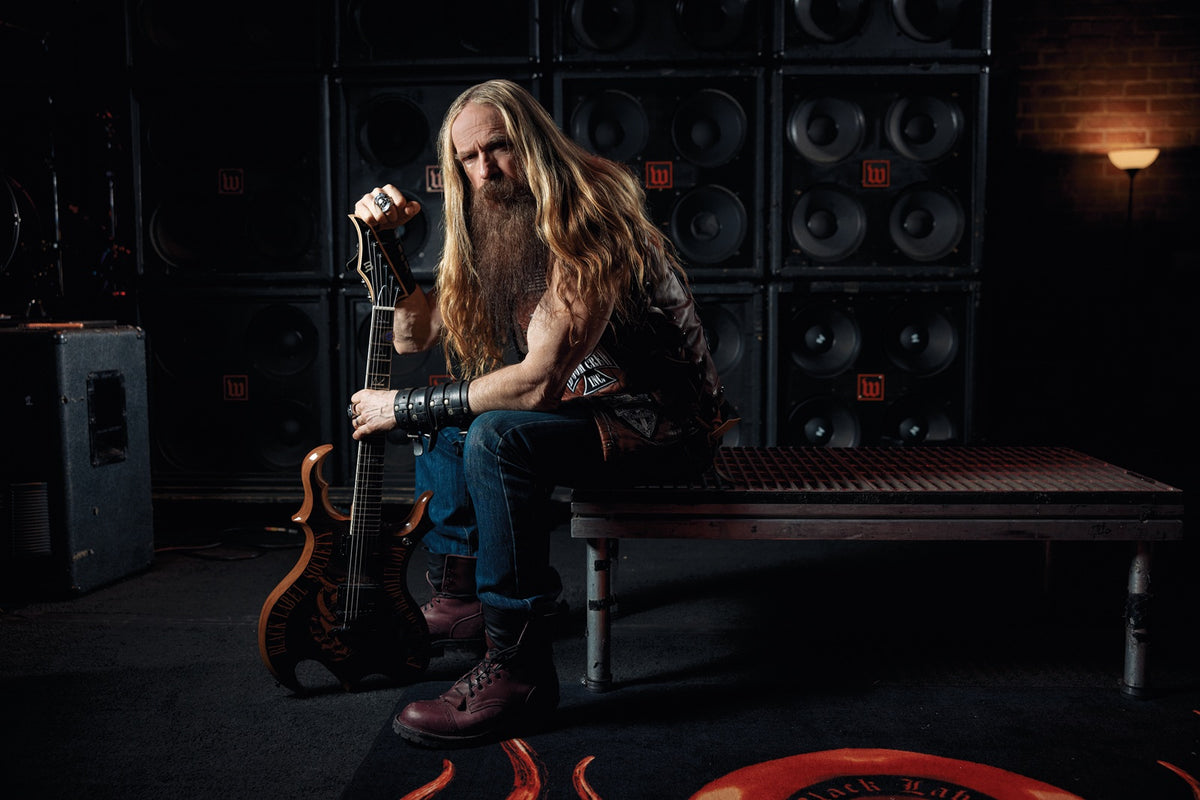
“It’s an ultimate, humongously awesome morning,” exclaims Zakk Wylde.
When the iconic guitarist appears for our Zoom call, he’s joined by his Ultimate Warrior and Lord Humungus action figures, which he fidgets with at the bottom of the screen. “I’m already on my second cup of [Valhalla Java] Odinforce [coffee],” he continues, flashing a grin through his bushy beard. “So I’m firing on all cylinders.”
We’re speaking about Black Label Society’s latest album, Engines of Demolition — “the new hot-rocking … toe-tapper,” Wylde interjects — the band’s first studio release since 2021’s Doom Crew Inc. More than just a follow-up, the record reflects the past several years of Wylde’s life, pieced together between relentless touring and personal loss, and defined, as he puts it, by the “highest highs and lowest lows” of that era.
Those years were anything but quiet. While building Engines of Demolition, Wylde crisscrossed the globe as part of the Pantera celebration tour, honoring his fallen brothers Dimebag Darrell and Vinnie Paul. Performing Dime’s guitar parts night after night inevitably seeped into the new material.
“You can’t help but be inspired by Dime’s energy and what he brought forward,” Wylde says. “He was like the Ultimate Warrior, just intense energy and passion. Dime’s presence is everywhere, in regards to the energy in the riffs.”

Justin Reich
He’s continued leading BLS — featuring co-guitarist Dario Lorina, bassist John “JD” DeServio and drummer Jeff Fabb — while also keeping his Black Sabbath tribute project Zakk Sabbath on the road. Wylde is even preparing to take part in one of 2026’s most unexpected collaborations: an as-yet-detailed album with Star Trek actor and experimental vocalist William Shatner, guitarist Ritchie Blackmore (Rainbow, Deep Purple) and former Black Flag vocalist Henry Rollins.
And then there’s Ozzy.
Ozzy Osbourne — the man who gave Wylde his big-time start in 1987 and became a lifelong friend and mentor — died on July 22nd, 2025, shortly after Black Sabbath’s final show in Birmingham, England. Wylde joined him onstage that night for their final performances of “I Don’t Know,” “Mr. Crowley,” “Suicide Solution,” “Mama, I’m Coming Home” and “Crazy Train.” The loss hangs heavily over Engines of Demolition, which includes “Ozzy’s Song,” a heartfelt ballad showcasing Wylde’s piano work and some of the most vulnerable lyrics of his career.
“He was part of my life since I was 11 years old hearing Sabbath for the first time,” he says. “The guys that came before you are your teachers and your mentors. That’s how you learn. So you have to have that respect.”
He remembers Osbourne not only as a larger-than-life rock god “holding court and telling you all these Spinal Tap Sabbath stories,” but also as a generous, humble working musician whose attitude toward the job never changed.
“Ozzy would always just be, ‘All right, let’s do this… So we can get you back to the pub and get back to what we want to do. We can sit here whining and moaning and complaining. It’s not going to fix anything. Let me do the dishes and you vacuum the floor. I’ll make the beds. Then we can get out of here and go to McSorley’s and meet the guys, then we’ll go see Sabbath at the Garden.’ You know what I mean? It’s got to get done, so we might as well get it done.”
For Wylde, the past isn’t something left behind. It continues to inform everything he does today. After all, this is a guitarist whose journey began as a fresh-faced New Jersey kid sending in an audition tape to replace Jake E. Lee in Ozzy’s band, stepping into a lineage that included Randy Rhoads. He emerged as one of the defining guitar heroes of his generation.
From Ozzfest stages and a Grammy win to health scares, the loss of close friends and the founding of Black Label Society — which has grown from side project to full-fledged heavy institution — Wylde has endured nearly every extreme the genre can offer.
Reflecting on the turning points that defined his career, he shrugs at the idea of ever feeling fully prepared. “I don’t know if you’re ever going to sit there and go, ‘Are we ready?’ You could practice all you want, but then when you get there, you just got to relax and go for it. And then hopefully everything pans out.”
Today, Engines of Demolition finds Wylde balancing reflection and firepower. “Name in Blood” delivers classic BLS muscle: crushing riffs, a massive chorus and an extended solo. The Mad Max-inspired “Lord Humungus” stomps whatever’s in its path. “The Gallows” oozes with Southern gloom, “Gatherer of Souls” channels Tony Iommi’s groovy doom, and closer “Ozzy’s Song” reveals a softer, more introspective edge.
Throughout it all runs Wylde’s unmistakable guitar voice — a Southern rock and blues-infused strain of heavy metal built on towering riffs and head-cutting solos. A lifer and one of heavy music’s most celebrated players, Wylde remains, even now, intent on pushing forward.
And true to form, he’s doing it at full volume.
With a new album, multiple touring projects and a legacy that stretches from Ozzy to Pantera and beyond, Wylde’s story is still being written.

Travis Shinn
You started writing Engines of Demolition in 2022 while you were on the Pantera celebration tour. What headspace were you in at the time?
Zakk Wylde Just what it always is: You come up with a riff that you’re happy with. Because it always comes down to the riff, whether it’s “Smoke on the Water,” “Into the Void,” “Whole Lotta Love” — it’s the riff. Then you have liftoff and the song will usually dictate where it’s going. When you get tired of writing heavy stuff and riff-based things, you sit with an acoustic or get inspired on the piano, write some mellow things. But no, no different than when I first started writing “Miracle Man” with Ozzy. If something moves you and you get a cool riff, then the boat starts moving.
That’s where it always starts. Usually [my wife and manager] Barb will be like, “Oh, the fellas will be out at the Vatican [Wylde’s HQ] in about a month.” So, you just go out there every morning with a cup of Odinforce and start jamming riffs through a little practice amp. And when the guys get out here, then we’ll record. Usually, it’s an implosion of ideas. When the dust settles, the guys will go home, I’ll finish tracking it and then it’ll usually inspire a melody. Then I’ll sit in the truck and write some lyrics and sing it. Then me and Dario [Lorina, BLS guitarist] will put the solos on there and then we’re good to go.
We did a batch of songs and went back out with Pantera celebration, came home for a year and then wrote more and went back out for another year. Then before you know it, here we are, it’s four years later. So, then the guys came back out. We jammed some new ones, like “Gatherer of Souls” and then “The Hand of Tomorrows Grave.” And I think “Ozzy’s Song.” I had the music, but obviously I didn’t write the lyrics for that until the end — until after we laid Ozzy to rest. A bunch of songs came at the end. And a couple of them, like “Above & Below,” were from the first batch of riffs that we had in the beginning.
I really like “Gatherer of Souls.” That one stood out to me. That riff is great.
It’s from the Lord Iommi swap meet. [Laughs] It was over there. I got it for like $7. It was a good purchase. I don’t think they knew what they had. I didn’t say anything.
“Name in Blood” is also a really tough song.
Thanks, man. That came together over the course of three or four years. We don’t demo songs, but “Name in Blood” started completely different. We had to trim the fat in the verse, and just stayed with the riff, pounding away [until] that song mutated into what it is. But once the song’s done, it’s done.
“Stillborn” [off 2003’s The Blessed Hellride] or “Suicide Messiah” [from 2005’s Mafia], those were in one sitting from beginning to end. Very rarely do I write where I got bits and pieces sitting around all over the place and then we come back to it. I’ve actually enjoyed this process. You had “The Gallows,” “Lord Humungus,” “Broken and Blind,” and now we’re up to “Name in Blood” — that’s over a year and a half of releasing singles every couple months, which I like because it gives everybody a chance to digest the new album.
“Ozzy’s Song” feels like one of the most personal things you’ve ever written. Can you tell us what that experience was like?
We laid Ozzy to rest, and then I flew back out and we played Jones Beach [in Long Island, New York]. That was the first Pantera show after laying Ozzy to rest. I was having Ozzy flashbacks because the last time [Ozzy and I] played there it was raining and it was packed. I remember the first 30 rows, everybody was knee-high, thigh-high, in water at Jones Beach because of the way it’s set up right there on the water. I’ll never forget that.
When the Pantera celebration run ended, I came home and sat in our library here at the house and I was looking at one of Ozzy’s books that we have. I was just looking at him, and I listened to the tune, and I wrote the lyrics right there. We’d keep listening to it in the truck. And every time, Barbaranne — my girlfriend of 78 years — would say, “Babe, put on ‘Ozzy’s Song’ again.” She just kept referencing it as “Ozzy’s Song.” So, I was like, “I’m just going to call it ‘Ozzy’s Song’ because that’s what it is.” Obviously, we had to end the record like this — [it had to] be the last song.
Was that moment in the library emotional for you?
Yes. When I was looking at the book — and looking at Oz while I was writing the lyrics — the book fell down and poked me in the eyes and then punched me in the mouth and said, “Now go make me a ham sandwich and go light on the Colman’s. And wash your hands before you make my sandwich. You better wash your hands.” [Laughs]

Travis Shinn
Ozzy’s legacy is obviously huge. I was eight the first time I heard him. For metal and rock fans, he holds a special place in our hearts. But he also meant so much to so many other people…
When they had the big parade for him during his funeral procession, I think for all of us… It’s like people were when Johnny Carson retired: “He was in our house every day on television. I grew up with him. Every night before I went to bed, we would watch him and I’d go to sleep. He was part of our family.”
For me, like you said, even if I never played in the band and I was never able to wear the Ozzy pinstripes… People like Ozzy, these iconic figures, become part of everybody’s life. When you hear certain songs, it brings you back to, “Oh, I remember being at my grandmother’s house the first time I heard…” Like certain memories you have that are connected to these records, movies and Ozzy being on a TV show. One time Oz was like, “This one woman came up and said, ‘Oh my God, your TV show, it’s hilarious. You and your wife and your family. It’s so funny. And my kids told me you do music, too. I didn’t even know you did music.’”
Ozzy’s reach was that huge. Ozzy was such a huge part of so many people’s lives and touched them in a positive way. That’s what made Ozzy so special.
To bring it full circle, when you listen to Engines of Demolition, what do you think it says about where you’re at in your life today, compared to where you were when you first joined Ozzy’s band?
Well, when I did the first album with Ozzy, I was into soft shoe and tap dancery and beef brisket. And now, by getting to this album, Engines of Demolition, it just solidifies my love for soft shoe, tap dancery and delicious beef brisket. That’s all I got. And that’s my story and I’m sticking with it. I love dance and I love beef brisket.