
For years, Amy Gonzalez scraped together cash from day jobs and afternoons busking with a ukulele, saving toward a single afternoon at Nightowl Studios in Boise, Idaho, where she could commit Violent Vira — her manga character, scream queen, Tumblr-girlie alter ego — to tape.
When she finally stepped through the studio doors, she breathed in deep, then paused in front of the vocal booth to freeze the moment. She opened Snapchat, took a selfie between the cushioned walls, and captioned it: “On my way to the top.”
The song she captured that day was “I Don’t Care,” a goth-rock rager punctuated by her theatrical wails and raw, half-screamed hooks. Gonzalez posted it to TikTok in 2021. The views quickly racked up, nudging her closer to the peak she knew she’d someday reach. Then, two weeks later, just as she was nearing something like a breakthrough, she woke to the news that Luka, her partner, had died.
“I was very, very depressed. I didn’t want to be here anymore,” she says. In the months that followed, Gonzalez disengaged from the world. Everything turned to sludge. She developed an eating disorder and could barely pull herself out of bed. “I had to switch gears in my brain,” she recalls. As “I Don’t Care” kept spreading online, music became her survival mechanism. “I didn’t want to stop. It was the only thing I had to live for.”
Today, Gonzalez is in a much different place. Now based in Dallas, the 25-year-old’s songs about obsession, longing and death have attracted a fervent online audience. That following has helped turn her from an anonymous Idahoan into an artist with sold-out headline tours, major festival appearances including Sick New World and Welcome to Rockville, and a recording contract with Mom+Pop, which released Violent Vira’s debut album, Lover of a Ghost, in 2025. This fall, she’ll bring her black-laced goth rock across North America, supporting BABYMETAL and Halestorm. But even as Violent Vira grows, Gonzalez’s music remains rooted in the feelings that first made it necessary: grief, alienation and the desperate need to turn private pain into something larger than herself.
Lover of a Ghost, which is set to receive a deluxe edition this July, tells the story of a young woman haunted by the spectral presence of a missing lover. Many listeners assume the record is autobiographical, and Gonzalez understands why.
“A lot of people think Lover of a Ghost is based on my life,” she says. “Some songs are. But not the album, it’s the personification of my grief.” Even in bereavement, Gonzalez was adamant that she wouldn’t turn her first album into a direct memorial to the person she lost. To do so, she felt, would have reduced both the relationship and herself. “As much as I loved Luka, I never wanted to make a work of art based solely around the loss of them,” she says. “I don’t want that to be my identity.”

Grayson Mosk
Instead, she displaced her experience into fiction. Across standouts like the grungy and menacing “Saccharine,” anthemic “Common Decency” and shoegazey “Burn Me With a Bible,” Lover of a Ghost revolves around two figures: a nameless girl and the ghost of the lover she cannot release. The girl, Gonzalez explains, is literally called Girl. In the record’s mythology, people think Girl is odd and unsettling, a reflection of the estrangement Gonzalez felt while grieving. The ghost, meanwhile, is a vanished lover Girl begins to hallucinate after believing him dead.
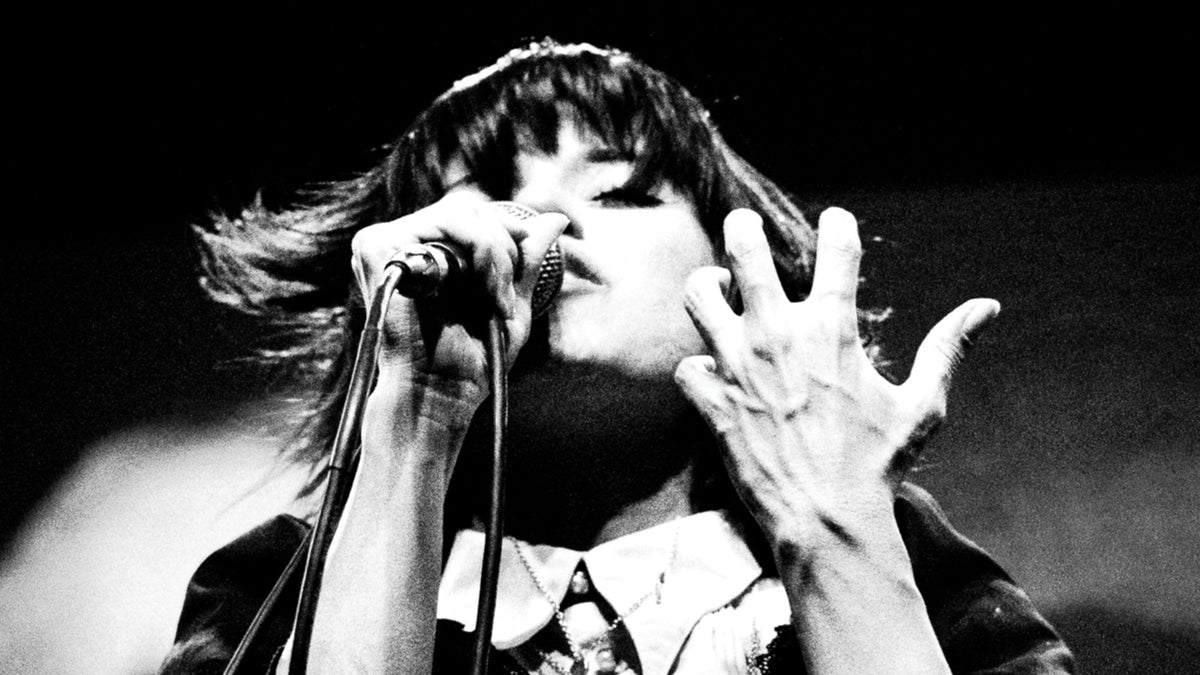
Onstage, Gonzalez becomes a gothic apparition, howling a torrent of motherfuckers and other curse words her religious parents would have kicked her out of the house for using. She screams them to the kids who have always felt too much, and who, like her, waited until the house was asleep in the blanket of night to listen to the music they weren’t allowed to love — music their parents deemed “demonic.”
The daughter of first-generation Mexican immigrants, Gonzalez watched her parents search for community through religion, moving between denominations in pursuit of belonging. That same sense of connection has been harder for her. “I’m a very lonely person,” she says. It’s a familiar condition for her generation, raised on the promise of constant connection and often left with a simulation of companionship instead. “I just scroll and scroll, telling myself I’m just looking things up for marketing research. A depressing cycle of looking for something to make me feel…something.”
The closest thing Gonzalez has ever found to a salve for loneliness is rock music. In it, she discovered a confidant and a mirror. She used it to muffle the sound of family fights and turned to it when everyone else told her she was “too much.” It accompanied her as she traded pink for black as a teenager and screamed into her pillow. It follows her still, in the same full-throated cries she now makes as Violent Vira.
As far back as she can remember, Gonzalez was desperate to become a musician. She wanted to help give her family a better life (“My dream is still to buy my mom a house,” she says), and to feel the kind of adoration that had always seemed out of reach. As an “upper-lower-class” kid in the Pacific Northwest, there didn’t seem to be many viable routes into music beyond Simon Cowell’s reality-TV factory of dreams. She auditioned for American Idol and America’s Got Talent, but found no luck.
Her doorway into music arrived through another dream factory: TikTok. Gonzalez studied what went viral and reverse-engineered it. “I started writing down what the formula was,” she says. She bought ring lights and explained the story behind each song. The success she keeps finding on the app has continued to feed something in her that grief nearly emptied out. “I’m hungry for more,” she says. “I’m starving.”
She speaks eagerly about future tours and the forthcoming deluxe edition of Lover of a Ghost, featuring Spanish-language, acoustic and live versions of album standouts. But the bigger Violent Vira becomes, the more Gonzalez finds herself pulled between the hunger that has carried her this far and the healing she knows she may eventually need.

Jakob Simpson
Now in her mid-twenties, with real momentum finally building, Gonzalez is in a liminal period. She’s old enough to recognize recurring patterns, but still young enough to feel that transformation remains somewhere in the future. She mentions therapy several times, with a hint of guilt: She wants it but is scared to fully commit.
It’s that fear she addresses in her latest single, the incensed, post-hardcore-influenced “False Reaction.” Mixed by Zakk Cervini (Evanescence, Limp Bizkit, blink-182), the song finds Gonzalez reflecting on how depression can cloud your entire identity. “Selfish loathing is a drug I buy,” she sings loudly, then follows it with a quieter “I know,” as if scared to admit even that much self-awareness. When it’s suggested that the song seems to treat self-loathing almost like an addiction, she responds with immediate recognition. “You hit the nail on the head,” she says. “I romanticize the sadness.”
Gonzalez fears who she might become without sadness. She has yet to commit to therapy or medication, partly because she worries that healing might alter the artistic identity she has built out of emotional extremity.
The people drawn to Violent Vira frequently recognize themselves in her intensity, in the fear that love and loss are inseparable. “I can’t believe we all survive that,” Gonzalez says. “I’m always so scared for when I’ll have to experience grief again.”
Lover of a Ghost concludes with “Chasing Ghosts,” a eulogy for the grief, obsession and self-mythology that first gave Violent Vira its shape. What comes next for Gonzalez will be a kind of reincarnation — “something darker,” the vocalist says. Destruction is another form of creation; despite everything, she keeps marching on.
Violent Vira will be premiering her Lover of a Ghost film, directed by Dylan Cole, on Veeps this Wednesday (July 29th). The livestream will also feature a live performance and a Q+A. You can get tickets and find out more about Veeps subscriptions here.