
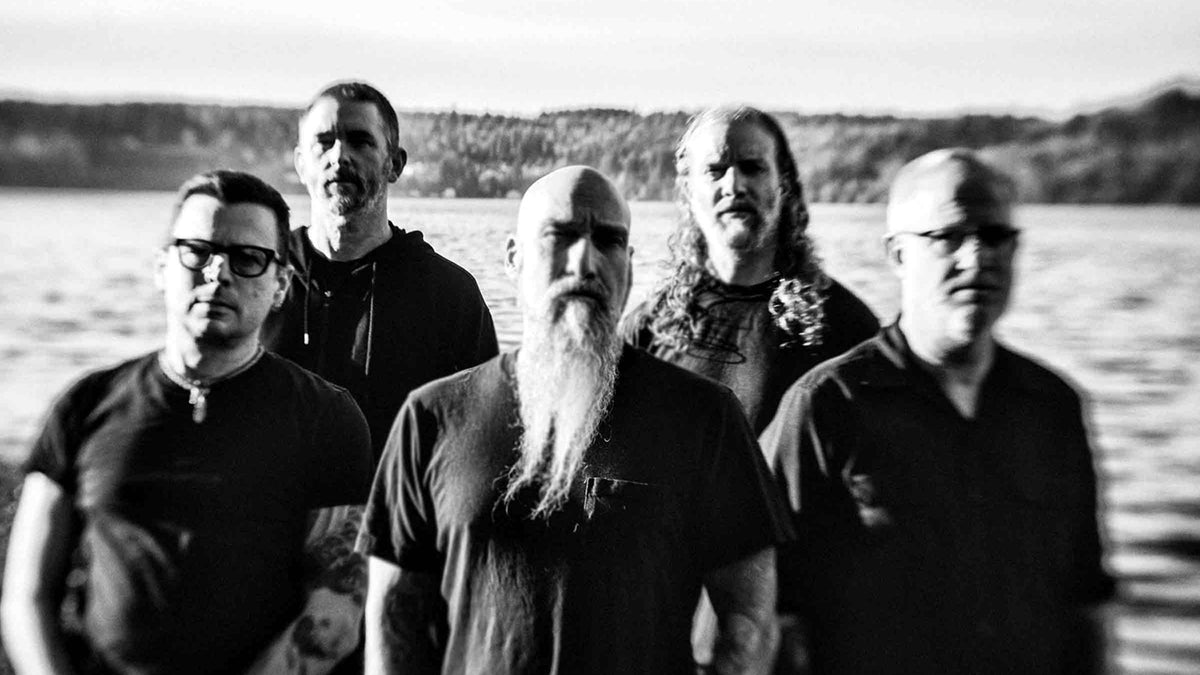
On the morning of March 20th, 2026, Neurosis fans woke up to something many had stopped expecting: a resurrection.
The Oakland post-metal titans had lain quietly dormant since their 2019 tour, only briefly emerging in 2022 to announce they had parted ways with co-founder Scott Kelly over his abusive behavior toward his family. Was the band, which originally formed in 1985, calling it quits? Would there ever be more Neurosis music? The remaining members — guitarist-vocalist Steve Von Till, bassist Dave Edwardson, drummer Jason Roeder and keyboardist Noah Landis — weren’t saying.
For more than three decades, Neurosis had been one of heavy music’s elemental forces: a band that dragged hardcore punk, sludge, doom, industrial noise, ritual percussion and apocalyptic atmosphere into a realm of their own. Their shadow stretches across generations of underground metal and heavy music, from Slipknot, Mastodon and Converge to Chelsea Wolfe, Amenra and beyond — artists chasing something more primal, expansive and spiritually punishing than riffs alone.
And then, like a bolt from the blue, came the spring equinox announcement: Neurosis had been reborn. Sumac leader and former ISIS member Aaron Turner had joined on vocals and guitar, and the new lineup would play its first gig in July as the headliner of Fire in the Mountains 2026, a four-day music and Indigenous culture festival at Red Eagle Campground in East Glacier, Montana.
Oh yeah — there was also a new Neurosis album, which surprise-dropped that same morning. An Undying Love for a Burning World, the band’s first release since 2016’s Fires Within Fires, is as heavy, brutal and cerebral as anything Neurosis have ever unleashed, but it also lands like a necessary blast of catharsis amid the global chaos of 2026.
“I would say this music is necessary at any time,” Turner tells Revolver. “Certainly, there’s an increased sense of dread and anxiety right now, so this record is helpful in that regard, but it’s also in keeping with the precedent that Neurosis has set from the very beginning.”
“We’ve been basically writing one song this whole time,” adds Von Till. “It takes different subtle shifts, but it’s spiraling out from — and spiraling toward, simultaneously — the same center of a deep sorrow for a deep wound that is thousands of years old: our lack of connection, our disconnect from being what we’re supposed to be, human beings living in right relation with our own minds, each other and the planet. Because of technology and social media, it all just feels overwhelmingly apocalyptic. But if you ask some of our Native American friends they’ll be like, ‘Oh, you’re just figuring this out? We’ve been living this for hundreds of years!’”

Scott Evans
That idea of right relation also shapes Neurosis’ return to the stage. Fire in the Mountains is presented by the Firekeeper Alliance, a nonprofit dedicated to reducing suicide in Indigenous communities; Von Till serves on the organization’s board. The band’s first show of this new era won’t be a standard comeback gig, but something with deeper purpose: on the sacred lands of the Blackfeet Nation, inside a festival built around music, ceremony and Indigenous cultural exchange.
In the interview that follows, Von Till and Turner talk about the secrecy behind Neurosis’ new album, Turner’s addition to the lineup, how Fire in the Mountains got the band off their asses and into the recording studio, and what it means to, as Von Till puts it, “reclaim our life’s work.”

Scott Evans
Steve, how did you guys decide that Aaron was the right addition for Neurosis?
Steve Von Till In late 2023, the four of us had gotten together just because it had been too long since we’d made music together, and we missed each other. It was instantly productive and instantly clear that we wanted to keep exploring this idea. When we realized we wanted to bring in a fifth member, we didn’t want to burden anybody with being a “replacement.” We wanted somebody to come in as a fresh energy, full of ideas and their own unique style. We’ve known Aaron for a long time, and I was always inspired by his ability to do what I loved about DIY music — start a record label, put on gigs, start a band. Aaron and I had a few deep conversations over the years, so there was just a vibe. Our only hesitation was that it was too obvious. We thought everyone would go, “Yo, duh!” But we just had to go with the gut, and the gut said: “Ask Aaron!” And in our minds, it wasn’t a tryout. It was total trust: “Do you want to join our band?”
Aaron, how did you feel about getting that invitation?
Aaron Turner Well, I didn’t understand that it was an invitation. [Laughs] Steve and I had some preliminary conversations about it. I thought we’d play together and see what it felt like. I didn’t understand that by saying I was interested, I was committing if the idea was accepted. Then Steve just called me up one day, and he’s like, “All right, we talked about it. Everybody agrees, you’re in.” I was kind of like, “Oh, that’s interesting — we haven’t even played a note of music together.”
As Steve said, our connection goes back many years. Without knowing it, I had been piecemeal submitting my application for several decades. And knowing Neurosis as people and as a band, I knew a fair amount about what I was agreeing to do. I knew that this was a set of people with very deep-rooted artistic integrity. It was still overwhelming to hear that I had been invited not just to play with them, but to join. And then there was the next step, which was playing together — which was equally exciting and daunting and surprisingly fluid.
Steve, were you guys clear that you didn’t just want Aaron to sing or play guitar, but that you wanted the full “Aaron experience” in Neurosis?
Von Till Yeah. We’ve always been about reinvention and evolution, and because of how we had to fade to the background and put it on ice for a while — and tend to our life’s work as a dying corpse — we wanted the reinvention to be strong and energized. We wanted it to have fresh input. We like Aaron’s ideas, and we knew we didn’t have to explain anything about where we were coming from — he just intuitively knew it.
We started by playing a couple old songs, just to get our feet wet. And then we had a couple of new ideas already sitting around, and Aaron instantly inserted himself with confidence, commenting and critiquing and adding his own parts. By the second time [we played together], he was bringing in ideas of his own. That’s exactly what we wanted. We wanted a reinvention … and we wanted to make sure we came out swinging.
Aaron, you’ve been a Neurosis fan from way back. When you were bringing in those new ideas, were you specifically tailoring them to the band?
Turner I was intentionally tailoring things for Neurosis — essentially, doing what’s right for the group and speaking with my honest creative voice. It was definitely nerve-wracking. But it also felt like, Well, if they don’t like them, I’ll just write more.
We’ve all been writing music for a long time, and nobody gets personally offended if their ideas are rejected. That’s just how you get to a good end result, by going through that process — as Jason [Roeder] described it, the “Neurosis meat grinder” — where everybody puts in their raw material, and then, as a collective, it becomes refined and unified. This is a true committee process, and there are no punches held. If somebody doesn’t like an idea, it is shot down without any perfunctory niceties. That bluntness, though maybe a bit harsh at first, was also refreshing, because it’s awful to be in a creative situation where people aren’t speaking their minds. You end up with a compromised end result and with resentments, and I don’t want to be in that position. I’ve been there, and it sucks.
Von Till Neurosis has always been that way. Not a single note squeaks by that everyone hasn’t approved. Not everything has to be discussed, some stuff is just inherently like, “Yep, that’s it.” But other things are microscopically picked apart till everybody loves it. It is brutal, but it is consensus.

Scott Evans
When did you start recording the album?
Von Till We didn’t even know that we were going [into the studio] until about last September. We had a bulk of material taking the skeletal shape of a record, but we’d only gotten together a few times in 2024 and early 2025. Various circumstances in our personal lives made it very difficult to find the energy, persistence and resilience to focus enough on it…
I work with a nonprofit in Montana called the Firekeeper Alliance, which is focused on reducing suicide in Indian Country. One of their pillars is using creativity as part of a strength-based approach — using heavy, dark, intense emotional music as a protective factor. I’ve been on the board since it started, and Charlie Speicher, the founder, was one of the few people that knew we’d asked Aaron to join. He asked, “What are the chances that Neurosis could be the band to represent Firekeeper Alliance’s mission as the headliner at next year’s Fire in the Mountains festival?” I said, “That’s my dream, but we’re not ready. We’re not going to play anywhere or even announce that we’re together until we have a record of new material with Aaron, and things are rough right now.”
I went back to Aaron’s place, and we had a heart-to-heart talk: “Are we really doing this? Why are we doing this? What do we want out of this? Can we find a way to persevere together? Because we have this opportunity where our return could be in the most appropriate location for the most appropriate reason.” I shared my experience of the festival last year, how it felt way more like ceremony than a music festival — especially because of the mostly local-led workshops on sovereignty, buffalo restoration, processing grief and trauma, settler colonialism, resilience — and how that’s exactly where we need to be. In Blackfeet culture, when a call comes out for you to bring your expertise and your gifts to help, you answer the call. And we all said, “Yes, let’s do it.”
Before anybody could change their mind, I called [producer] Scott Evans: “When’s the soonest we can get in the studio?” It was right around Thanksgiving. We knew there was no way we could have this entire 64 minutes of material ready in one batch, so we broke it into thirds. We rehearsed the first third at Aaron’s. Two weeks later we recorded it in Seattle. Two weeks after that, we rehearsed the second third. Two weeks after that, we recorded it. Two weeks after that, we rehearsed the final third. Two weeks after that, we recorded it. Two weeks after that, we mixed it in Oakland. Several weeks after that, we were approving test pressings. And a couple weeks after that, we dropped it out of nowhere.

Bobby Cochran
Why did you keep the album’s existence so tightly under wraps until it was released?
Von Till I didn’t want to promise something until it was reality. Our statement was the 64 minutes of material. You can’t piecemeal it out. There’s not one track that represents everything that we had been through, and everything that we had put into getting to that point. It all had to come at once. I wanted it to be digested as a record, not prejudged. People have all kinds of reasons to naysay things or come up with preconceived assumptions before they’ve had a chance to digest it. This just bypassed that whole system. We’ve never shied away from wanting to do the epic thing, so that was a pretty epic way to go. And the spring equinox felt like the right day to do it.
Turner This was not just a new record, but a rebirth and an announcement about our participation in Fire in the Mountains. So creating an idea around the presentation of the record in a way that felt meaningful was important.
Von Till I run our label [Neurot Recordings], so I was literally sitting there about to push “Send” at 7 a.m. on spring equinox. My hand was shaking because of the weight of what we were about to unleash. And then the next 72 hours brought wave upon wave of words that I would never have predicted, like, “What a great day to be alive!” or “I can’t believe how much I needed this!”
We understood that feeling. We needed to reclaim our life’s work. We needed to do this. But to have so much unrelenting acceptance of Aaron being absolutely the right guy, and people diving into it immediately and just being blown away and emotionally moved by it was a very healing experience for us. The cesspool of the internet became a place of unexpected joy in our universe for a while, and I would have never put any money on that.