
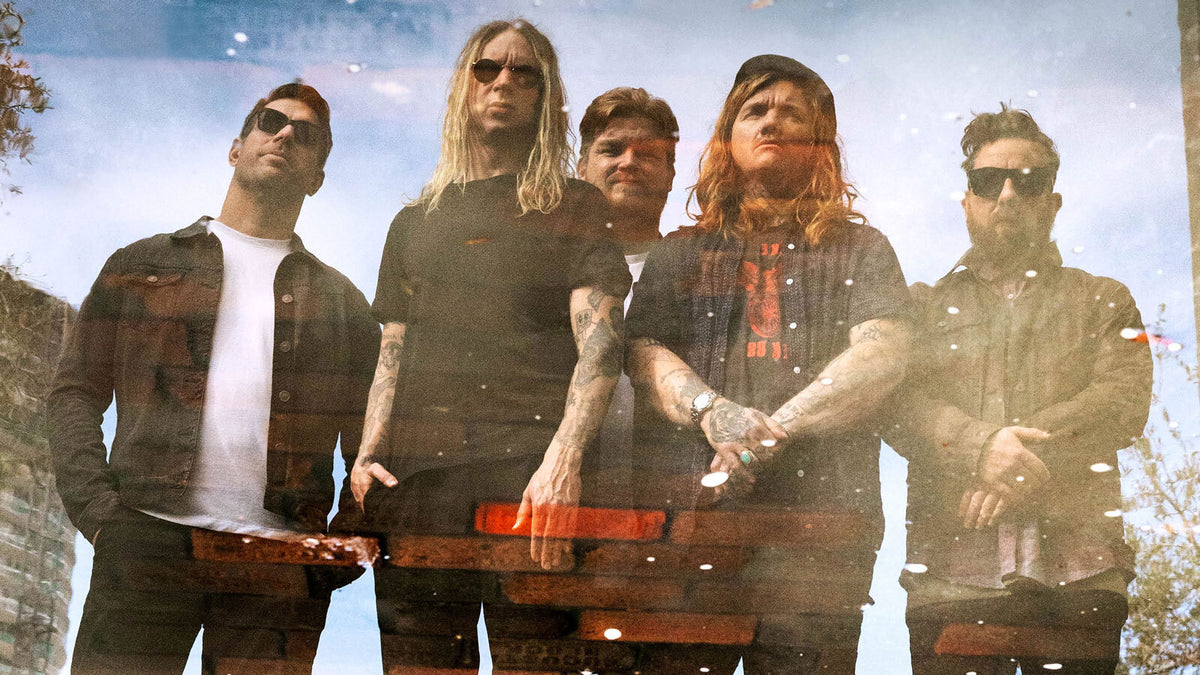
“When you’re in a band,” there’s always going to be a certain level of unhealth, which I don’t know if people talk about enough,” says Underoath’s founding drummer and co-vocalist, Aaron Gillespie, on a brisk, early morning drive to a studio session in Nashville. “It’s hard to do this for 20 minutes, let alone [28] years.”
Gillespie speaks from experience. Since forming in Ocala, Florida, in 1997, the Tampa-based band have weathered significant lineup changes, core ideological shifts and fickle industry trends — not to mention successfully resurrecting themselves after a two-year breakup. Along the way, the post-hardcore veterans have released numerous critically acclaimed albums that defy genre limitations, bridging the gap between underground experimentation and stadium-sized rock.
They’ve played the biggest festivals, toured with nearly every pillar of the metal establishment and dropped adventurous cross-genre collabs — with artists ranging from Bring Me the Horizon and Ghostemane to country singer Mitchell Tenpenny and EDM producer Rezz. Through it all, Underoath remain one of the most influential and enigmatic acts in heavy music.
Underoath’s career has been defined by constant evolution and a relentless focus on the future. But when Revolver connects with Gillespie and singer Spencer Chamberlain in January, we catch the band at a particularly reflective — and pivotal — moment. They’re wrapping up their 20th anniversary tour celebrating their 2004 breakthrough album, They’re Only Chasing Safety, while also preparing for the release of their highly anticipated eighth full-length, fittingly titled The Place After This One. As they tell it, this marks the end of one chapter and the beginning of a new one.
“As serendipitous as it is and not planned, I think the 20-year anniversary shows kind of closed the first chapter of the band,” Chamberlain declares. “This [album] is the start of the next 20 years. I haven’t felt like this since we made [2006’s] Define the Great Line — and I feel like lightning in a bottle was captured.”
What might the next era of Underoath look like? If it’s anything like their first, fans are in for a wild ride.
When Underoath emerged in the late Nineties as part of the burgeoning Y2K metalcore movement, which also included Poison the Well, the Dillinger Escape Plan and Converge, their faith-based principles distinguished them from the pack and helped them become the leaders of the Christian metal scene. (The band would later publicly distance itself from this belief system.)
In those early years, Underoath cut their teeth on the DIY circuit, playing intense shows in sweaty VFW halls and youth centers while steadily developing their distinctive blend of melodic aggression. Then, in 2004, their popularity unexpectedly skyrocketed with the re-lease of their second LP, They’re Only Chasing Safety.
That genre-defying record created a ripple effect in the scene. Countless imitators — including some of their closest peers — scrambled to catch up, trying to capture the fresh new sound that Underoath had introduced. “I think people sometimes say we ‘invented’ a sound because we liked Taking Back Sunday and Jimmy Eat World as well as Botch and Nine Inch Nails and wanted to see how we could put all of that together,” says Gillespie. “I think that’s what you got with Chasing Safety.”

Underoath’s Aaron Gillespie
In the modern age, you don’t need to venture far to see Underoath’s immeasurable influence. The band’s fearless, and oftentimes polarizing, creative vision helped establish an essential template for today’s biggest metalcore acts — from Bring Me the Horizon and Architects to Bad Omens, Spiritbox and many others.
Throughout the current They’re Only Chasing Safety tour, Underoath — Gillespie, Chamberlain, guitarist Tim McTague, bassist Grant Brandell and keyboardist Chris Dudley — have treated rapturous, sold-out crowds across the globe to a performance of that classic album, which includes fan-favorites “Reinventing Your Exit” and “It’s Dangerous Business Walking Out Your Front Door.”
And to shake things up when the extensive run got “grueling and monotonous,” Chamberlain says, the band surprised fans by showcasing a few new songs from The Place After This One, including the venomous first single “Teeth,” cautionary tale “Survivor’s Guilt” and the raging “Generation No Surrender.”
“It kept us from going crazy,” Gillespie says of performing the new material, before quickly adding, “I know it sounds like bitching, but the point I’m making is that we’re really lucky. A lot of people take for granted what they get to do.”
While Underoath have generally kept their eyes laser-focused on the future, the anniversary tour put them in a reflective state — especially Chamberlain. After all, the vocalist made his debut as the band’s frontman on They’re Only Chasing Safety, following the departure of founding vocalist Dallas Taylor — and a lot has changed in the past two decades.
“While I love playing these songs live and celebrating it, there’s not a whole lot for me to hold onto lyrically as an adult,” he admits. “Life didn’t start happening until after that record — as far as real things to say and talk about. This was before the drugs, before the depression and before any real-life events had happened.”
Chamberlain is not wrong. Since They’re Only Chasing Safety, Underoath have endured more ups and downs than bands twice their age — enough to fill multiple feature-length biopics if they wanted to. From Chamberlain’s long and isolating battle with addiction and subsequent road to recovery, to the band’s internal struggles over creative direction and grueling tour schedules, their journey has been any-thing but easy.
“If I told you life was always great, that would be bullshit,” Gillespie asserts. “Imagine if you worked at a hedge fund and there are five people who are the boss — it’s a wild thing.”

Underoath’s Spencer Chamberlain
In 2010, Underoath faced one of its biggest challenges when Gillespie announced his sudden and shocking departure from the band. Not long after, in 2012, the band itself called it quits. But fate had more in store for the group. The guys eventually reconciled, and in 2015 they announced they were reforming for the Rebirth Tour. The shows were a resounding success, and, miraculously, Underoath have remained active and productive ever since. Which is not to say it’s been entirely smooth sailing.
Following the reunion tour, it didn’t take long for fans to start clamoring for new music. In 2018, Underoath answered with their sixth full-length album, Erase Me — a bold statement of their evolution that showcased the band’s willingness to experiment with more accessible alt-rock sounds. The move was divisive, drawing mixed reactions from both critics and fans. It wouldn’t be the last time Underoath 2.0 sparked a polarized — and often in-tense — response from their audience.
They’ve even caught flak for work on other people’s songs. Case in point: “a bulleT w/ my namE On” from Bring Me the Horizon’s 2024 release POST HUMAN: NeX GEn. Oli Sykes and Co. recruited Chamberlain and Gillespie to provide guest vocals for the anthemic post-hardcore track. On paper, it should have been a universal slam dunk for followers of both bands. However, an evangelical subset of Underoath’s fanbase took serious offense at the singers of the ex-Christian band unleashing the blasphemous lyrics: “And if Jesus Christ returns/We’ll just kill the fucker twice.”
“Oli got on FaceTime with us when we were tracking the feature. His main concern was if we were having fun doing it. I thought that was really cool,” Chamberlain recalls, adding of the subject material: “I think it’s brilliant. He knew how much of a stir it would cause if I sang those lyrics. It was well thought-out, and they ruffled exactly as many feathers as they wanted to — which is our m.o., too. We’re clearly getting under your skin in the same way we did when we were making Define the Great Line or They’re Only Chasing Safety.”
Chamberlain insists Underoath aren’t deliberately trying “to piss people off,” but concedes that “there is something to be said about stirring the pot.”
“Every record we’ve ever done, people find a way to hate it,” he continues. “When an artist makes something that I don’t understand right off the rip, especially if it’s an artist that I love, I want to listen to it and understand why. Not until all five of us are stoked does a song make it out of the studio. That’s how it is every time we make music … Whatever you [eventually] hear in your speakers is exactly what excites Underoath at this moment.”
What excites Underoath most right now is precisely what their new album delivers. The follow-up to 2022’s Voyeurist (which marked a return to eclectic heaviness with its mix of ragers, choir-assisted anthems and moody-to-manic epics), The Place After This One is a 12-song powerhouse that explores nearly every sonic avenue the band has traveled.
The record combines the sharp, earworm pop hooks of their later material with the raw, un-filtered aggression that put the band on the map in the first place. In fact, certified barnburners “And Then There Was Nothing” and “Loss” may have critics who claimed Underoath abandoned their heavy roots eating their words.
Still, even when the band wade into more experimental waters on The Place After This One, it feels intentional and forward-thinking. Take “Shame” — an infectious track that borrows from EDM’s playbook with its rising crescendos, instrumental drops and a minimalist one-word chorus that drives the point home without getting lost in excess.
One of the album’s most sonically compelling moments comes on the closing ballad “Outsider.” The track finds Underoath at their most tender, wrestling with the negative aspects of our hyper-connected digital world. It also showcases Dudley’s talents as a soundtrack composer with its evolving cinematic soundscapes, atmospheric textures and vocoder elements.

On The Place After This One, Underoath continue their selective approach to collaborations — which really only began circa Voyeurist when rapper Ghostemane appeared on “Cycle.” But they’re careful not to overdo it. “The day and age of every song [needing] to have a feature of some other artist who is massive, or has a different pool of fans than you, has always grossed me out, to be honest,” Chamberlain admits.
But sometimes a collaboration is just destined to be. While workshopping what would become “Vultures,” Chamberlain was struck by how the guitar riff in the bridge reminded him of heavy-metal critical darlings Mastodon. Once he laid down his initial vocal, he couldn’t deny the resemblance to the gruff stylings of Mastodon bassist-vocalist Troy Sanders, either.
As it happens, Chamberlain and the bassist have been close friends since 2008, having spent time together on tours and in Atlanta — Mastodon’s hometown and the city where Underoath recorded several of their classic albums, including Define the Great Line. Reaching out to collab felt like the natural next step.
“It was literally just a phone call,” Chamberlain says with a laugh, adding, “Troy has always treated me like family and has the biggest heart. So we just caught up, talked about our lives, and I told him he’d be perfect for the song — but no hard feelings [if he wasn’t interested]. ‘Vultures’ is pretty outside of the box, even for Underoath. We wanted to make a song that has that Rage Against the Machine feel — some-thing that makes you bob your head. [Thankfully], he loved the song, and I hope and pray that we play a festival someday together in the future, and he comes out and rips it with us.”
Beyond just the sonics, The Place After This One marks the point where Gillespie and Chamberlain have mastered the balance of their vocal duties and lyrical contributions better than ever before.
“I think Spencer and I’s language to one another has gotten so cut and dry,” says Gillespie. “We do really well now with not keeping secrets inside of lyrics. Our communication has broadened to almost a Morse code where it’s just honest and fast when it comes to writing. I know Spencer to the point where when we are writing, I can say, ‘Nah, you didn’t mean it like that,’ and he can say the same to me.”
This near-telepathic connection between Gillespie and Chamberlain extends beyond their music to their life experiences, which share similar painful touchstones and necessitated a healthy outlet for their anger and frustration.
“I don’t know how to say this without being blunt, but Aaron and I have been in the same place before, which is when you have a child with someone and you’re cheated on — and the way that shit will make you feel and piss you off,” Chamberlain reveals. “You gotta get it out somehow, and I think a lot of what Aaron and I both felt in our personal lives came out in songs like ‘Cannibal,’ ‘Teeth’ and a few others where the anger is pointed in a general direction, which we haven’t done in a long time.”
Thankfully, Gillespie and Chamberlain have each moved on to healthier relationships and marriages. And as Chamberlain sees it, releasing their anger on the record has allowed for a greater “sense of relief, therapy” and healing from those dark periods.
Another lyrically freeing aspect of The Place After This One is Chamberlain’s vulnerability when addressing his past struggles with addiction — an openness that has, in turn, aided his recovery. This is especially evident in “Survivor’s Guilt,” a song that candidly explores the tragedies caused by addiction, which opens with the poignant lines: “Seven years I’m eight down in ’23/I would have gone with them if it was up to me.”
“That first opening line means it’s been seven years since I’ve been off drugs and have lost eight friends in 2023 — and how it makes you feel lucky, but also guilty,” explains Chamberlain. “I just got lucky. I got out before the fentanyl phase, and a lot of my friends didn’t. It doesn’t mean I’m better than them, and it hurts. There’s still a lot of guilt that comes with that when you’re dealing with friends and family who have lost loved ones.”
Individually, and collectively, Chamberlain posits that Underoath is “the healthiest the band has ever been” going into the release of The Place After This One. “I think it’s because we’re all grown up enough, and our lives are in better places where no one is falling apart at the moment.”
But, of course, there were still hurdles to cross be-fore the album came to life. In 2023 — just days before their Blind Obedience tour with Periphery and Loathe was set to kick off — Underoath announced their split with longtime guitarist James Smith. The band has kept mum about the details, and even now, Chamberlain and Gillespie hesitate when the topic is broached.
And then Chamberlain chimes in: “We totally should [talk about this]. We never have. … He just became burnt out, uninterested, and he didn’t like traveling to anywhere that wasn’t close to home.”
“That’s the worst part of this job,” Gillespie interjects. “You should see the hoops that we run through to be good fathers in the middle of this job. The glamorous side is that we get to go to all of these places, but the unglamorous side is that I’ve only been there with my youngest child — who is four — for two of her birthdays. It has to be in your soul. This has to be all that you really want. And that doesn’t mean you have to be a shitty father or a shitty husband, but it does mean that you have to miss some stuff.”

The band knew Smith had reservations about touring, so Gillespie says they scheduled a call in hopes of changing his mind. Unfortunately, the guitarist wasn’t receptive. “We had a tour starting a week after this call, and then he just didn’t show up for rehearsal,” Gillespie says somberly. “Three weeks into that tour, we were more at peace and told him not to come back, and that was literally it.”
“He got put into a corner, which has happened to me before,” adds Chamberlain. “I’ve been kicked out of the band before. There are times that you don’t even realize that you are doing something wrong. But all your friends think you’re wrong, so you have to put your head down and figure it out — even if you’re mad at them or don’t agree. Either way, you have to apologize, try harder and hopefully see it the way they do. When James didn’t have that reaction to the conversation, I reached out to him [personally]. I said I know where you’re at right now and how this feels. I don’t think I ever heard back from him after that…”
Despite the rift, the guys still sing Smith’s praises, calling him a wonderful father, husband and friend. “I miss him being here,” says Chamberlain.
Gillespie shares the sentiment and is even open to reconciliation. “If we’re ever playing multiple nights in Tampa and he wants to come up and play some songs, I think it would be dope,” he says. “Life is too short and hard to be a dick about stuff.”
Given Underoath’s history, it wouldn’t be surprising to see Smith join his ex-bandmates onstage again. Just this past December, the guys welcomed back former frontman Dallas Taylor to perform their cult-classic song “When the Sun Sleeps” (from the criminally underrated 2002 album The Changing of Times) to the delight of every diehard fan in attendance.
“Time heals all wounds,” says Gillespie.
Whether it’s member departures or unexpected reunions, one thing is for sure: The show must go on. The only thing Underoath can focus on now is whatever lies ahead, which is exactly the overarching concept of their new album.
“I suck at living in the moment. I’m obsessed with what happens next,” Gillespie admits with a nervous laugh. “The Place After This One is what happens when you spill it all out, are honest with it all and just hope that you land on your feet. This is us dealing with what was happening at the moment, and what happens at the moment affects what happens next — even if you can’t control either one.”
For Chamberlain, the title The Place After This One and its central themes directly reflect how he envisions the band’s future as they enter their next era. “The first chapter has those records, the breakup and all of this stuff,” he says, “and I think the first chapter is [finally] closed.
“Something special happened when we were making this record,” he continues. “We came to a head with enough bullshit happening in life to where we were able to get on the other side of all of it and be free enough to write and talk about it. Whether it’s successful or not, it doesn’t matter to me. I feel it — and I do think it’s our best record.” He pauses.
“I’m not going anywhere. I’m looking forward to another 20 years.”