
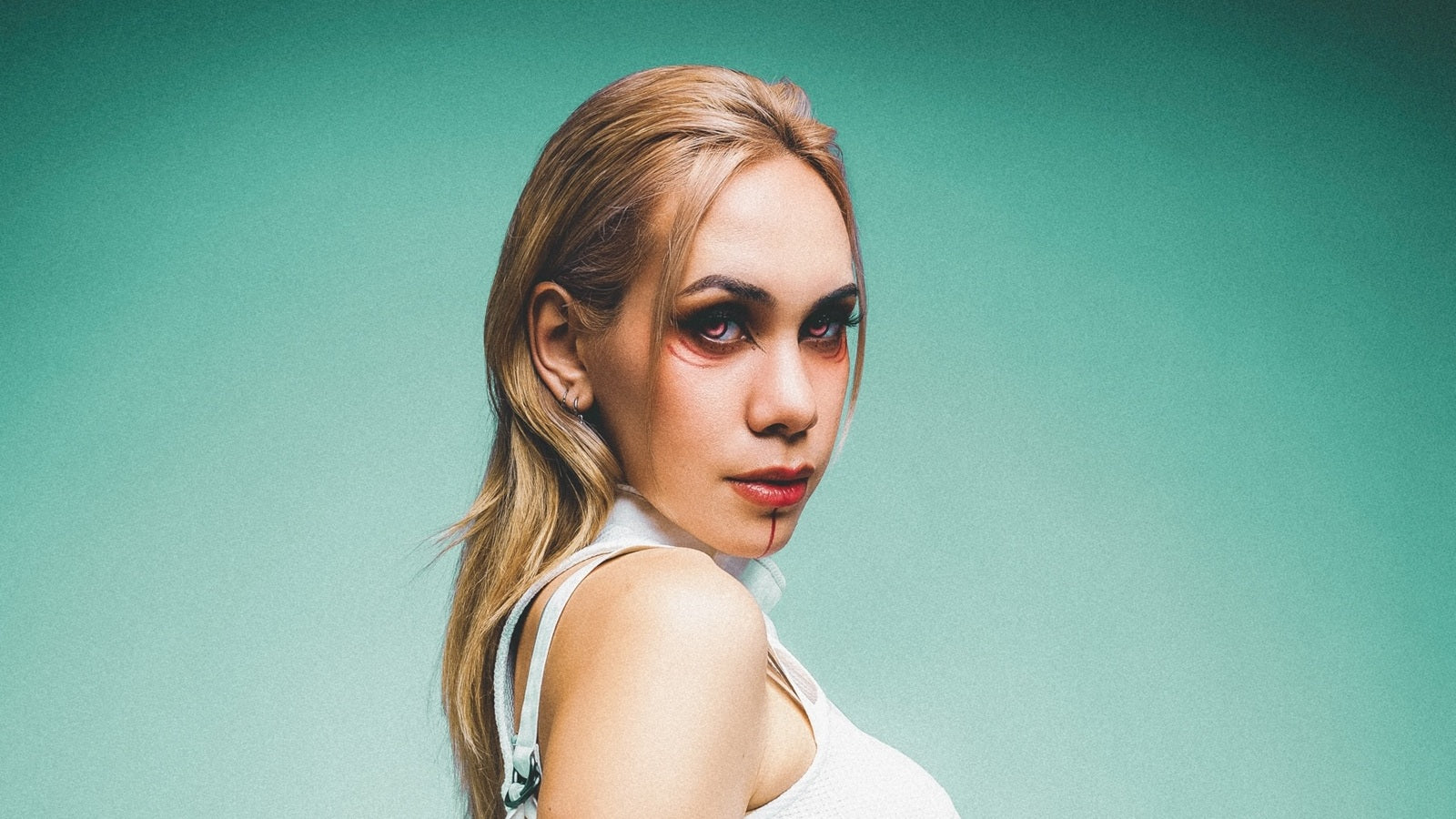
Daedric’s new album, As the Light Left, is armed to the teeth with everything from boom-tubing modern metalcore hooks, to nu-styled turntablism, to a barrage of bestial screams and heavenly-sung moments from dynamic project founder and vocalist Kristyn Hope.
As it happens, the singer is also often seen strapping an impressive, if intimidating, straight sword of Chinese origin — Hope wields the big-ass blade across several videos and photoshoots attached to the Texan outfit’s sophomore LP.
Prior to this, she held a Dawnbreaker sword inspired by her love of The Elder Scrolls series — the band’s name honors a villainous Skyrim character, while Hope’s lyrics to new songs like “Night Mother” also pull from gaming lore. Choosing her latest blade, however, had more personal origins.
“I got it off of Etsy from an artist. I was looking for something in the Asian realm, because for this album I was trying to bring in some cultural references from my own background,” explains Hope, who is half-Filipino. “[But] not just relegate it to the Philippines, but kind of broaden it, because the Philippines does draw on other cultures for their styles.”
Though not as violently dramatic as an Elder Scrolls adventure, the making of As the Light Left turned the recording sessions into an aesthetic battle zone.
When they first started working on the follow-up to the band’s 2023 debut album, Mortal, Hope and her project-mates — producers Clay Schroeder and Geoff Rockwell — put everything on the table. When this quickly amounted to more than 100 demos, Daedric’s resident swordsmith realized not everything would make the cut.
“We kept pruning and changing things. Some [songs] we thought seemed like a shoe-in, [but] the next thing you know, someone’s like, ‘I hate it, we’re not using it,’ and so it was very much a battleground in that way — but not in an unhealthy way.”
While at times critical, the creative process was ultimately constructive. An abandoned track of Rockwell’s took on Eighties metal flavors, a vibe Hope felt was a touch too dated when set against the record’s most cutting-edge elements — from pop-djent breakdowns to shadowy R&B-influenced moments.
“We are mixing in nostalgic sounds with modern sounds, [but] that one I felt was too nostalgic,” she says. “Not relatable. To me, at least.”
Speaking with Revolver, Hope sheds light on making the latest Daedric album, keeping her storytelling bleak, gaming on the road, the band’s “Dark Legacy” thus far, and more.
The title of “Sand Tiger” alludes to the Cave of Wonders from Aladdin — huge movie, but kind of a deep-cut character, in a sense. It’s not like you’re naming the song “Jafar” or “Aladdin.” What compels you about the imagery of the Cave of Wonders?
KRISTYN HOPE: So that was actually just pure coincidence. The working title for the track was [already] “Sand Tiger,” and as I was tracking the [vocal] part right after the turntable scratching, I was experimenting with all kinds of different voices and tones — just trying things [out] because I wanted it to be really cool. And as I was experimenting, that voice came out of [me], and I made a joke, like, “This sounds just like the tiger from Aladdin. Not Jasmine’s Tiger, but the Cave of Wonders tiger.” So, we were all just laughing about it, and then we decided to keep the name. It was just a funny coincidence.
More consciously, the sound of the song references bands like Limp Bizkit and Linkin Park. How did you first connect to nu-metal music of that era?
Linkin Park was, like, the highlight of my childhood. I wasn’t there for the first album… but I remember Transformers debuting “What I’ve Done,” and I was just like, “This is the best song ever.” It was my song for years. It was my ringtone, back when you used to do that.
I just thought Linkin Park was the best band ever, and I loved how emotional Chester sounded. So that was my tie to nu-metal. I never really listened to Limp Bizkit or much of Korn until recently, and I now have an appreciation for them — but my heart definitely belongs to Linkin Park.
This album was originally going to be titled Nails, right? Why did that change?
That was the working title for “Night Mother.” The only reason we really changed it is because a band came out with a song called “Nails” around the same time that we were working on it. There would have been enough of a gap [between the release of the two songs] for it to be fine, but Clay was like, “No, we cannot name it ‘Nails,’ because there’s a song called ‘Nails’ by this bigger band.”
So then, we went through a few names, and when I was thinking about writing about that [Skyrim] questline, I thought the nickname for the character in that questline was a cool one. And it kind of sounds mysterious. Even if you don’t know Skyrim, the name Night Mother has this cool vibe to it.
Is there a through-line of Elder Scrolls and Skyrim-related lyrics through this record?
I would say it’s there pretty solidly… [but] I did inject a lot more personal stuff this time, not being afraid [of being] rawer and truer to what was going on in my life.
How did you connect to “Night Mother” on that more personal level?
You could really look at it as a diary entry for me. [There’s] kind of a recurring theme in [the] relationships in my life, where I go in with this open heart, and I’m fully trusting and hoping for the best. [But] I don’t have any idea of what kind of person this might be. I let things play out, and sometimes, obviously, that bites me. And it hurts, especially if you’re close to and really cared for that person, and it makes you feel like your reality is crumbling because everything was a lie.
So, that was me being honest about a fault of mine that can also be seen as a plus. Sometimes those kinds of characteristics hurt you more than help you.
Did embodying the Night Mother help you understand that kind of a situation?
It helped me understand that it’s a common human experience that most people have had, to some degree — that level of betrayal, and feeling that loss of trust.
For the Night Mother itself… if I was a villain, then yes, because I would just say, “Burn it all down and kill everyone,” because the Night Mother has no sense of guilt. No heart.
Have Daedric fans started referring to you colloquially as “Mother” because of this song?
Yeah, people on Instagram or Discord have nicknamed me the Night Mother, like, “Here’s Night Mother.” I’ve also been called the Feral Queen. I don’t hate either of those, I think they’re funny.

How did you discover your voice early on?
As a kid, I was incredibly shy. I’m not really sure where that came from, but I actually didn’t speak for a long time — and my parents thought I was mute. My extended family didn’t even try to engage with me…[but] I secretly loved singing.
I had access to very little music [growing up], but my mom did have these CDs of Whitney Houston and Mariah Carey. So, I would listen to them when my parents weren’t home — I would try to emulate that
It was all hymns and classical music [before that], so I sang, but it wasn’t that inspiring. But when I heard Whitney and Mariah belting their hearts out, it’s hard not to get pulled into that. Later on, around high school, I would hear things on the radio, and then I started gravitating towards hard rock and metal.
How has your work as a vocal stunt performer impacted your presence in Daedric? Your profile through the Monster Factory lists you as being able to do zombies, beasts, ghouls and more…
I would say it’s a one-to-one translation, because the kinds of techniques that I’m using for the acting are very similar to the metal growls — especially in terms of sustainability and stamina. Of being able to do that over and over and over as we’re tracking. It’s just using your creativity to bend it to be [either] more musical or more dramatic.
What are some of the ways you pushed yourself creatively on this album?
We definitely stretched the dynamics of this record — from going even heavier, to even softer than [on Mortal] — and [we’re] not being afraid to express ourselves [either] way.
All the time, [people] demand us to only do screaming stuff — “That’s the best, just don’t even bother with singing” — and then I have the other camp that says the opposite, and they’re like, “Don’t bother with that screaming.” If I listened to any of them, I would never make music.
Where did “Dark Legacy” come from?
That one was entirely written by Clay. He’s very much in the R&B and hip-hop mind-space. And I love The Weeknd! I was thinking this would be such a cool Weeknd[-type] song, because I missed this version of the Weeknd when he would sing haunted stripper music. I’d always wanted to write a song like that.
So going in, I just thought, “OK, what would The Weeknd write?” And of course, it filters through me, and it changes the song.
I was really happy with how that came out, because we didn’t feel this need to scream or inject any heaviness [into the song], we just let the track exist as-is. It’s one of my favorites, actually.

If As the Light Left features a narrative journey, where do we end up by the end of the record?
I would say this album doesn’t have a happy ending. I was thinking about this a few weeks ago, actually: I have a love for horror films, and I especially love it when it doesn’t end well — when there’s that cliffhanger or gutted feeling.
If you’ve seen the movie The Mist, that ending is just gut-wrenching, and it’s horrible, but it makes the movie that much more amazing. It could have easily been this campy ending where they win against the creatures in the mist, and everybody’s fine, but the tragedy of [the ending] makes it more beautiful and realistic to me. I think about every day: People die suddenly. They weren’t expecting it, and their families weren’t expecting it. There’s no happy ending. It’s just the end.
As I was writing this record, it was very much [focused on] fate versus free will. But in the end, we do all still die. It may be really tragic because there’s things left on the table that you wish you could have done…
That’s why we called [As the Light Left’s opening song] “The Other Terror” — there’s the fear in front of you that you can see, and then there’s the fear behind you that you don’t know… and you have to decide whether to face the one that you see or the one that you can’t.
Are you facing unknowns at the moment, as Daedric?
I feel like there’s always an unknown in front of you, but that’s what makes it exciting — because if I knew that everything was going to be perfect, there would be no excitement. There’d be no thrill of the possibility of failure. That’s what makes things exhilarating: that you work to try to achieve perfection, and you never will, but you still try anyways.
Going into this tour, any number of things can happen — from physical dangers, to technical difficulties, or [shows] getting canceled. I’ve heard of venues flooding the day before, and a band shows up and they can’t even play. Or last tour I lost my voice, and that was a really scary thing. That was quite humbling, [and] terrifying.
Do you have vocal prep techniques you’ve accumulated since then?
Absolutely. On the tour with TesseracT, I met up with Dan [Tompkins], because he’s a vocal coach, and he gave me vocal massage techniques, and some recovery techniques. I also got in contact with Marcus [Vik] from Invent Animate, and he gave me some really good techniques, as well.
Playing into the song title, what’s Daedric’s dark legacy thus far?
…That’s a hard question, but I would say it’s our openness about being nerdy. We’re all nerdy in a different way. I’m the gamer nerd — the guys don’t game at all, so they have no concept of what Skyrim is, and they don’t really care.
Clay is definitely audio nerd. He’s always learning about new plugins and things like that. And then you have Jeff, who is a self-admitted Trekkie.
Obviously, everyone wants to be cool — to be this mysterious, badass — but I think there’s something endearing about embracing the geeky stuff, too, and just saying, “I love me, I love what I’m doing, and I love that I know way too much about Skyrim.”
Do you game on the road?
I’m planning to this time. I didn’t last time because I have motion sickness, so I was staring out the window a lot. I have since learned about things like Dramamine, so I’m hoping that stabilizes me so I can actually play on the road. That’d be nice!
This interview has been edited and condensed for flow and clarity.