
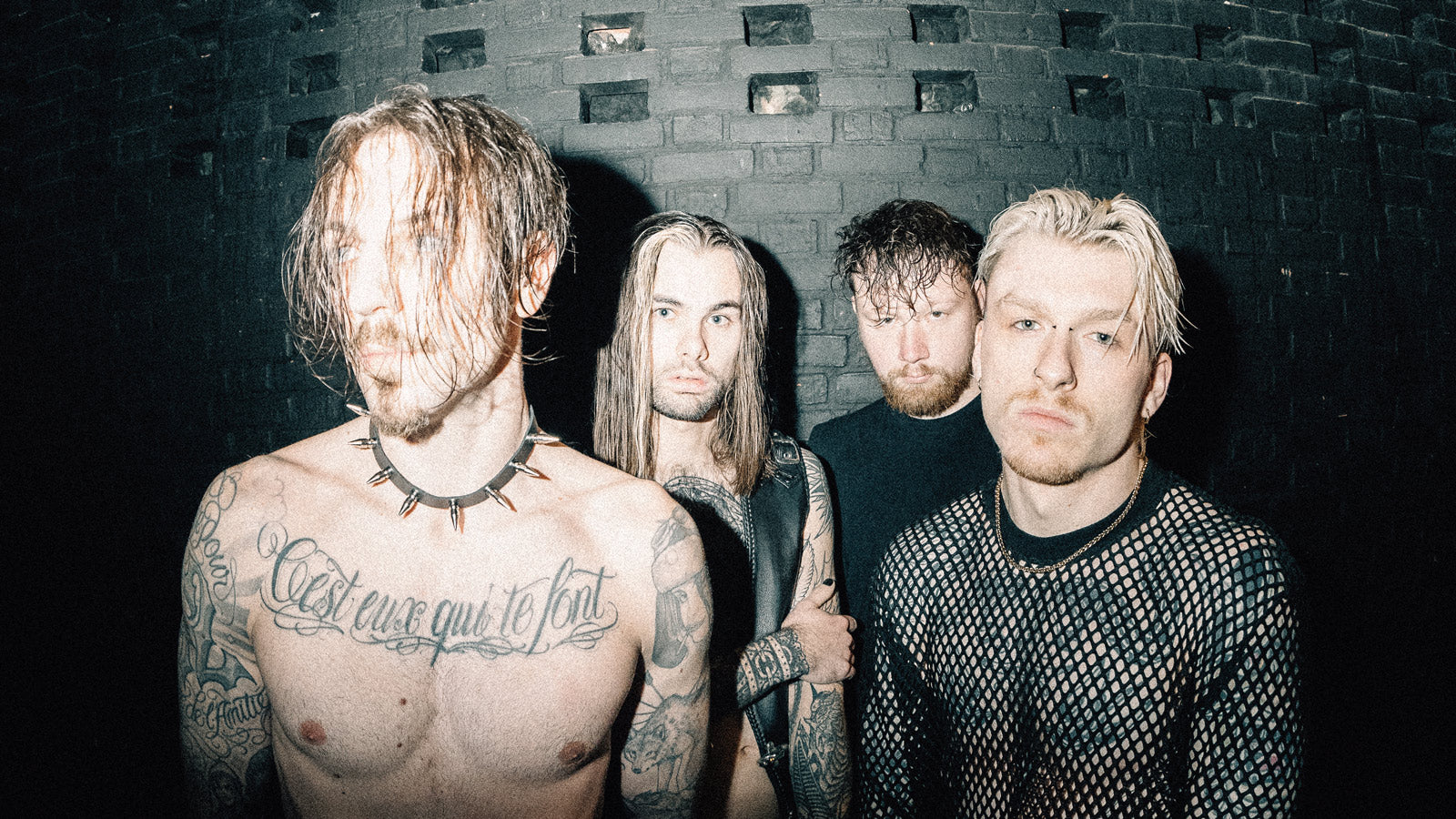
Marc “Zelli” Zellweger is a force of nature onstage — unleashing deathcore squeals and rapid-fire screams that hit like rap bars, whipping the crowd into a frenzy. But the Paleface Swiss vocalist is all smiles when he Zooms in from the green room of Munich’s Backstage Werk venue, radiating an easygoing calm.
It’s early February, and his Zurich-based nu-core outfit is in the midst of its first major European headlining tour, with the Acacia Strain supporting, and the magnitude of it all is still sinking in.
“It’s crazy, almost every single show is sold out,” he exclaims, shaking his head with a mix of gratitude and disbelief.
But Paleface Swiss aren’t just having a moment — they’re making one.
Since forming in 2017 — originally under the name Paleface — Zellweger and Co. have been on a relentless grind. Independent operators since day one, they self-released a pair of EPs before making waves with their 2020 full-length debut, Chapter 3: The Last Selection, and its follow-up, Fear & Dagger.
Their explosive sound — melding Zellweger’s ferocious vocals with crushing beatdown riffs — has earned them a passionate global following, millions of streams and profile-boosting tours. They’ve shared stages with the Ghost Inside, Bodysnatcher and others and made their mark on major festivals including Sick New World and Hellfest. Zellweger’s distinctive vocal style has also led to guest features with Left to Suffer, VCTMS, Nasty, Fox Lake and others.
In January, Paleface Swiss dropped Cursed, their third and most ambitious album yet, which pushes their sound in a more chaotic and experimental direction. After they wrap their current European tour, they’ll head stateside this spring with support from Stick to Your Guns. If all goes according to plan, 2025 will be the year Paleface Swiss cement themselves among modern deathcore’s elite.
Despite the raucousness of his band’s music, Zellweger’s roots trace back to a tranquil upbringing in Switzerland. Raised by a single mother, he moved frequently before landing in a small village outside of Zurich. The constant relocations made it difficult to maintain friendships, but otherwise, he describes his early years as idyllic — if a bit uneventful.
“My childhood and teenage years were really boring [and] basic,” he admits. “But I had an awesome childhood. Everything went really well for me. Growing up in Switzerland is something I realize I should be extremely thankful for.”
With virtually no local music scene to speak of, Zellweger discovered rock and metal in isolation. “The first rock band I listened to was Nickelback — and I still fucking love Nickelback so much,” he says with a laugh. “But Slipknot was the band that got me like, OK, I want to do this.”
Zellweger’s musical education — and eventual transformation from rabid listener to metal frontman — was entirely self-directed. “When I learned how to scream [and] what heavy music should sound like, I was alone,” he says. “When I started this, I wasn’t into any kind of scene. I was just in my living room, like, This sounds great.”
Zellweger eventually developed a vocal style that was all his own, defined by scorching highs, rumbling lows and a unique cadence surging with ferocity. When he finally decided to start a band, there was only one guitarist he wanted by his side — his best friend, Yannick Lehmann.
“Yannick was the only guitar player I really knew,” he admits.
The two had been close since their teenage years, though their friendship had an awkward start: Zellweger unknowingly began dating a girl who was already seeing Lehmann. Once the singer found out, he immediately reached out to make amends. Lehmann’s response? “Oh, never mind. Thanks for saying that,” Zellweger recalls. “Let’s go drink beer and be best friends forever.”

Despite their close friendship, Lehmann never intended to join Paleface Swiss. But Zellweger convinced him to help record their first EP. “I had no idea how to do anything,” he says. “So, I convinced him [to] record some music so I could find new guitar players.”
That plan never quite panned out. “I’m like, ‘Please play the first show with me because there will be guitar players in the crowd, for sure,” he continues. “And it kept going like this… I think we made the right choice.”
Once Zellweger, Lehmann and the rest of Paleface Swiss — now rounded out by bassist Tommy-Lee Abt and drummer Cassiano Toma — solidified their lineup, they set their sights on breaking out of their country. “Switzerland is so small,” says Zellweger. “There’s not many musicians or entertainers coming from [here]. Our biggest goal was to get out as soon as possible.”
Their other goal was “to create the heaviest, most raw, most emotional, aggressive band with no boundaries and no rules,” adds Zellweger. That vision became the band’s foundation.
Paleface Swiss broke onto the scene in 2018 with their Chapter 1: From the Gallows EP, a gruesome slab of deathcore that harkened back to the genre’s Myspace glory days. But as they evolved, so did their definition of raw and emotional. Their sophomore album, 2022’s Fear & Dagger, saw them addressing mental health struggles with newfound depth. With Cursed, they’ve turned the intensity up to 11 while also making space for something richer and more nuanced.
“It’s the most personal and the darkest record in terms of topics,” says Zellweger, referring to Cursed’s themes of depression, grief and the decay of youth, all of which were drawn from the band member’s collective experiences. “On the previous record, we wrote for our friends, for people that we love … and told their stories as well as ours. On this one, it’s basically just us telling our stories.”
Ironically, Zellweger made his grimmest record in one of the world’s most beautiful settings — the Canary Islands. “It was the first time where we went somewhere and left everything behind and just focused on writing,” he says. “We were like, ‘You know what? Let’s just take a few weeks off and go somewhere without anything in our head but writing music.’”
The result is their most dynamic record yet. Cursed opens with a twisted rendition of the Tenerife lullaby “un pobre niño murió” before pivoting into nu-metal catharsis on the battering “Hatred.” (“Everything is absolutely fucked,” Zellweger snarls on the latter.) The album closes with “River of Sorrows,” a ballad that showcases the vocalist in a wholly new light — spotlighting serenades rather than screams until its dramatic closing moments. And while the track is a clear departure from the band’s signature aggression, it also feels like an exciting evolution that Zellweger says “came so naturally.”
As Paleface Swiss have evolved, so has Zellweger. “I was an asshole when we started this band. Everything needed to go perfect,” he admits. “But this whole [process] is turning me into the best version of myself. I’m extremely happy — not just for the music, but also for what the music does to me.”
Looking ahead, the singer is clear about his objectives. “I want to do this for as long as possible — because I have so much fun doing this, not because I’m forced to do it … I love what I’m doing, and that means that I keep doing whatever the fuck I want.”
It’s hard to imagine Zellweger and Paleface Swiss doing anything less.