
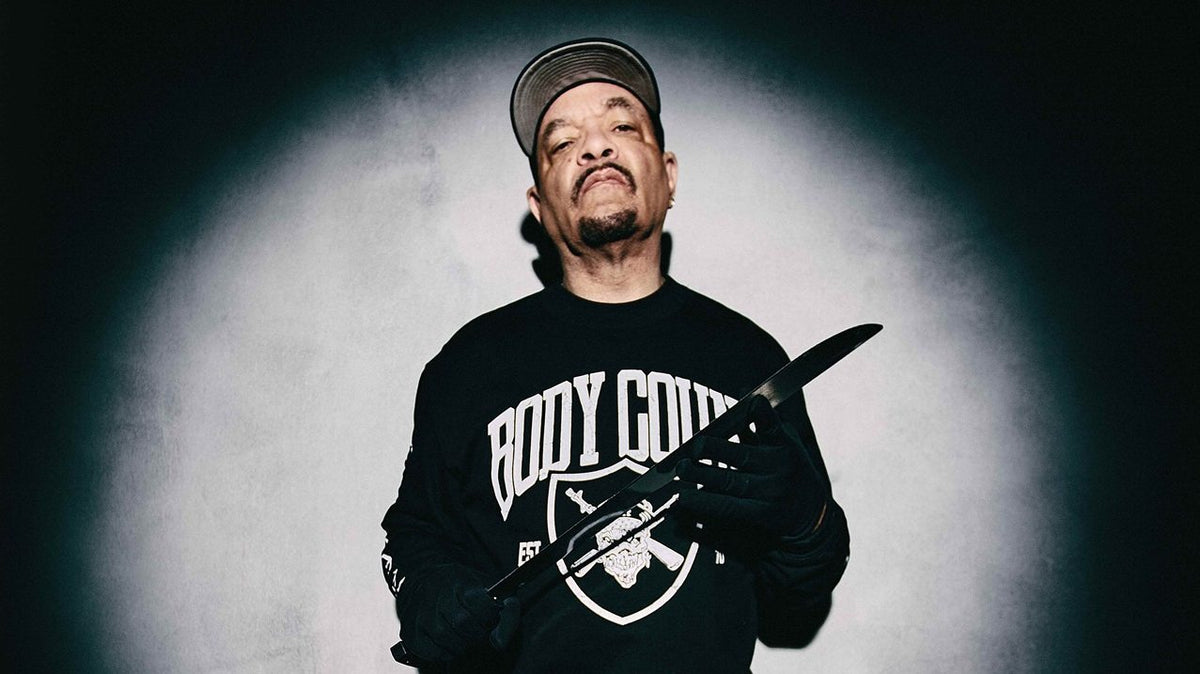
“I act for the money — and I do music to remain sane,” says Ice-T. “I think every human being needs to do something that’s 100 percent them, whether it’s cooking, whether it’s painting, whatever. And at the end of the day, I’m a songwriter, you know?”
Since 2000, the groundbreaking rapper has made a comfortable career for himself as Sergeant Odafin “Fin” Tutuola on NBC’s Law & Order: Special Victims Unit, the longest-running prime-time live-action series on American television. But while many musicians-turned-actors in the same position might be inclined to just coast on their good fortune, the man born Tracy Marrow continues to go hard behind the microphone.
Merciless, the eighth and latest album from his even longer-running metal band Body Count, more than lives up to its name. Produced by longtime collaborator Will Putney (Fit for an Autopsy, Better Lovers) and arriving via Century Media, the album finds Ice and his Body Count crew — guitarist Ernie C, sampler/backup vocalist Sean E Sean, bassist Vincent Price, drummer Ill Will, rhythm guitarist Juan of the Dead and Ice’s hype-man son Little Ice — blazing through uncompromising tracks like “The Purge,” “Drug Lords” and “Fuck What You Heard,” with a little help from friends and family.
Max Cavalera, Howard Jones (Light the Torch), Fit for an Autopsy’s Joe Badolato and Cannibal Corpse’s George “Corpsegrinder” Fisher all lend their voices to the record — as do Ice’s wife Coco Austin and their eight-year-old daughter Chanel, who shriek up a storm on the cartoonishly gory “Psychopath.” And then there’s Pink Floyd’s David Gilmour, who reprises his iconic guitar solos on a thoughtful reworking of Floyd’s 1980 hit single “Comfortably Numb.”
Through it all, Ice sounds as intense and engaged as ever — fronting Body Count is clearly as much fun for him these days as it was back in 1990, when he and Ernie C founded the band. “When I act, I’m really just trying to take that character that the writer or director imagined, and make it believable,” he explains. “But when I do music, I walk into an empty room and create it from ground up — it’s a whole ’nother thing.
“And then performing music is a whole ’nother energy that a lot of my actor friends envy,” he continues. “Because on a set or in the theater, you’re sticking to a script. With live music, you could just stop and say, ‘I feel like taking a shit onstage!’ — and have 50,000 people scream, ‘Take a shit!’” He laughs. “It’s truly spontaneous. There’s nothing like it.”

Jesse Korman
It’s been nearly 35 years since you started Body Count. Did you have any idea back then that the band would have this kind of longevity?
ICE-T Oh, absolutely not. I mean, Body Count was created as a side band just for fun — to let Ernie play guitar — and we never really realized we were going to make albums or anything like that. It was something I was doing on the side. We started off playing pizza joints in L.A. and little gigs like that. But when we played Lollapalooza [in 1991], that’s when we really knew it had legs. We were like, “Oh shit — a lot of people are digging it!” [Laughs] And, you know, it just keeps on, man. It’s a very interesting band. I mean, we’ve gone through a lot of incarnations — we’ve lost members, and it just keeps on.
Has the process of writing and making music changed a lot since body count’s self-titled debut in 1992?
Well, absolutely, it’s changed. You know, after we lost D-Roc [the band’s original rhythm guitarist, who died in 2004] and Moose [the band’s original bassist, who died in 2001] and all them, we were having a lot of trouble trying to figure it out. We didn’t even know if we were going to make another record. Our drummer Beatmaster V [who died in 1996] was the leader — he was the one that made everyone get to rehearsal. So, someone had to take that part of the band. I can’t play instruments, so the band has to connect. When they do rehearsals, it’s just the band rehearsing music — and you have to have somebody who will drive that. So, Vincent Price took that role [when he joined in 2001]. He’s the guy that holds the band together.
So that was the first part that was missing. Then Vince brought in Juan. Juan is a journeyman metal guitarist from Evildead, and Juan had the connection to Sumerian Records. And [in 2012], Sumerian said, “We’ll give you guys a budget to make an album.” They also introduced us to Will Putney. Will Putney is the linchpin. Will Putney is like a super-producer who can produce pretty much any kind of rock you want. He came over to my house in New Jersey and said, “I totally understand Body Count. I know what you guys are doing. It’s hardcore, but it’s got humor. It’s outrageousness.” I’m like, “Oh yeah, you got this shit!” We’re not a metal band that’s trying to scare you, like we’re gonna burn down churches and shit like that. If we are gonna burn down a church, it’s gonna be funny. [Laughs]
So Will came in, and that’s when we got the second wind. We went from Manslaughter [2014] to Bloodlust [2017] to Carnivore [2020], and now here we are at Merciless. You gotta really have a good, cohesive crew to keep making good records. You can’t just jump from place to place to place to place. Doesn’t work like that.
What’s working with Will Putney like?
Well, Will Putney, I call him the Dr. Dre of metal, because he has the ability to produce different bands but make them all sound the way they should sound. He makes them sound the best at what they do. We don’t sound like Fit for an Autopsy. We don’t sound like Better Lovers, Will’s new band. But if we want it dark, he knows how to get that sound. Because at the end of the day, this is a sonic medium, right? You could write the best songs in the world, but if that producer can’t make it come through those headphones the way you want it, it’s gonna suck.
Will knows how to make the record sound intense and loud, and then he under-stands me. When we did “Psychopath,” I’m like, “I need some screams. I’m gonna have Coco and Chanel scream in the bathroom.” He’s like, “Yeah!” And then I come back and hear it, and he’s like, “I put this buzz saw on here.” You have to have some-body that really understands what the band is — you know, if I’m gonna go produce GWAR, I have to truly understand GWAR — and he understands. And as far as his ear, it’s unmatched, you know? The records just keep sounding better and better.
You mentioned how the band gets together first to work on music. Do the guys cook up the tracks and then send them over to you?
Absolutely. That’s how we work. The band starts making riffs — they’re in L.A., so they go into rehearsal and start coming up with ideas. Then they send me ideas — not songs, ideas — and I listen to them, and I’ll go, “That sucks. That sounds like somebody else’s shit.” Or I’ll go, “Yo, the breakdown right there, make a record out of that.” And then when we start to get the song together, I sit with the track. I put on the headphones and I just vibe. This might sound real “artistic,” but the track starts to tell me what it’s about. [Laughs] When I heard “Psychopath,” I’m like, “This sounds like the inside of an insane person’s mind!” And that’s the way it was written.
How did the “Comfortably Numb” cover come about?
I always dug the bassline to “Comfortably Numb.” The bassline reminded me of [composer] Giorgio Moroder, the last scene in Scarface — that very thematic stuff. Now, there’s a part in the real “Comfortably Numb” where it goes [sings the pre-chorus melody] — I took that out. I just like the bassline.
I thought about it, like, You know what? We are comfortably numb right now. There’s two fucking wars going on, probably many more, and we just turn the channel and watch sports. We’re not connected to what’s really going on in the world. Like I say in the song, “You got a TV, a computer, so you don’t care… You lock yourself in a house, try to forget about the millions dyin’ from war, starvation and drought.” It’s like we’re numb to violence. We’re numb to every fucking thing that’s going on. So I just tried to write some real shit, you know? I wrote about my life. I wrote about me getting old. I wrote about how I feel about us as humans — like, if there’s a God looking at us, we’re a piece of shit to him right now, because we’re fighting over race, we’re fighting over religion…
So I write it, we make the record and we send it to Pink Floyd. And one of their publishers said, “No. They don’t do covers. They don’t do samples.” You know, like, this is fucking Pink Floyd motherfucker, they don’t do this! So, it was shot down. Everybody’s like, “Well, just change it.” I said, “Nah, the record dies with this. It’s an idea. It’s a concept. I’m not going to do another bassline. I’m not going to change the hook. It’s dead.”
Then my manager, Jorge, he reached out to David Gilmour’s manager, because somehow he knew somebody who knew somebody. And when David Gilmour heard the song, he goes, “Fuck yeah! I want to play on this record!” And then when Roger Waters heard it, all he was concerned with was who was singing, which is me, and both of the guys signed off on it. I know Roger’s got his own point of view about things, but I was able to be so right down the middle with this song — it’s just talking about us as humans, and you can’t deny what I’m saying on the record — that I could get two people with different views to say, “Yeah, this is a good song.”
So, David wants to play on the record, and says, “Just send me the track.” He goes in the studio, and he lays this shit down. Then we’re like, “OK, dope. We got this shit done!” But then we’re like, “What are we gonna do for a video?” David’s like, “I’ll be in the video.” So, we sent a camera crew over [to England] and filmed him playing. We’re gonna make it look like a recording session: I’m gonna get my guys in the studio playing, with me behind the mic, and put it together with David fucking Gilmour playing on the Body Count record — which is the dopest shit in the world.
And the thing of it is, I performed the record on tour. I closed the show with it, and it works. I set it up by saying, “You know, every year we pay homage to a group that we’re inspired by. We’ve done Suicidal [Tendencies], we’ve done Slayer, we did Motörhead.” I said, “How will I fuck you guys up this year? How about some…” and I pause, “Pink Floyd?” And the crowd goes, “What?!?” [Laughs] And it’s like, boom, we hit ’em with that first note. Ernie’s playing [the solo] when we play live — and it kills!
I know you go way back with the rock stuff. Were you listening to Pink Floyd’s The Wall when it came out in 1979?
Yeah, I was definitely in tune with all that, and that’s how come I know about this song. Another thing with Body Count is, I never wanted to pigeonhole us to one sound. So, we kind of do punk. We’ll do some speed metal, some thrash. We’ll do some Black Sabbath-ish things. But it fits — it fits with us. And what I talk about [in “Comfortably Numb”] is 100 percent Body Count, without bastardizing their song. I didn’t turn it into, like, “Comfortable Buns” or some shit. [Laughs] I wouldn’t have gotten approved for that!

Alessandro Solca
Along with Fit for an Autopsy’s Joe Badolato, who I’m sure was a connection from Will, you’ve also got Max Cavalera, Howard Jones and Corpsegrinder on the new record. How did those guys get involved?
Everybody that’s on a Body Count record has become a friend of Body Count. We only fuck with people we like. Pink Floyd was really our farthest reach. Most every-one else, Howard and all them, they’re in our circle. We’ll get to a point in the song where we’re like, “Yo, you know who would sound dope right here?” When you can find the right person for the right song and they fit — like, “Corpsegrinder has the right voice for this song!” — that’s what music is about. And like you say, Joe is in the studio a lot with us, because we record out of the same place.
Let’s talk about your TV career for a second. You’ve been on Law & Order: Special Victims Unit for what, almost 25 years now?
Yeah, I’m the longest-running actor in a continuous TV role. [Law & Order’s] Mariska [Hargitay] has me beat as an actress. But yeah — and I [first] went on that show to do four episodes! [Laughs]
You’ve got your show, your music, your family and other pursuits. How do you juggle it all?
Whatever’s making the most money is the most important. That’s how it starts. So SVU is the breadwinner right now — it’s been for 25 years, and I’m working five days a week on that. Then on the weekends, I have time to go into the recording studio. Right now, I’m on musical hiatus. I’m not writing anything, because we got this new record coming out. So, I can kind of chill, right? But Will’s studio is not far from me. I can go there, and everybody respects my hustle, like, “Well, Ice’s time is limited. Let’s do this, and let’s do that.”
Chuck D said, “Ice, at this point, if you’re not having fun, you shouldn’t do it.” You know, I’m really having fun — so I want to do it. And it’s amazing what time you can make for shit you want to do. But I’m not doing as much as people think. I do Law & Order, that’s my thing, and now it’s really just down to Law & Order and Body Count. Those are my two main grinds. I haven’t been motivated to do a rap album, even though me and [Naughty by Nature’s] Treach did a record together called Black Cadillac, which is going to be animated — it’s some wild, psychedelic pimp shit.
It’s been a while since you’ve dropped a full-length hip-hop record. Is it just easier, or maybe more satisfying, to make Body Count albums at this point?
Well, there’s more energy behind doing a Body Count record, because you’ve got members that want you to do a record: “Come on, Ice, we got to do another record!” With Ice-T, if I don’t want to do it, there’s no one to put pressure on me to do it. I think that if I do another Ice-T record, it’ll be because I’ll hook up with a producer. It would be probably like me and one person just making tracks. But — and this sounds corny again — this shit requires inspiration. You have to get inspired, you know? I mean, I might have to hear somebody’s record to be like, “Fuck that — I’m going in the studio!”
See, it’s different making records when that’s all you got — like, if you don’t make this record, you don’t eat and you’re gonna lose your house. That’s a whole ’nother thing. And you’re not necessarily going to make the best record under that pressure. You’re going to start making what the record label wants you to make. So, what Law & Order has done for me is: I’m really able to make records like I want to. If the label don’t like it, I don’t really give a fuck — my lights ain’t getting cut off. So not having to work under that pressure is good.
I know if I did another hip-hop album, it would be sick, though. I know that. You know, I’m 66 years old. I can out-rap these little niggas — like, they can’t fuck with me. And also, with hip-hop, it’s never aged out — no one’s ever seen how long you could really rap. I just came off tour with LL COOL J. He’s out there, Chuck is still out there. We’re like the oldest rappers, so, when does it stop? I honestly don’t think artists ever stop — if you’re a real artist. Miles Davis was dope till he died. James Brown was dope till he died. Fucking Mick Jagger’s 81! I don’t think you lose it, unless you stop — and stop giving a fuck about it. So, you know, I might wait until I’m 70 and write a rap album to shit on all these little motherfuckers. [Laughs]