
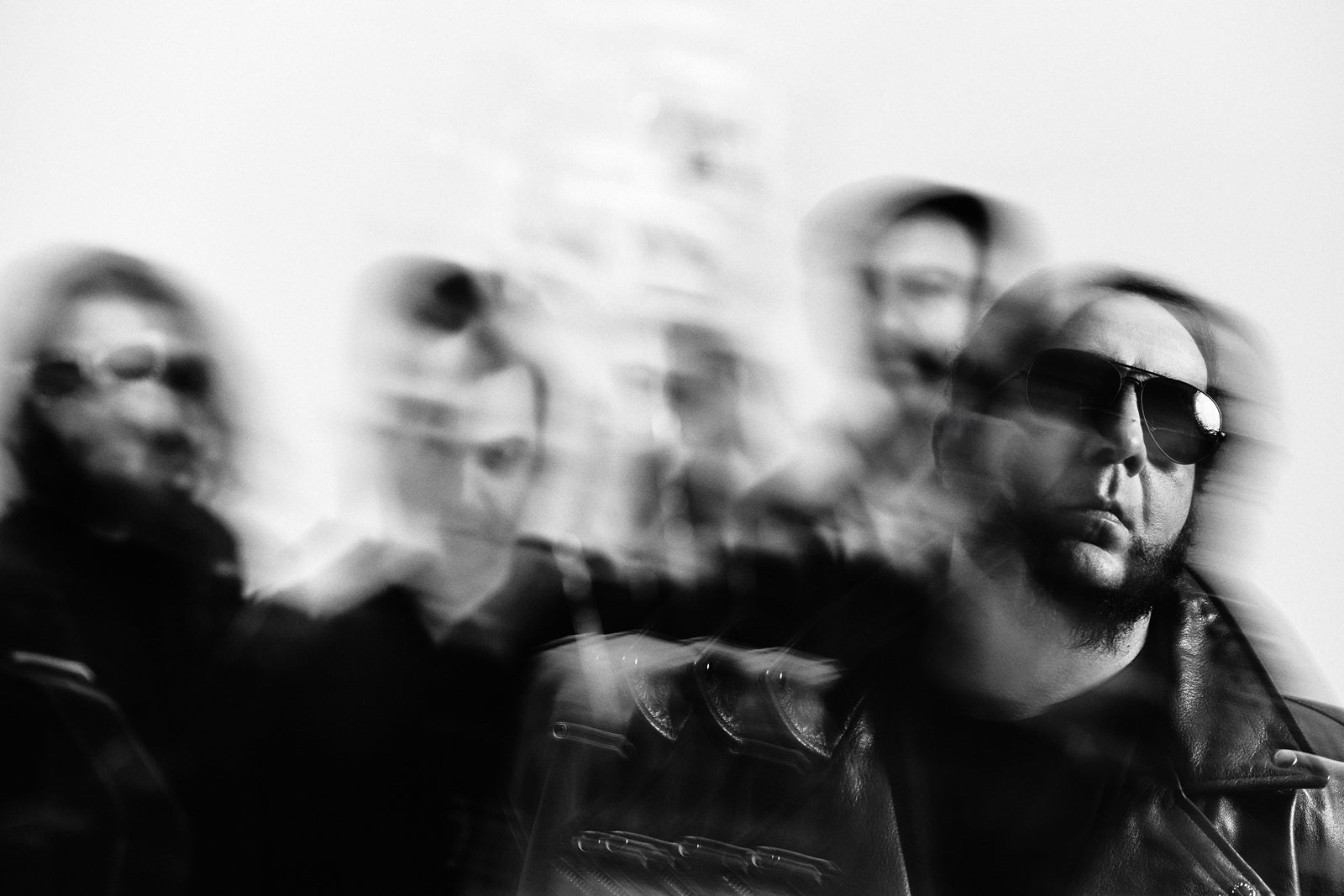
There’s violence within Daron Malakian — inside all of us, really. That reality both troubles and fascinates the iconic System Of A Down songwriter, vocalist and guitarist, because not everyone knows how to harness their rage for the good of humanity. And the way he sees it, it’s only getting worse out there.
Malakian brings this to attention all throughout Addicted to the Violence, his third and latest album with Scars on Broadway — the musician’s other long-running heavy project. Indeed, the outfit’s first full-length release since 2018 is a narrative minefield of seething political divide (“Your Lives Burn”) and ruthless abuses of power (“Satan Hussein”).
With “Killing Spree,” the album’s thrashed-and-thunderous opener, he channels the chaos of a generation raised in a desensitized world — where self-destruction and violence play out in countless forms — unleashing it all with a madcap tiger’s roar.
Malakian recalls getting into his share of fistfights while he was growing up in 1980s Hollywood. But as a KISS-loving guitarist with a flair for the dramatic, he eventually realized he wanted to channel his anger more constructively onstage.
“They took me to the school psychiatrist when I was in high school, because me and my friends, all we did was ditch or fight,” Malakian explains from his living room, where he’s flanked by musical instruments, decorative skulls, a vintage boombox and a portrait of original rock & roll rebel, Little Richard.
“They were like, ‘What do you do? You’re failing all your classes and doing all this shit,’ and I was like, ‘I play music!’ They looked at me like, ‘None of your friends are musicians. You don’t take any music classes,’ and I was like, ‘I learned by myself — I’m going to start a band one day, and I’m going to play on the Sunset Strip.’”
That self-determination paid off, clearly. Malakian is reflecting on this just days after System Of A Down celebrated the 30th anniversary of their first-ever show — which notably did take place on the Strip at Los Angeles’ famed Roxy Theatre. While the metal legends haven’t released an album since 2005, System are still commanding massive crowds around the world — including the literal fire-wielding fans that flocked to a stretch of the band’s South American shows this past spring.
As for Scars, Malakian is ringing in his 50th birthday this summer by releasing a wildly eclectic set reflecting his love of metal, ’70s prog synths, Armenian wedding music, outlaw country and devilishly Omen theme-channeling musical mayhem.
“It all starts from a very innocent place, which is playing with my toys,” he says of his songcraft, adding that he and current collaborators Orbel Babayan (guitar, keyboards), Niko Chantziantoniou (bass) and Roman Lomtadze (drums) are excited to share those dangerous toys with a rabid fanbase.
Speaking with Revolver, the Scars on Broadway leader further guides us through out-of-control concert experiences, Instagram death reels and the nature of his Violence.

Travis Shinn
What’s got you thinking about violence so much these days?
DARON MALAKIAN It’s not just these days. I wrote “Killing Spree” a very long time ago. I write songs, and I hang onto them. There is no rhyme or reason as to why or when they come out. They may share a theme, [though] I don’t write them to share a theme.
But what made me write about [violence]? I mean… I don’t think every song on the record is about violence, but violence exists. I think the world we live in now is much more violent than it was in the world that I didn’t live in, in the Forties and Fifties — if you compare the youth of that time to the youth of now. You had violent things happening back then — you had World War II — but the music was mostly about love and relationships. As time went on, movies, music, society… everything kinda got more desensitized and violent.
I see videos on Instagram where there’s a car, and it’s doing donuts, and there’s kids standing around. Next thing you know, one of those kids gets wiped out by the back end of the car … and there’s everyone recording it. Some people are laughing.
Shit happens where you might see someone getting beat up on the street, and people just don’t help. Again, they’ll record it. It’s become entertainment to see this kind of shit. And then you wonder why a kid walks into a school and blows away his classmates and the teachers. People go, “Well, why did he end up like that?”
I’m not the guy that blames it on the guns. I don’t think the guns are the problem in that situation. The AK-47 was built in 1947, but you didn’t have kids doing that in 1947. So, what changed?
You might be suggesting, in some form, that it’s the technology. Smartphones are a passive, but participatory, form of redistributing the violence…
I don’t know what it is. Kids might be heavily medicated at a very young age. A kid acts up in a classroom, and they [say], “He has attention deficit disorder.” They probably would have put me on those pills if I was a kid, because I was a class clown. I was always interrupting.
But it’s not just one thing. It’s not just technology. We didn’t get here overnight. Things evolved to this point where we have a society that produces this kind of [violent] human being.
Did the process of making this album have you reflecting on your own relationship with violence?
Well, I’m lucky that I have an outlet. If I didn’t have music, I don’t know what I would do with my violence, or my anger, or even my happiness. There’s just so many different emotions a human being feels.
I’ve seen violence, personally. When I was in high school, my friends were not artists. We were all dudes that would get into fights. But… we fought with fists. The generation after me started bringing knives, and then the generation after that started fighting with guns. The violence is evolving.
I’m not gonna lie, all those things I just talked about seeing on Instagram, I watch it — because as a human being it’s hard to turn away from it.
How has being a musician helped you channel your aggression? We spoke with Shavo [Odadjian] last year, and he told us about an old System show where you tackled him onstage. He tumbled over and cracked his skull open — he had to go to the hospital afterwards…
That was playful, it wasn’t like I was trying to crack his skull open. There are different sides of me that come out onstage — and in the songs that I write. There’s a side of me that’s a funny guy. There’s a side of me that’s an asshole. There’s a side of me that’s really nice. There’s a side of me that is serious. There’s a side of me that’s angry. We’re not all just one emotion.
And an angry moment in a song can turn very funny. In “Killing Spree,” for example, the riffs are really fucking heavy and drive-y, but if you listen to how I’m singing the song… It’s a topic that some people are afraid to even touch, but I’m clowning around with it as well. In my head it’s all in the same. That’s just how it spits out of me.

Kevin Winter / Getty Images
Addicted to the Violence’s “Satan Hussein” is also navigating those extremes — the seriousness of the topic colliding against the irreverence of the music. What can you tell us about writing that one?
I could say it’s about power. A drug has power over you. A government has power over you. Someone you love can have power over you. Someone you hate can have power over you.
And “Satan Hussein” was kind of inspired by Saddam Hussein. It’s not about him, but that’s what triggered my direction into the song and the lyrics — you know, “I’m your neighborhood watch with a machine gun in my crotch.”
I went to Iraq when I was 14 years old, in 1989. That was peak Saddam times. I was a kid that grew up in Hollywood. I went to Iraq to visit my family for two months, and I experienced this whole different world [ruled by] this guy that everybody was afraid of. But his picture was fucking everywhere. He had power.
That picture of Little Richard I have over there — if this was in Iraq at that time, that picture better have been [of Saddam Hussein]. Every house you went to had his picture in it.
One of the strongest sounds on this record is Orbel’s keyboard playing — “The Shame Game” has that super spacey, proggy feel. While “Done Me Wrong” almost has a Deep Purple kind of drive to it.
I think that color brings the album together in a weird way. It’s not on every song, but it appears every so often. You touched on Deep Purple, but Armenian pop music has keyboard players that play like that. The guy would usually be playing weddings with a cigarette in his mouth. We call that rabiz music. “Done Me Wrong” has that flavor. It’s a heavy rock song, but we’re mixing that rabiz keyboard style in there. I was really excited about that.
Are you ready to take Scars’ Armenian wedding music to the people?
I’d like to play festivals. I don’t have any long tours planned, but I don’t count that out.

System Of Down live in Brazil, 2025.
Can you tell us about your recent South American shows with System? You posted some footage from a Brazilian concert — there’s a massive crowd, and there are circle pits of fire. You described it as looking like a war zone out there.
Well, I’d never seen anything like it. Fans have never reacted [to System] that way, or been allowed to react that way, in the United States. You can’t even bring in a bottle of fucking water into the venue [in the U.S.]. But these dudes were bringing torches and spitting fire out of their mouths.
It started in Peru. They would light these flares, and then they were in the pits. Peru was a pretty intense scene — something about the pyromaniacs in Peru — but then I noticed that happening at every show. By the time we got to the last show, which was in São Paulo, I said something like, “If you notice, we don’t have any pyro onstage, but our fans bring the fire.” And they fucking brought it, man.
It’s funny — there were these firefighters shooting water, trying to turn off the flares. I’m there onstage telling [the crowd], “Burn the fucking place down!” [The firefighters were] looking at me like they wanted to fucking kill me.
There’s a different culture there. I don’t know if it would go off in the United States the same way — the Dodgers win the World Series and people go outside and start burning cars and flipping things over. It turns into something a little more violent.
You’re more comfortable with South America’s kind of chaos…
Not me, personally. I’m just saying why that is allowed there and over here you can’t even bring in a lighter to the venue, you know? [But South America] was more of a celebration. Like, you can use a gun to kill someone, or you can shoot a gun up in the air and say, “Happy New Year!” They were really just celebrating our band and our songs. They were having a great time. It blew us all away, to be honest with you, and we’ve been doing this for a long time.
Shavo recently hit Instagram with a poster for System Of A Down’s first show. How do the excitement levels compare between playing those recent South American shows and playing the Roxy in the spring of 1995?
Trust me, I was very excited to play that first show at the Roxy. I was with a band that I believed in. I had played in other garage bands, but System Of A Down was the first band that I was a part of that I had a big hand in forming.
I’ll be honest with you, the excitement level of that show was equal to playing in front of 75,000 people in São Paulo. Maybe more. But [with what] the band has reached — like, shit, you thought you made it because you played the Roxy? Well, you’re here now in this country full of people, there’s 300 people standing outside your hotel room, and when you come out they treat you like you’re the fucking Pope. It’s fucking crazy, man. I really appreciate it.
I don’t walk around town when I’m at home. I don’t have friends that are rock stars — all my friends are plumbers and electricians. They’re all my high school friends. My life is normal. I go to my parents’ house on Sundays. I watch football with my uncle. So, until someone walks up to me like, “Oh, dude — you’re Daron from System Of A Down,” I don’t [think about it]. It fucks up my head, in a way.
On the idea of friends and family, did you show any of these Scars songs to the other System guys as the album was still developing?
No, the other guys in System haven’t even heard the album. [Only a] handful of people, like if someone would come by my living room and I’d be like, “Hey, you want to listen to the new Scars record?”
Addicted to the Violence comes out on your 50th birthday, right? What do you make of that milemarker?
I guess I’m giving my fans a present for my birthday. It’s a present to me, as well, to share it and finally get this album out. You know, there’s nothing more important to me than music. I’m very blessed to be able to be a songwriter and have a career being songwriter. There’s no better way I could think to celebrate my 50th birthday than to share these songs with the people who care to listen to them.
Not to belabor the metaphor here, but could the “Violence” be the music itself — the art that you produce, and how it expunges itself from you?
No, I don’t think the music is violent, necessarily. With the song “Addicted to the Violence”… I’ve had struggles. I don’t like getting too deep into it, but it’s about that. It’s my demons, in some ways… But then when I sing about myself in some way, shape or form, I also bring the world in with me. I put it all together. Both perspectives make sense. If you told me it’s about society, I’d say yes. If you told me it’s about me, I’d say yes. I’m a man, living in the world. And the world affects me.

Travis Shinn
How are you feeling about finally bringing these Scars songs to the world?
It’s exciting. I know that Scars is not the juggernaut that System Of A Down is. But through the years, the people who are into what I do have been like, “When is this third Scars record gonna come out?” I hear it all the fucking time because I feel like they’ve [accepted it] like, “All right, System’s not making any records, [so] when are you going to do Scars?” It’s ready to be shown and put out there. And it seems like whoever is into Scars has really been hungry for this.
I’m very aware that I’m blessed to have so many people that actually give a shit. I’m still blown away by that every day of my life, man. I’ve never gotten over the fact that someone out there is going to turn on that album and enjoy it. [Or that it’s gotten] to the point where they’re tattooing my face onto their bodies, and shit. That means a lot to me. I don’t take it for granted.
There are people that really hate what I do, but then there’s those people who really love what I do. I like that both exist.
Since you pointed him out earlier: When did Little Richard come into your life?
Later in life. You know who gave me that picture, though? Vinnie Paul from Pantera! He came to one of System’s shows in Dallas. I don’t know why, but he brought that picture to the show — [still] no clue, to this day. But I kept it, and I leave it there [on my piano].
Little Richard was one of the architects of rock & roll. I have respect for those people — like Little Richard and Jerry Lee Lewis. But I listen to so many different kinds of music, man — Miles Davis is a hero to me.
That’s what’s crazy to me: I’m in awe of these people, still a total fucking fanboy, and then I have these [fans] that look at me this way… I gotta pinch myself a hundred fucking times.