
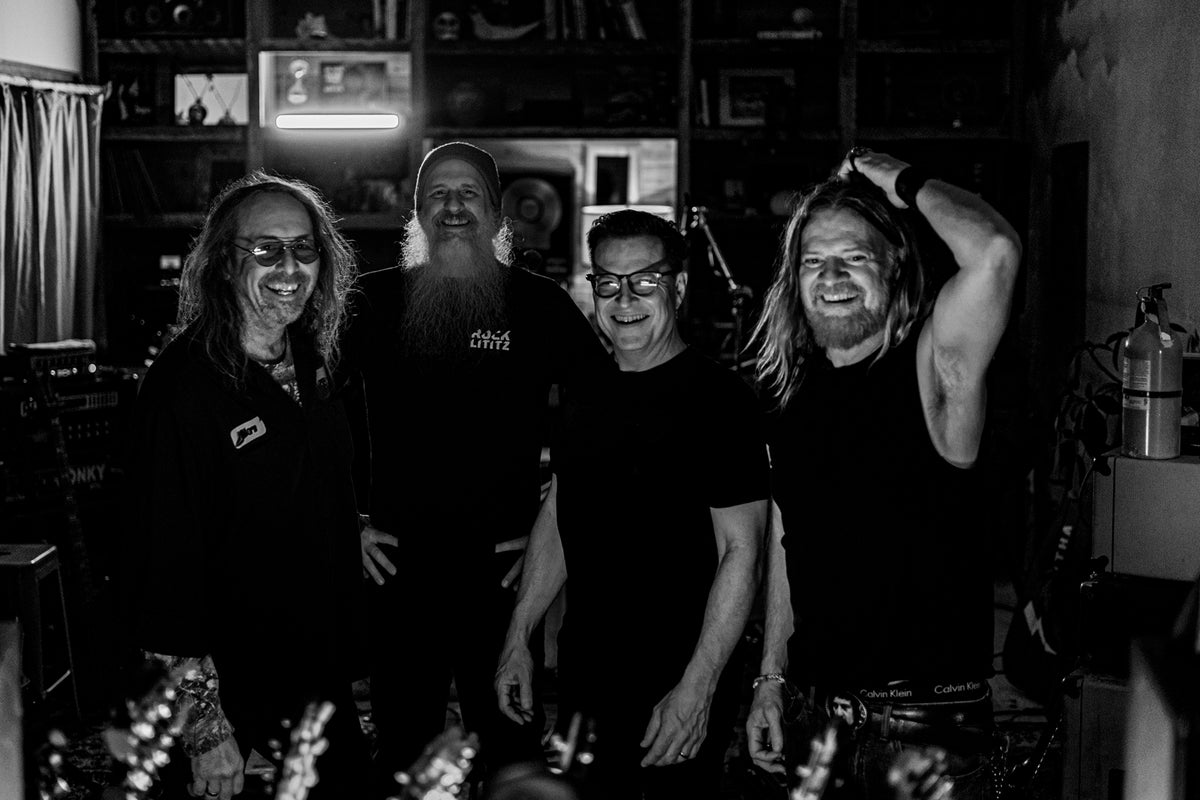
It takes a legend to spot a legend.
A few days ahead of Revolver’s conversation with Corrosion of Conformity vocalist-guitarist Pepper Keenan — to discuss their forthcoming Good God / Baad Man double LP, their first since the 2020 passing of founding drummer Reed Mullin — he and the rest of the band hit their Instagram feed to announce the arrival of their latest savage skinsman, Nick Shabatura.
The newly instated, Chicago-based drummer seems like a perfect fit with Keenan’s brand of awesomely boggy riffage, considering Shabatura also plays in NOLA, a Windy City tribute to Keenan’s other longtime project, sludge supergroup Down. That’s not how they tracked him down, though. After “secretly searching for drummers” the past few years, Keenan and Co. were ultimately put onto their current percussionist by another titan of industry, and one of metal’s greatest timekeepers: Anthrax’s Charlie Benante.
“You gotta trust Charlie’s opinion,” Keenan says, explaining that Benante discovered Shabatura while rolling through Chicago with the Pantera celebration. “[Charlie]’s been there since day one; he knew Reed from the old days. So, it was just a cool thing.
“It was something he didn’t have to do, but he thought of COC when he saw this dude playing drums. And sure as shit, [Nick] came down and nailed the shit out of [the rehearsal]. We would have never found him in a million years — he wasn’t even on the radar. And that’s kind of the way we liked it.”
As Keenan talks up Good God / Baad Man, he acknowledges the rich history of the Raleigh, North Carolina-formed Corrosion of Conformity — from their early hardcore sound to the swampy, Southern Rock-infused edge he helped usher in after joining COC in the late Eighties, and into the present day. Up until Mullin’s death in 2020, his beats had anchored the band into all kinds of heaviness for the majority of their 40-year career. Mullin is missed, to say the least.
“It’s no secret that ever since Reed passed away, we’ve been fumbling around, because that’s a hard dude to replace. We were very aware of that,” Keenan says of the band trying to find their rhythm in Mullin’s absence — though he’s keen to shout out live drummer Jon Green for helping them out on the road the past few years. He also credits Stanton Moore, a COC vet who returned to the fold more than 20 years after cutting 2005’s In the Arms of God to lay the hammer down for Good God / Baad Man.
On top of this, founding bassist Mike Dean also departed COC in 2024, citing a desire to retire from the road — onetime Down guitarist Bobby Landgraf is now handling the low-end. Despite the multiple shake-ups, Keenan and longtime guitarist Woody Weatherman knew they had to keep Corrosion going — or, to put it another way, they just couldn’t quit being one of America’s premier volume dealers
“The COC train didn’t stop,” Keenan continues. “Me and Woody were like, ‘We got way too much to say on all this shit,’ you know?”
The guitarist is discussing this in the lead-up to COC’s next North American tour, and spent his morning tweaking up his guitar collection for the road. During his Zoom call, he flashes a chrome-plated Tony Iommi signature pickup gifted to him by bluesman and “closet metalhead” Alvin Youngblood Hart, a symbolically-loaded noisemaker that may or may not get into one of Keenan’s SGs by tour launch. He strums a nearby guitar, unaware that it’s still plugged into an amp, and a glorious chord burst rattles the Zoom room. In that way, some things’ll never change with Keenan.
Good God / Baad Man reflects COC’s sonic heritage, and arrives as an aural diptych of complementary flavors. Good God is the heavier of the pair, either working the band through totemic stoner gloom (“The Handler”) or punch-you-in-the-face punk (“Gimme Some Moore”). Baad Man is a more free-flying affair, with riffage reflecting a love for ZZ Top and Southern Rock. All of it was written at their Riffissippi home studio, where Weatherman and Keenan were spinning some of their favorite records between heavy riff sessions.
“We started drinking beer and playing guitar like we were 16, 17 years old, not giving a shit and having a really good time… It was the funnest record we’ve ever done, without a doubt. There was no pressure, we just did what we wanted to do,” Keenan confirms, adding that no matter the direction, the pair were feverishly capturing song ideas “like gorillas pounding on a 4-track.”
“It sounded killer,” he adds. “It had the thing to it that we were looking for — kind of on the verge of collapse at some points.”
Working through that controlled chaos, COC are now firmly back on the tracks and ready to ride through the next phase of an iconic career. Speaking with Revolver, Keenan further discusses COC’s new lineup, chain-swingin’ battle cries and more.

What do you remember about your first practice with Nick?
Pepper Keenan We played in Chicago when we were on tour with Judas Priest and Alice Cooper, and he came to the show, and we got along great. That’s almost more than half the battle. You can be the best drummer in the world, but if you don’t like Black Flag and ZZ Top, you’re not gonna be in COC. It’s not gonna happen. So, anyway, we got along great, we drank beer, we fucking hung out, listened to tunes, and watched Priest. That was a good thing.
Then he came down and he rehearsed. Man, he did his homework. He came in [knowing] 27 songs and didn’t even bat an eye. He knew them better than I did. So, we rehearsed, and we just kept going and going. It was super cool, because the drummer who played on the record, Stanton Moore — a super badass drummer from New Orleans — came down to lend support to this dude. I’d sent him videos of Nick playing, and Stanton goes, “That’s your guy.” And this is Stanton, who’s cutting his own foot off to give the gig to somebody else, you know what I mean? That’s not something most people would do. [But] he was admitting, “This guy is your future thing.”
But yeah, the guy’s a pro. He did his homework. He didn’t fuck up once on that shit. So, it was great, and we’re stoked to have him. He’s a beast. He plays hard. He’s got stylings that reminded me of Reed.
Good God / Baad Man is the first Corrosion album in a while. It’s likewise the first since Reed’s passing, and also Mike’s exit from the band. You’ve obviously faced some huge life changes — How were you feeling about the state of COC, as a band, before you started making this record?
The last record [No Cross No Crown] came out in 2018, and then COVID was shortly after that… That was two years wasted playing a lot of guitar and sitting in the garage. But then we did all kinds of shit after that: We toured with Ministry; we toured with Lamb of God. We were all over the damn place… And then Reed got ill…
And then, after that, we kept going. We had Jon Green playing drums, and these tours kept coming. I think the last show we did was in Chicago, and then when we got back from that, that’s when we spoke with Mike Dean.
We were working on new shit [and] started demoing stuff. Mike Dean had decided that he was done with going on the road, and wanted to focus on his studio work and producing bands. Which, of course, me and Woody supported 100%. I get it. If you’re done, you’re done. And Mike Dean ain’t gonna fake it, I know that.
So, we brought Stanton in, and then we brought Bobby in… we just started trying to find the coolest people we could.
You’d explained a while back that part of the process towards putting this album together revolved around listening to some of your favorite records together, which led you towards your “Riffissippi sessions” videos and a cover of Free’s “Fire and Water.” Pardon the pun, but how did listening to those albums free you up, creatively?
So, we had this giant room in a black shack. And we brought all the gear in. There was no control room, it was just a giant living room. And in this giant room was a fucking turntable with shitloads of records — We had amps, records, [and] a refrigerator 10 feet away. We were just doing whatever the fuck we wanted to do. Guitars everywhere… it was kind of a perfect situation. If you were an 18-year-old guitar freak, you’d have been in heaven.
We listened to a lot of records in between shit. We’d take breaks, drink half a dozen beer, and chill out. No pressure. It didn’t cost us anything. We weren’t paying by the hour. We were hanging out for weeks at a time, just jamming. And I think that it shows on the record.
But yeah, we were listening to all kinds of stuff, like Free. The funny thing was, Stanton had never heard it before! He didn’t know who that was, and that blew me and Woody’s fucking mind. But I’m sure I don’t know a lot of Dave Brubeck shit that he loves.
So, there was a degree of childlike [wonder] on this stuff, because Stanton was just so pure about it. Then he’s like, “Hey, let’s cut that!” I was like, “What do you mean? You don’t just go cutting Free songs, motherfucker? It ain’t that easy!” But he convinced me to do it. I said, “Dude, I can’t sing like Paul Rodgers.” He’s like, “Just sing it like it’s you!”
Next thing I know, that motherfucker’s got us tracking fucking “Fire and Water,” one of the most holy grail rock songs. Like, they’re gonna kill us, dude! [Laughs]
Are there any other covers coming up?
Yeah, we did a whole shit ton of them. We did Fear’s “I Love Livin’ in the City” — that’s on the B-side [of the “Gimme Some Moore” 7-inch] — and we got some other ones. I’m not gonna say yet, but they’re fucking killer…It was a lot of fun.

It sounds like you’re having a lot of fun on the record, too. Let’s talk about “Gimme Some Moore”, and the vibrancy within it. How do you remember that song coming up in the process?
That was something I had beaten into the ground 10 times, but I couldn’t get it to land on its feet. But when we were in the black shack tracking it, something clicked.
I threw all the words away and started from scratch. Stanton started playing the drums to it, and I think I wrote the lyrics syllabically to what he was doing on the drums. I started chasing him more than worrying about the riff. And once I freed myself up from trying to be in constraints of the guitar chords, it opened up a whole other world — it became this punk-as-shit fuckin’ thing. It sounded like the kind of song you would write when you were 16 years old — from the angle of a high school kid who hates fucking everything, and wears a leather jacket with Bathory painted on the back of it.
With the part where I scream Woody’s name in the middle of the song and it goes into a solo, originally that was the end of the song. I told [album producer Warren] Riker, “Just play it again.” So, it’s actually the same song twice. We looped it!
With the chorus in mind — “Struggle is worth the fight / Leather, chains and spikes” — how do you rank the importance of those items in your personal wardrobe?
I mean…you can tell the world a lot by wearing a spiked belt, dude. If you’re at the grocery store and you’ve got a spiked belt, people look at you a little different. Some of them might look at you like, “Damn… I wish I was still that guy.” [Laughs]. Yeah, it’s a big deal, I’ve got a fucking shit ton of them upstairs.
But it was just a battle cry. A bunch of heavy-metal buddies heard it, and they were like, “Fuck, that’s good, dude. Wish I’d have thought of that.” It’s just where we were at, fucking leather, chains and spikes. This is us. This is what we do. Fuck all y’all. It’s that kind of thing.
You’ve got Al Jourgensen joining you on that battle cry. How did he get involved in the project?
COC toured with Ministry and the Melvins a while back. Al Jourgensen and I had never met each other before that, and he was like, “How the fuck did we never meet?” And of course, we were [instantly] thick as thieves. We got along great, and we are still friends to this day. I’ve stayed at his house, and he’s been out to Mississippi.
I sang a song on his last record [HOPIUMFORTHEMASSES’ “Goddamn White Trash”], and he reciprocated.
Can you discuss the difference in approach between the two records? You’ve got doomy, ominous scenes within something like Good God’s “You or Me,” which discusses the ingrained violence of man, and then there’s Baad Man’s “Handcuff County,” which presents a more irreverent kind of ass-kickin’ fun.
I think the Baad Man side of it is more the “street” end of things, and the Good God part is more the spiritual side of things, if that makes any sense.
Songs like “Handcuff County”… these are the actual brass tacks of being on the dirty streets. It’s the Taxi Driver version of the Good God thing.
Which mode do you naturally wake up in, Pepper? Do you get philosophical in the morning, or are you just leaning into that real-life grit?
It depends! If I’m at a keg party, I’m probably putting on fuckin’ Baad Man first. I’d bum everybody out with Good God. If you’re at a fucking boombox party on the beach, you’re not gonna put on Good God. But I don’t know…it was just me and Woody exploring all the things that we dig.
[With regards to Baad Man], we love Foghat. We love ZZ Top. We love that kind of shit. We love fucking Grand Funk Railroad!
You’d mentioned that the COC train is still going. Baad Man’s “Forever Amplified” maybe touches on this side of things, and acts like the ultimate Road Dog anthem: “On and on and on we ride.” How does that sentiment speak to you at this moment?
Well, the way Woody and I were talking about it is that when I hear this song, it reminds me of all the people I’ve lost. And it’s written for the people we lost — Reed Mullin being the prime catalyst of that song, along with another dear buddy of ours named Rio Hackford, who died of cancer. He did a bunch of videos for us.
The song was originally called something different, but then I sung some dummy lyrics and it sounded like I said “forever amplified.” I’ve done that before, where I just skitter-scat fuckin’ dummy shit, and then something comes out of it. And then that was the direction the song was going in.
It was just a real heavy topic, you know, with COVID… And then Woody lost one of his parents doing the record, and then I lost one of my parents doing the record. A lot of things like that led into it, [and then] it seemed to make more sense. It gave us clarity to move forward with the idea of “Forever Amplified.”
When you hear the end of the song, the giant guitars up in the sky and all that kind of shit that it’s doing… I hear it and think of Dimebag Darryl. It was a very emotional moment when we tracked it. It was the last song we did, and the last thing we recorded was Jelly [ed. Galactic vocalist Anjelika “Jelly” Joseph]. She had never really done anything like this before, but she plays in a funk band with Stanton, and she’s a fantastic vocalist — grew up in a Baptist church upbringing.
We played her the song and told her what it was about. She read the lyrics, and she had goosebumps. I said, “Just do your thing,” and she thought of all the same shit we were thinking of when we were doing the song — of all the people she’s lost — and she just leaned into it. There weren’t many dry eyes in the house when she finished that.

Looping it back to the central idea behind “Forever Amplified” — and connecting it to the experience you and Woodrow have been through the past few years — what motivates COC to keep on riding?
Well, first of all… don’t get me wrong on this, that song is not just about what me and Woody were feeling. I think there’ll be a lot of veterans who left fucking Afghanistan that are damn sure gonna have that in their earbuds and get it. There’ll be a lot of divorced moms who’ll get it.
That being said, the drive that me and Woody have is [this]: We do [COC] because we enjoy doing it. It’s not about money; there’s a degree of satisfaction on executing something from thin air. And when you don’t have much air left, and you still claw your way out of the muddy pond…There’s a lot more to this stuff than people think, dude.
In terms of making music, I’m so thankful that I’m in a band with Woody where we’re not singing about ghouls, or titties and beer. I’m thankful that we have an angle where we can hopefully do things that mean something.
I don’t know… It’s just what we do, and we put a lot into it. And we had fun doing it.
This interview has been edited and condensed for flow and clarity.