
Tobias Forge reassures us that the splashing water we hear in the background is only coffee brewing — “if you were wondering,” he deadpans.
It’s 7 p.m. in Stockholm when the Ghost mastermind answers Revolver’s call, and he’s in good spirits as he settles into our chat with a fresh cup in hand. The caffeine is understandable.
He’s just wrapped a month-and-a-half-long European tour behind Ghost’s sixth and newest album, SKELETÁ, and he’s already preparing for the summer leg of their Skeletour World Tour 2025. The upcoming run will be the band’s biggest North American trek yet and will include their first-ever stop at the iconic Madison Square Garden. A pinnacle milestone for any artist, headlining MSG is just one of the testaments to Ghost’s undeniable dominance.
Over the last two decades, they’ve evolved from an anonymous Swedish band — featuring an anti-Pope and his Nameless Ghouls — uploading doom-laced heavy-metal songs to Myspace, into a global, Grammy-winning, TikTok-viral, chart-topping force. But despite the band’s massive success, the touring ritual still takes its toll. “My experience from the last tour was so bad that I don’t want to do it anymore,” he reveals.
That “last tour” he’s referring to? It culminated in RITE HERE RITE NOW, Ghost’s first concert film (also North America’s highest grossing hard rock cinema event in history) — and the grand finale of the Impera era. Released in 2022, that record explored the rise and fall of empires with thunderous, arena-ready precision. While the cycle brought the band to new creative and commercial peaks, it also left its creator physically and spiritually depleted.
He began to suffer panic attacks, often brought on by the claustrophobia from wearing a full-faced mask onstage for hours. “It’s unresolved things in life [that] can trigger these spasms of panic,” Forge says, “kind of like having an electrical problem in your house and your lights start flickering. But it’s still very scary.”

Jennifer McCord
“I understand that it’s not the mask,” he continues, “but [rather] the feeling of being submerged — and to have something pressing on your neck and not being able to breathe properly.” Even after he realized the mask wasn’t the true cause, the fear attached to it lingered — especially during shows when he couldn’t stop to catch his breath. So, the vocalist made some adjustments.
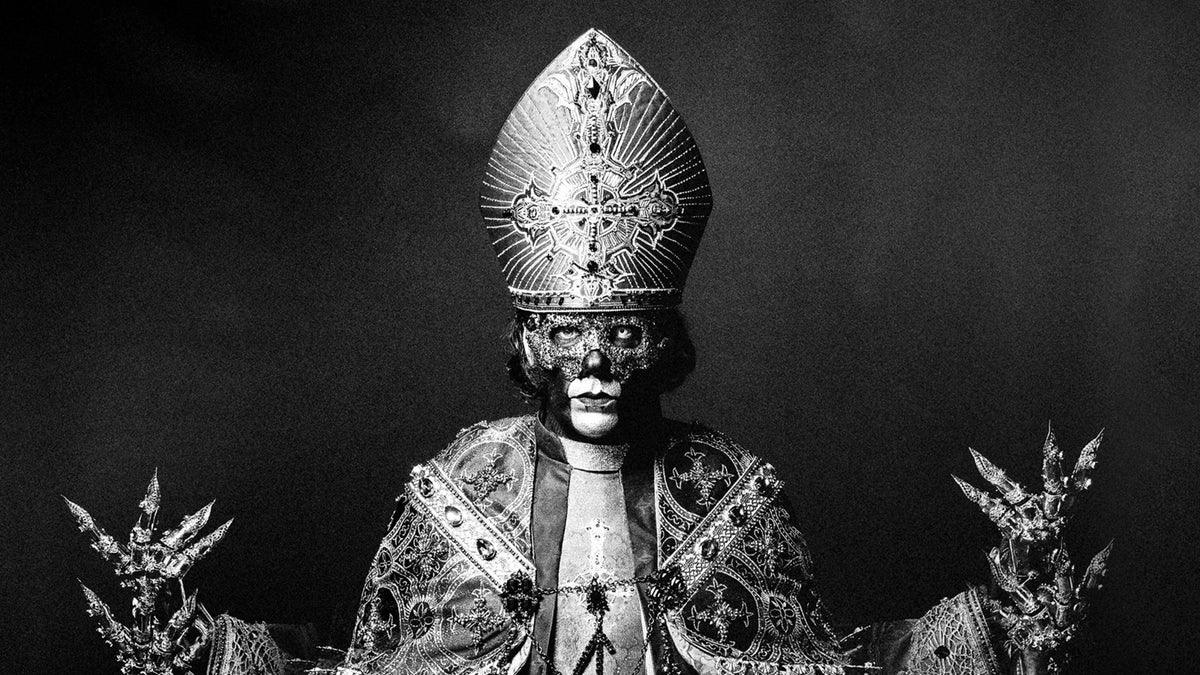
The timing was perfect. After all, a new Ghost album means the unveiling of a new Papa — and Forge took the opportunity to design a mask that was significantly more wearable. The public was introduced to their new frontman, Papa V Perpetua, this past March with the announcement of SKELETÁ.
With a purple mitre, claw-like fingers and — most noticeably — a sparkly skull mask covering only the upper half of his face, Papa V signaled both a visual and symbolic evolution. Upon V’s ascension, his predecessor (and twin brother) Papa Emeritus IV was “promoted” (or demoted, depending on your perspective) to Frater Imperator. The shift marked a new chapter in the Clergy’s ever-expanding mythology and a notable creative pivot for Forge himself.
This time, Ghost’s songwriter wasn’t interested in themes of global upheaval. Instead, SKELETÁ is akin to the skull mask — a work of bone-deep introspection. It’s a sweeping collection that explores an array of rich themes: love as a form of possession (“Satanized”), the ache of regret (“De Profundis Borealis”), glimmers of hope (“Peacefield”), the breaking of self-deception (“Lachryma”), the pull of lust (“Umbra”) and spiritual connection (“Cenotaph”).
When SKELETÁ was released in April, the album debuted at No. 1 on the Billboard 200 — the first hard rock album to do so in over four years — and cemented Ghost’s hold on both the longtime faithful and the newly converted.
The band’s theatrical presence, particularly the emerging profile of Papa V, has only grown since. In May, the new Papa joined Opeth guitarist Fredrik Åkesson (who also contributed to Ghost’s Impera, the Phantomime covers EP and SKELETÁ) to deliver an impressive rendition of Queen’s “Bohemian Rhapsody” at the Polar Music Prize ceremony. They earned a mid-song standing ovation, with legends Brian May and Roger Taylor just a few feet from the stage. Later this summer, V is also set to perform in Birmingham at Back to the Beginning, Black Sabbath’s final show.
But for Forge, confronting the physical and mental toll of the last few years didn’t end with redesigning the mask. It’s pushed him to reconsider the entire experience of being onstage — including the expectations he places on his audience. Like at the European shows, all attendees at Ghost’s upcoming North American concerts will be required to lock their phones in Yondr pouches, as part of a new phone-free policy aimed at reclaiming real connection.
“I had very deep, personal, emotional concerns,” Forge says between sips of coffee. “If I’m going to play in front of 10,000 people and there’s going to be this condom of a phone between us — I don’t like my job anymore.”
“I’m willing to take that risk,” the vocalist continues, referring to the possibility of alienating some fans. “Otherwise, I am losing my soul here.”
The changes he’s made are already starting to work. After years of strain, Forge has begun to rediscover joy in the communion that happens onstage — especially when everyone is truly present. And now, once again, he can hear the rumble calling. “That [recent European tour] was a very reinvigorating feeling compared to what I felt a year and a half ago,” he says. “I’m enjoying the fact that I get to spend two hours every night with people who are there, who seem genuinely happy.”
In the following Q&A, Forge lifts the veil on Ghost’s most ambitious live production yet, reflects on the emotional burden of the band’s rise and shares how he’s learning to embrace the moment — one ritual at a time.

Ryan Chang
The upcoming North American tour has Ghost’s largest production yet. Can you explain what fans will see?
Tobias Forge A lot of the things that we’re doing now on this new tour are things that have been on my list for a long, long time. Things that, at the end of the day, as sad as it is to say, kids, I’m sorry — sometimes it’s just money. It’s just a matter of you need the resources, you need the funding to be able to do certain things. That has been a growing pain for me ever since day one. Still is.
I mean, every time you come up with anything that’s fun, anything that’s cool, anything that’s magical, it’s always like, “Oh, it costs like hundreds [of] thousands of dollars just to try to do that, and if you make it, it will take three days to get that into every arena.” OK, fuck it then, because it’s just too difficult. It takes a lot of patience. So, a lot of the things that we’re doing on this current tour are things that I’ve had on my to-do list for 10, 15 years.
We’re starting to close in on where I wanted it to be in terms of… I don’t want people to see it as “acts” — because technically it’s not. But the show is built in acts in a way that I’ve always wanted to do it, where the show starts in one size and then it grows into something else and then it develops into a third.
In RITE HERE RITE NOW, that was as good as it gets in 2023, everything that we achieved was with the music and with clothing. And that got us far, but now this is correlating more with how I regarded the show to be dramaturgically expanding from a simple start into a quite drastic, bombastic ending.
Fans are dressing up, phones are away for two hours and no openers — it reminds me of a Broadway theater show. Was that also part of your intention?
Absolutely. Well, everything is a chain reaction. We have done “an evening with” setup in the past, so it was always on our radar as an option. “An evening with” setup is always a little bit risky simply because, and of course your readers will know this from experience, almost every metal show — and asterisk, I know that we’re not a metal band, OK? But we’re a metal band to a large degree, and we behave like a metal band, and we’re lumped together with metal bands and we’re in a metal context.
Anyway, in the metal community we are used to metal and hard-rock bands being lumped together into bills. That is by tradition. It’s just a code of the road.
As anything goes up the floors in the administration building, they said, “The only thing that is a potential problem, and this is something that we need to all talk about really transparently is: [the Yondr pouch] really doesn’t work if you want to pack up with a lot of bands. It’s going to be a practical problem because you’re going to get all these people into an arena. First, they’re going to see some band that they don’t want to see, maybe. As soon as they’re out, they want to go and get their phones. As soon as there’s another band, they have to go in again, and then they’re going to go out and get their phones.
So, you basically have to make sure that your show is so good that we only have to get people to put their phones away one time and then they get to leave. That’s our experience.”
One of the stops is Madison Square Garden, which you have never played before. That must hold some significance for you.
Of course. Since I was, six, whatever year I first heard Get Yer Ya-Ya’s Out! with the Rolling Stones, which was a record that had a deep impact on me and still love to this day. But as a kid, it was one of my go-to live albums. That was obviously recorded in Madison Square Garden. Ever since it’s been a venue that I held with high regard. And yeah, finally we’re doing it, which feels very like a big accomplishment.
SKELETÁ was the first hard-rock album to top the Billboard 200 in over four years and the bulk of the sales were physical as opposed to streaming equivalents. What’s your reaction to that?
I mean, once upon a time I dreamt of not having a job and just being able to pay my bills playing music. But as you’re walking along in your path forward and a certain possibility sort of emerges, it transfers from your wish list to your to-do list. I don’t remember exactly, but I think it was Meliora that was the first one that sort of gained any recognition, where it was actually Top 10 — and that, 10 years ago, was like, Holy shit [laughs]. Then the next record [Prequelle] also went up pretty high, and the record after [Impera] landed at No. 2, and then all of a sudden it becomes really important because you’re like, “Oh, fuck. We’re so close now.” When you’re playing Division II, you’re not really dreaming of winning the gold medal. But once you’re up there and you’re in the finals, it becomes very interesting.
So, when you’re releasing records now, it just takes this one artist who’s bigger than you to just make songs available, and they’re basically achieving great sales just by existing. Of course, we’re not really relying on every other person to stream every song once and never hear it again, we actually sell records. It means something to me because that’s a real embracing of the experience that you want to relate to others.
When it landed No. 1 that was emotional, especially as a Swedish person. I don’t think it’s the same if you’re born in England or Canada or America, because so many of your fellow countrymen and women have done it before you. But here in Sweden, we don’t have that. That was a huuuge thing when Europe had a No. 1 single in America with [1986’s] “The Final Countdown.” And then … Roxette had a few No. 1 singles with “The Look” and “Listen to Your Heart” and “It Must Have Been Love.” That was with me even when I was playing death metal and punk.

Mikael Eriksson / M Industries
Two weeks after SKELETÁ, Sleep Token also scored a no. 1 album. Clearly the public is really connecting with heavy, masked bands that lean into world-building. Do you see any parallels between Ghost and Sleep Token?
None beyond the ones that you said. But those are pretty substantial. Of course, we’re a lot more similar than we would be with a completely unmasked band who played in flannel shirts with no gimmick. And yeah, I mean, maybe that says more about contemporary times and the need for escapism than it says about us as bands.
I really think with 24/7 internet life and the constant sight of bad shit everywhere, people yearn for an escape.
I think that you’re right. I think that there’s always been a demand for escapism, but especially in this day and age just as an awakened person regarding the world. I think it’s hard to fathom for a lot of people that are struggling with daily things just to make ends meet and make sense of practical things in life. It’s hard to fully cope without having an outlet that’s sort of parallel.
And I think that that goes for the generation of people that bought Tolkien’s books or watched Star Wars or even read The Iliad. I think that there’s always been a need for that. There’s a need to see the world in a made-up, weird way in order to be able to understand it better. That’s why I say that I don’t write fantasy lyrics.
I mean, there’s this idea about the world of Ghost being a fantasy land, which is great, but that is also largely because of our fans. I’m creating a lot of it, but they’re creating even more of it — and I think that has to do with the fact that most of them do not know who I am. I don’t communicate much privately to the world. As far as I know, Sleep Token does not either.
And that leaves a lot to the recipient, if you will, to make up themselves, and that’s exactly how literature and music and art has been forever. You get an impulse, you get a feeling, and then you get to make things up yourself. I think [that’s] one of the reasons why a band like Sleep Token — or Ghost or Slipknot or any band that leaves certain things out of the totality of the picture — is enthusing. I think that is because we do have a will to imagine and to world-build ourselves. Doesn’t mean that you have to create a completely George Lucas universe, but you want to fantasize about things. And a lot of other artists aren’t leaving much to interpretation because they fully display everything — or at least a somewhat full picture of who they are, what they are, where they are, what they do to whom and when.
There is an emotional theme to SKELETÁ, which has songs about love, hope, death, lust, hate. Is there a certain emotion that’s harder to write about than others?
Joy. I very rarely write about joy [laughs]. I don’t ever think I’ve ever written any [songs about joy] seriously. I have a few examples of that, where a chorus is written as a joke, and then at the end I’m like, “Oh, that’s another beautiful melody with a nice chord sequence. I’m just going to change the words.” If you hear the original demo with funny Swedish lyrics, you’ll hear that it’s the same thing, but I’m just singing something else.
That’s always been a way for me to play. That’s how I playfully write. But on the other hand, when I think of it, even when I’m writing for fun, the lyrics are always about something miserable [laughs]. They’re always driven by sadness or despair, but in a comedic way. And I don’t know why that is. I don’t know why I take so much solace in humoring despair. I never really thought about it until you said it. But as I’m scanning through my funny lyrics as well, it’s always about someone being unfaithful or someone being angry, or it’s always this misplaced perspective of someone being discontent.
You cited George Lucas and the world-building of Star Wars. Some vinyl versions of SKELETÁ have Perpetua on a throne on the back cover — like Palpatine in the emperor’s throne room. What character do you relate to the most in Star Wars?
Anakin [Skywalker]. Because I feel kinship with him… and I have twins!
I think he’s a great manifestation of someone like myself whom tries — and still is trying — to make a better person of myself than I might have been. And who’s made a lot of mistakes because of immaturity and anger and, well… anger and immaturity together is not great. I definitely think that the way that he succumbs to the dark side and how he literally gets engulfed in darkness, I think that most people at some point in life have felt that. Basically, I think that Anakin is probably the most human.
When I saw Episode III [Revenge of the Sith]… that deeply resonated with me, and with his inability to choose right sometimes — or obviously he chose and then he had to suffer because of it. I’m not saying that my life is sort of an Anakin story. I’m just saying that because I recognize my Anakinian flaws. I really try to become a better person going forward.
There’s a short clip on social media of you saying you were struggling with claustrophobia from the Papa masks. With respect, would you explain what you’re going through?
Yeah. I’ve gone through episodes of having panic attacks triggered by claustrophobia. And I’ve learnt that it doesn’t have to be deep as hell. I can have panic attacks without the mask, too.
And even though I understand it was not the mask, I attributed a lot of the fear I had to the mask. So, I simply needed to stop wearing it, and if I ever wore it again, it needed to be in a very controlled environment where I could take it off whenever I needed to.
That was the problem with the shows: I couldn’t stop. And anybody who has had a panic attack knows that the problem when you’ve had one is that sometimes you’re afraid of getting another one — even though it’s perfectly safe. But when you can’t [afford to] have one, that’s when you will probably have one. That became an issue on tour. It was ultimately very freeing for me to be able to get the thumbs up from the fan base that it was OK.
V’s mask kind of just covers your eyes and head. Is that helping you?
It is not doing V any favors, but it does a great deal of change for me. Yes.
Speaking of V, what would you say his personality is, having gotten to play him on the stage for a little bit, compared to Cardinal Copia/Papa IV?
He’s a better singer now, which is cool. He’s not as big-headed, literally. A little bit more fluent, I think. It’s hard. I’m not really the right person to say, but I do feel that we are communicating better, him and I.
Look, I really like Cardi. I really like our Frater. He’s a funny person because he’s so pathetic, and even though they resemble each other, I don’t think V is as prone to patheticism. I think that they have the same propensity for a lot of bark. Maybe not a whole lot of bite.
Meliora is celebrating its 10th anniversary this year. A majority of the songs were also on the set list for the European tour. When you look back, what’s your reaction to that album?
I love that record. They’re obviously all my kids, so I love them for what they are. I tend to not really go back again and listen to them unless… when I make a set list, for example. It might be that I listen to the start and the ending of a song just to hear, like, How does this transition into that song? So, I haven’t really heard Meliora from start to finish, I don’t know when I heard it last.
“From the Pinnacle to the Pit.” I love that. We have played that for almost every tour, I believe, since then. “Mummy Dust” has been an evergreen song in our set that I really like. There’s no other song in our set like “Mummy Dust.”
On this tour that we just did, we played a lot of Meliora. We played “Spirit.” We played “He Is,” of course. This is one of the few tours that we’re not playing “Absolution,” which has always been a very powerful song — big rock & roll moment, cool solos. Oh, and we’re playing “Majesty.” That has been a missing song for a few years. Really liked that. Really cool song. What songs aren’t we playing? The one song that we have played the least, I think, is “Deus in Absentia.”
I know people get hiccups when I say that we’re not playing certain songs, and it doesn’t mean that we never play songs ever… It just means that the reason why we’re not playing “Deus in Absentia” is because it’s such a sort of an ending track. Throughout your career you might shuffle things around, and on this tour we just chose to play “Monstrance Clock” from Infestissumam.
Ghost made a concert film, hit no. 1 on the Billboard charts, won a Grammy and you’re about to play Madison Square Garden. What’s left on your bucket list?
The great outdoors experiment. I’m a patient person, as I said. A lot of the things that we’re doing now are things that I came up with even before Ghost existed. And I think the greatest end of the rainbow, sort of for anybody who’s interested in big stage production, is the great outdoors, because that’s when you can really build your own world.
Even when you’re playing an arena which is super comfortable, it’s a confined space and you can’t really work with depth the way that you can when you’re outdoors. As much as I’m a control freak who really cherishes the repetitive nature of playing indoors [without] weather, I am also the same way that a sailor would be — intrigued to sail around the world.
I think I have the same inclination to conquer the outdoors. The night — when you’re up against the elements of rain — the chances of there being a brilliant, beautiful sundown during your set is just so captivating. I still have not achieved that. But it’s OK if it doesn’t happen. I can wait.