
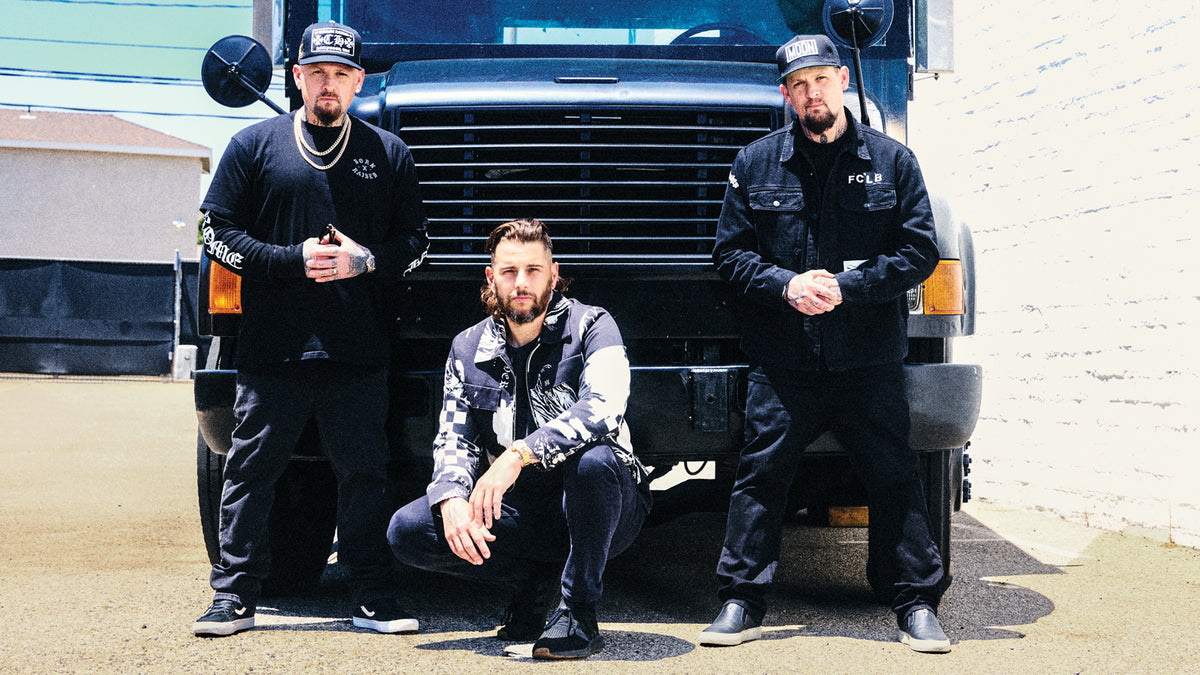
This story originally appeared in Revolver’s Fall 2025 Issue, before the announcement of Avenged Sevenfold and Good Charlotte’s 2026 tour. Revolver’s presale for that tour is live now, using password AFM26 — get tickets.
In the 30 years since Good Charlotte first emerged from small-town Waldorf, Maryland, its twin-brother leaders, Joel and Benji Madden, have been many things: scrappy Warped Tour up-and-comers, platinum-selling pop-punk renegades, successful entrepreneurs, industry disruptors and devoted family men.
And if you ask Avenged Sevenfold frontman M. Shadows, they’re also the unexpected reason his band broke big.
At the turn of the millennium, MTV’s Total Request Live was a kingmaker. Broadcast daily from its iconic studio overlooking Times Square, the countdown could turn a new single, and an unknown band, into a national obsession. A regular bit on the show was when a headlining act brought a younger group on-air to debut a music video, hand-delivering them to millions of fanatical after-school viewers.
By 2005, Good Charlotte — who were already well-established mainstream successes thanks to their triple-platinum The Young and the Hopeless, MTV saturation and a 2003 Viewer’s Choice win at the Video Music Awards — were promoting their third album, The Chronicles of Life and Death. Their friends in Avenged Sevenfold, meanwhile, were taking a big swing.
After earning a rabid underground following with their metalcore beginnings (Sounding the Seventh Trumpet, Waking the Fallen), A7X’s major-label debut, City of Evil, swapped breakdowns and screams for Shadows’ soaring melodies and stadium-rock bombast. The shift alienated some early fans, and the mainstream hadn’t caught on yet. The record looked like it was headed for commercial failure. Then Good Charlotte brought them to TRL.
On live television, the Maddens introduced the video for City of Evil single “Bat Country” — a high-octane, Hunter S. Thompson-inspired fever dream — to a pop-hungry audience who latched onto it instantly. “Bat Country” became a TRL fixture and shot up the charts, eventually becoming certified platinum and winning Best New Artist Video at the 2006 MTV VMAs.
That TRL handoff cemented a friendship that’s lasted decades. Both bands went on to rack up additional platinum records, sell out arenas and even join forces in 2007 on Good Charlotte’s infectious dance-rock single “The River,” which featured Shadows and guitarist Synyster Gates.
Now, as A7X ride the wave of their ambitious 2023 album, Life Is But a Dream…, Good Charlotte are celebrating their 30th anniversary with Motel Du Cap, their first LP in seven years. The record pairs the catchy sounds, personal insights and thematic through-lines that have made Good Charlotte mainstays of the alternative scene — and showcases their wide-open collaborative spirit with guest spots from old pals like Wiz Khalifa (“Life Is Great”), country singer Luke Borchelt (“Deserve You”), indie-pop upstart Zeph (“Pink Guitar”) and hip-hop-rock fusionist Petti Hendrix (“Vertigo”).
Much like when they spun “Bat Country” on TRL, Motel Du Cap reflects the Maddens’ instinct for amplifying the next generation. “When we were able to take Avenged Sevenfold on MTV — where would we do that now?” Benji Madden asks, posing a crucial question about developing talent in today’s fragmented cultural landscape. He and Joel are helping to provide answers with their streaming platform Veeps and media network Artist Friendly Co. (which includes Revolver), as well as their management company, MDDN.
In the conversation that follows, the Maddens reconnect with Shadows to swap stories from their formative years, share hard-earned lessons learned along the way and reflect on the punk-rock ethos that’s kept their friendship — and their bands — thriving.

Joel Madden Over the course of our relationship, a similarity between all of us and our bands as people [is the] idea that we’re stronger together, and we pool resources, and we try to help each other figure things out. It’s a good [concept], but it’s very hard to execute on that. When I zoom out and I think about our relationship, aside from our friendship and history, just knowing each other, you’re on a very short list of people who aren’t transactional.
Benji Madden You’re able to have the closest, longstanding, easy friendships with people that don’t need anything from you. If you have friends who you’re always having to solve their problems, it’s tough. Our bands always have had this longstanding bond that doesn’t require maintenance. I think our bands have always operated from a place of abundance in the rock world. It’s very rare. You always have the vibe in the rock world where, if you’re winning, then I’m losing, right? It’s not the truth of life, ever. I guess you can call it the abundance mindset. There’s really this world where there’s so much: If you win, I win.
M. Shadows I think from day one, [it’s] the way you guys see the world and try to solve problems. That’s what you guys did early on, and it was outside of Good Charlotte, too. You use that as a place to get somewhere, and then you can start solving problems with Veeps and all these cool things you guys have done. It doesn’t matter if I’m doing one thing and you’re doing something else. It’s the same mindset — stirring up the pot a little bit, not being afraid and also knowing that everything’s not gonna work. We don’t judge each other on successes or failures. We’re at least out there trying to mix it up and make the world better for artists.
Benji We’ve all had the spirit of naturally trying to make things better for artists. It sounds really weird, but that’s disruptive. We leaned a little more pop-punk, you leaned a little more metal, but all of us are disruptive.
Shadows It all came from punk. We were all at Warped Tour together. That’s our ethos. When we went over to Ozzfest, there was the main stage and there was a side stage. We played Warped for four years before that, and we were getting hazed — and we had friends everywhere, and everyone was cool, and everyone was equal.
When we went over to Ozzfest, we had the ethos firmly in place from our forefathers of punk rock. … It was NOFX, Bad Religion, that was what we grew up on. We were learning from those guys. Everything was equal. Everyone ate whatever the catering was, and everyone was getting paid very little. But it was a punk-rock summer camp. Then you go to something bigger, and there’s a hierarchy, and that was weird to us. So, we’ve always kept the hardcore punk vibe, because that’s where we feel more comfortable. That’s where we grew up.
Benji That was such a fun place to meet.
Joel You have always fucked with us, before we were even near each other’s [Warped Tour] stages. I remember I talked to you on the phone — I was getting tattooed by Adam Barton and he was like, “My friend Matt is the singer of Avenged Sevenfold.” It was after your first record.
Shadows Adam did the art for it.
Joel He was like, “You guys should talk. You’d like each other.” You got on the phone with me, and you were nice, and I just knew there was no guard up. There was no “too cool.” It was at a time where we were trying to make our way. We were touring with MxPx at the time. I was already encountering the reality of life versus what I thought [it was going to be] when we were back in Southern Maryland, trying to make it. I thought, Everyone’s gonna love me and everyone’s gonna celebrate me. And then we were on tour, it was like cold water in the face for the first two years of being in the band world.
Shadows I’m definitely drawn to things that are unique and stand out, and Good Charlotte stood out. Not only for the music — the music is really important, right? You can tell these are good songs. This means something. And then there’s the whole thing on top of it that just feels and looks different. Even as I’m older, I’m just drawn to things that are original, that sit outside the box.
It’s funny, because we wanted to be one of the biggest bands in the world, but we went the exact opposite way about it. You would think, How do you become one of the biggest bands in the world? You do the things that all these other bands did. And for some reason, our bands did the opposite, which is how you get around to that point, right? It’s just something inside you. Maybe it’s that punk-rock rebellion. I don’t know what it was. I can’t even get inside my old brain and what I used to think.
But I do know one thing: Avenged Sevenfold always did the unexpected, and we were completely unapologetic about it.
Benji All three of us have the same mentality of just not really giving a fuck about anything other than forward progress in life. I think that even goes to our journey as men, wanting to be good dads and wanting that same mentality in our music. We’ve met at a very interesting point, now. I like to think that all of us with that mentality, we’re a part of helping the bands that are getting started right now.
Shadows I like talking to anybody that can see the whole thing happening from a higher perspective. I always think about looking down on the music industry [and it’s always] behind. They’ve really flubbed a lot of things that were very easy to see coming, in retrospect. It’s all these things that 10 years ago you could have said, and you’re getting laughed out of the room.
Even now, there’s people that just don’t believe it still happens. Technology has done that with the music industry. With streaming, it was not a problem until you were buying stacks of CDs and ripping every single thing off of LimeWire and Napster. All of a sudden they said, “Oh my God, this is a problem. We didn’t get ahead of this.” And then they had to make amends with a guy that just went ahead and did it anyway, which was Daniel Ek’s Spotify. All of a sudden, you’re playing by his rules.
If you’re an artist that can see from 500 miles above, you’re gonna have to ask yourself, “OK, what can a label do now? What can the industry do? What can they give me and what is it worth? Do you have MTV? Do you have radio? Do you have drivers? Should I be paying a record label 75 cents to my dollar for everything you do? Can you do anything for me? What genre am I in? Have you been able to do anything in this genre? Or is it a TikTok genre that they take and they put gasoline on it?”
You’d rather fail on your own terms than fail in a system where they shove your record into a back room and it never comes out. Or they do some stupid edit and you don’t back it, and all of a sudden you’re in a situation where you failed because of these people’s ideas that have nothing invested in you other than, “Can we call our shareholders at the end of the quarter, and do we make money or not?”
Joel If you win that way, you feel like a fraud. It doesn’t mean that there aren’t people that will contribute good ideas that you’ll back — that’s different. But if you go and put on a birthday clown costume, and you go and have a hit song, then you have to wear that birthday clown.
Benji The thing that people connect to is if you’re being authentic or not.
Shadows If we looked stupid 20 years ago, it was on our terms. That was my decision.
Joel We were riding in the car, and [my son] Sparrow goes, out of nowhere, “You know that if you Google ‘liberty spikes,’ Uncle Benj is half the page. Where did he come up with that?” And I was like, “He just liked punk music. Liberty spikes are an old thing. It’s as old as punk.”
Shadows I had liberty spikes for a while. I remember going downtown with my parents. They hated the look, right? We get on an elevator with this couple, and this guy’s, like, “Cool hair.” I thought he really thought my hair was cool. And I was like, “See dad!” He’s like, “He was making fun of you.” [Laughs] If you wanted it on tour, you’d also have to leave it in when you’re trying to sleep.
Benji I remember a Warped Tour where I didn’t shower for three weeks.
Shadows That’s like The Rev [Jimmy Sullivan, Avenged Sevenfold’s late drummer].
Benji I still have memories of him. That was one of the things that brought our bands even closer. At a young age, never having to suffer a loss, and watching you guys go through that was just something that really bonds you. Having history — you can’t pay for it.
Shadows No, you can’t. You were right there. Another band we got really close with at that time was My Chemical Romance. They came to my house after Jimmy died and stayed with us for a couple days. You realize your [true] friends and the people he touched.

Benji You know what I always find interesting about you guys? You’re an incredible singer. I love not just your voice, not just the soul of it, but the technical stuff. You make it look easy.
Joel My favorite thing about Avenged Sevenfold is you usually get a band that has musicality, but not the songs. Or you have the songs, but not the musicality. You have the songs and musicality. I would say Brian [Haner Jr. a.k.a. Synyster Gates] is one of the greatest living guitar players.
Shadows I’m with him every day. I agree. He’s never rested on anything. He’s always moving everything forward.
Benji It’s not ego driven.
Shadows It’s purely that he explores.
Joel He’s doing that and writing earworms with your guitar lines. To be able to write a melody like that and perform it on a high level… His guitar parts always scratch the itch for me.
Shadows He’s kind of allergic to guitar wankery. He doesn’t want to be that guy. He’s a disciple of the Beatles, you know? To him, it’s like, “We’ll never write a song that good, but let’s try.” It’s all about the song. It’s more about production techniques and vocal melodies than it is about him noodling around the song. Even with Jimmy, it was all so musical.
Benji At the same time, he was a wild animal. You were capturing footage of a wild animal. But he could go toe-to-toe with any studio guy.
Shadows It was like lightning in a bottle.
Benji It’s crazy to me that these kids [in Avenged Sevenfold] were in the same spot.
Shadows Maybe you guys can shed more light on this, but you guys went away for a while. Why was that? And then what made you want to come back and do this new record?
Joel I think unconsciously, and more consciously as we got older, we felt like we needed to get back to life. They always say you have a lifetime to write your first record, and then every record after that, you’re just writing records in a short period of time. We went on the ride, we had the experience, and it was great as a band — but then it became very hard to tolerate everything else. We refuse to submit to anyone’s idea of us, anyone’s rules: If you tell me to do something, I’m going to do the opposite.
I think at the point where, in 2013-2014, we made the Madden Brothers record. We even say that that should have been a Good Charlotte record. But I think at the time … We got together in high school. We had to evolve as people apart and as a group — and learn how to be in that marriage together. And it’s been an amazing journey together.
I fucking love my band. The four of us, since we were teenagers, is really special history. When I think of my past, I think of my band: That’s my familial group. We all come from broken homes and that’s our solidness.
Benji Except for [bassist] Paul [Thomas], his parents are still together.
Joel He understood. He was there on the ride when we were moving around. We were homeless, we were living with people — he was watching that whole thing. He’s seen us all the way. Paul’s always been my day-one. He knows me so well, and we don’t have to talk. It’s just deep. It’s like brothers.
Benji [Guitarist] Billy [Martin] was, like, this metal kid, which I loved. I’m a huge metal fan. I think what you guys are with metal, we are with punk and pop-punk. You guys love the metal crowd, but you’re like, “You’re not gonna dictate what we do. We’re gonna lead you guys.” When we came into it, we got put into the Warped Tour [scene]. Back then it was NOFX, Bad Religion, Rancid, Social Distortion, Pennywise. It was a tougher crowd than you find now. It was a different culture. Genres don’t mean as much now. But even as kids, we were like, “You guys aren’t going to dictate what we do.”
I think we also needed to reclaim ourselves [during the hiatus]. When we got in the mix of everything in the business, I think the only mistake we ever made was trying to please people. I think we got caught in some places where we did some things that weren’t authentic to us, but it was only out of wanting to be good partners and wanting to make everyone happy. I think we were driven a lot by approval. We weren’t thinking that they just got a $250,000 check, so they’re patting you on the back. In our heads, they were like, “You guys are hard working. You’re talented.” And I think that was what drove us.
Joel I do think that going away for so long — we needed to grow. If I go away and this thing doesn’t last, it wasn’t strong enough to last. If I come back and it’s still here, then it’s meant to be. And I really felt like we got to that place where we have the confidence to do what we want, when we want, on our own terms.
Benji I also think we needed to become the men we dreamed we could be.

Shadows It seems like you guys coming back feels a lot more confident. I always tell people this: “How can you write records back-to-back when your only life experience in between your last record and your new record is being on the road?” At that point, you’re just moving chords around.
Joel I would say that this last decade, I arrived for the first time in my life. I think in the beginning, I was trying to make it for some major reasons. Number one, to [get out of] poverty. That was my original mission. Then I discovered the art, and I actually like writing songs, and I actually want to be a good songwriter. I started chasing that, and I want people to like me. I had low self-esteem growing up. We always liked each other, but like, we got picked on and all that… The Nineties, you remember that?
But I’d say the last decade was — credit to my wife, credit to my kids, credit to my friends, my community — finding my place in the world where I can stand by what I do and I don’t give a fuck what anyone thinks, unless I respect them.
The last time we talked, you said, “We’re all dealt different cards, but at some point you have to look at the cards and play the cards you have and make the most out of where you were dropped on this planet, and what body you were dropped in.” And you have to, at some point, stop going, “Why?” And start fucking going forward.
We’re not trying to do anything other than what we think we should do. That was what we started doing when we started MDDN. We used to serve the career because we were afraid: “If I’m not in Good Charlotte, do I mean anything to the world? Am I important?” And I got over that. I was like, “You know what, if I’m not important to someone because of that, then I don’t want to be important.” Then I started doing shit outside of Good Charlotte, and I came back to Good Charlotte with real love and appreciation for doing this thing the right way.