
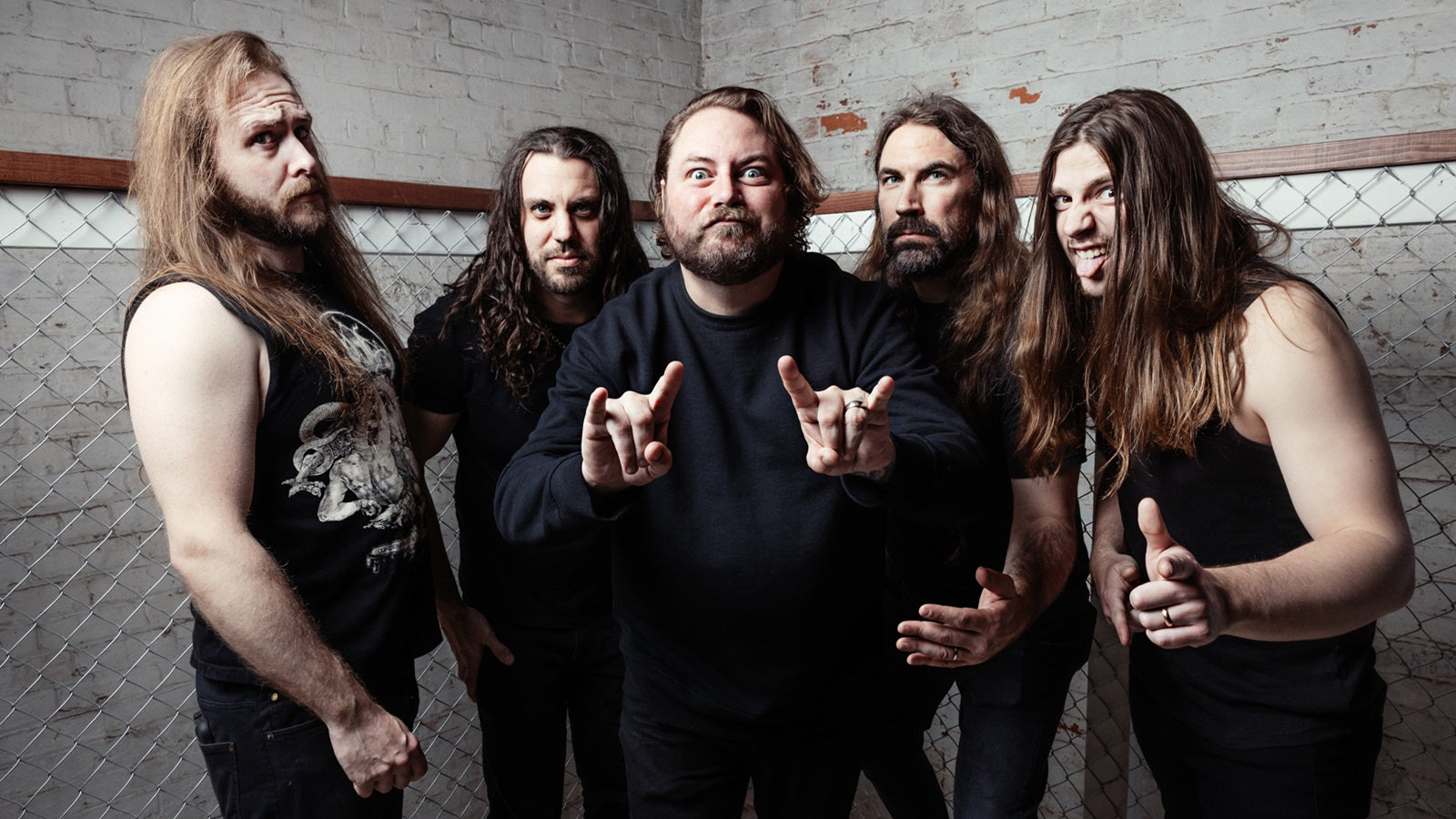
Brian Eschbach only traffics in high-grade product. That’s been proven time and time again through his work with the Black Dahlia Murder, the beloved American melodeath group he co-founded as a guitarist back in the early Aughts, and who have since grown into one of metal’s most consistently ass-whipping forces. Their new and riotously raging Servitude full-length — the band’s first studio release with Eschbach on vocals — keeps the quality-check intact.
But when Revolver first catches up with the Michigan-based musician and asks how his day’s been, he starts the conversation on a different train of thought — or maybe that’s “strain.” You see, when Eschbach’s not out on the road or in the studio with his prolific death-metal group, he’s “passionately involved” in a local marijuana company — from seed to sale.
“I work at an indoor weed grow, and it was harvest day. That’s always fun, getting to take down the fruits of the labor,” he says.
“It’s been a really rewarding experience learning how to care for these plants from moment one to done, so I try to get back to work as soon as I can after tour. And if the [Black Dahlia] guys are coming into town and we’re about to rehearse, I show up at work earlier in the day and do the rock & roll later. I try to keep it constant. I need to be busy.”
On that point, the Black Dahlia Murder’s Servitude gets the band back to brutal business as usual — take the full-speed-ahead, harmonic melancholia of songs like “Asserting Dominion” and “Aftermath” for proof — but it also marks a major turning point, as it’s the group’s first project since the tragic 2022 passing of their iconic founding frontman, Trevor Strnad. Though Eschbach had long been a backup growler for the band, he put his guitar down later that year to hoist the mic full-time — the lineup is now rounded out by guitarists Ryan Knight and Brandon Ellis, bassist Max Lavelle and drummer Alan Cassidy.
Servitude’s first blistering single, “Aftermath,” finds Eschbach screaming his way through a post-apocalyptic scenario where folks are “scavenging to survive” following a world-changing, cataclysmic event. When asked if the song is in any way referencing Strnad’s death, or how the Black Dahlia Murder have been forced to adapt in their late frontman’s absence, Eschbach says that’s not crux of the piece. This particular “Aftermath” isn’t that literal. Instead, the band’s news vocalist is honoring the rich, if at-times revolting, storytelling style they’ve been honing since 2003 debut LP Unhallowed.
“I don’t think anyone was really concerned about what I was going to produce lyrically,” Eschbach explains. “[The band] knew that I understood what these songs are supposed to have, or how you’re supposed to tell a horror story. We were so involved in [the making of the record] that there wasn’t really time to think about [Strnad’s] absence’s influence on it. We were just doing it.”
Speaking with Revolver, Eschbach details the blood-thirsty drive of his band’s latest release, and what it’s like to still be spreading death metal’s “dark word” around the globe with the other “cretinous vagabond goons” in the Black Dahlia Murder.

Oli Sansom
Servitude’s first two singles, “Aftermath” and “Mammoth Hand,” feature lyrics that focus on cannibalism in some form. Can we chew on that for a bit? Like, why do you think flesh eating was on your mind this time around?
BRIAN ESCHBACH I wouldn’t necessarily say cannibalism was on my mind. It just fit as a part of two different stories. But now that you bring it up, I’m feeling kinda hungry…
Faced with those connective images, though — and it pops up elsewhere on the album, as well — where do you think that could be coming from?
Like I said, it wasn’t really a conscious thing. I mean, when you’re talking about barbarians that are cutting down other villages in the tundra… yeah, they’re probably going to eat people!
And then [when you’re] talking about post-apocalyptic shit, whatever be the cause of it, we see all these different stories portrayed where people end up eating other people. But what other reference are you thinking of?
“Asserting Dominion” has that line about craving “the flesh of man” for a “miraculous feast” of sorts…
Well, that’s not a cannibalism one. That about the Tsavo Man-Eaters. That’s lions eating people.
In “Aftermath,” there’s a line about “feeding on each other when we can.” This is possibly taking things out of context, but that lyric — however gruesome —could arguably be speaking to the general creative process of working within a band. Or, perhaps, friends leaning on each other through troubling times. Can you speak to that particular lyric, and whether either of those scenarios apply?
It’s just a song about what tons of movies suggest happens with humans in the post-apocalyptic scenario, whether the background be a doomsday meteor or the undead walking the earth. I guess it’s up to the listener to interpret it how they’re going to.
How hard of a decision was it for you to take on the frontman role? And what made you all collectively turn the corner for this next phase of the Black Dahlia Murder?
When it came down to it, it was the only right decision to make, to continue with the body of work we had been living for 21 years. I look at it more as a collective leap of faith than a turning of a corner. We knew we could continue to make music that would honor this band’s legacy and audience.
Considering you’d spent more than 20 years onstage strapped to a guitar, how has it felt to transform yourself into a full-fledged vocalist? Did you have to relearn or rethink how you attack a set?
I had seen it done before a couple thousand times by various performers, so I had a pretty good idea of what needed to happen. I will say, the [first] handful of shows we did, it was quite like feeling naked, being onstage without a guitar. Once a song starts, though, there isn’t a lot of time to worry about anything. You just gotta do it.
Do you miss playing guitar onstage?
I have a series of back problems, so my back doesn’t miss the guitar at all. But with having to do what you have to do as a vocalist, that whole feeling of missing the guitar — as a piece of comfort — went away very quickly.

The Tinfoil Biter
How did you go about upping your vocal stamina, in order to scream a whole set through?
I spent a good amount of time screaming along to songs in the car while delivering weed. I’ve had to do stage banter a lot over the years, but with the transition, I do find myself at times saying the most awkward shit on the mic.
What’s the most awkward thing you’ve said so far?
I can’t think of anything specific, but I can tell you that sometimes you’re in an [international] area that — although they can probably speak better English than you can — they don’t necessarily pick up on slang. Or if you go off on a thought tangent, they’re probably not going to follow you. You should just stick to the script of, “Are you guys ready for more? Did you have fun?” When you’re talking to other cultures, you’ve got keep it simple.
What songs were you screaming along to in the car?
Black Dahlia songs! There’s a whole difference between jumping in to do backup vocals a couple times over the course of a three-and-a-half-minute song and singing the entire time — though not on guitar solos or whatever. So, I queued up a playlist of the setlist, and it [felt] like being 20 again, driving around delivering pizzas for Domino’s. I’d be screaming along to whatever I was listening to at the time, back in 2002-03.
Did anyone catch you practicing your screams while you were sitting at a red light?
You really ought to not look for eye contact when you decide to do that sort of thing. I’m sure many people saw, but I was trying to focus [on screaming], you know?
Do you have a newfound appreciation for some of those older songs on a vocal front?
Absolutely. I’m not going to tell you which ones specifically, but some are more challenging than others for different players — and for the vocalist, too, you know? You’ve got to be mindful of what onslaughts you’re putting together [for the setlist].
I definitely remember Trevor talking about it, like, “This one’s fast and [I’ve] got to say a lot, [so] you can’t put these two [songs] together.” And then I got to learn a different, first-person perspective as a vocalist doing certain older songs. I was like, “Yeah, yeah… I get it, man. That one’s a sprint!”
What’s the one song that really pushes your vocal abilities on Servitude?
As far as doing it in a live situation, “Aftermath” is the fastest song on the record, and the vocals are jumping with the beat the entire time. That one’s been educational. You have to breathe very particularly — like, [breathe] here, here, not there, here, there, not there. It’s a fun experience.
While you’re not playing guitar live anymore, you still wrote a bunch of riffs for Servitude. Since you don’t have to worry about executing the riffs each night, did you feel inspired to get extra technical and grueling with your writing? Like, that’s Brandon and Ryan’s problem, now…
I didn’t really take that into account. I guess I should have written some intense acrobatic shit for them to play, since those two are definitely top-tier guitar ninjas.
Earlier in the summer you’d revealed that “Mammoth Hand” was somewhat inspired by watching Eighties fantasy flick The Beastmaster. Are there any other movie moments or pop culture references wrapped into this LP?
From 2001: A Space Odyssey to Frankenstein, and the Bible for some anti-Christ shit, we touch on a handful of classic stories. Get your nerd detective kits ready to catch all the references.
How do you see the theme of Servitude connecting to this group of songs?
It’s just that these songs were written in service to an idea, and that idea is the Black Dahlia Murder. We’re here in service of what we love, and that’s this band.
The record’s “Panic Hysteric” centers around these nomadic, cretinous, “vagabond goons” spreading the “dark word” across the lands…
“Panic Hysteric” is straight up a song about rock & roll.
With that in mind, then, what’s been the most rewarding part of taking this heavy-metal journey with your Black Dahlia Murder bandmates so far — of being this band of “vagabond goons” traveling the world and experiencing the veritable “miraculous feast” along the way?
Interesting… OK. I mean, the best part of traveling and doing this is getting to know each other, for better or worse.
There’s been a lot of different people in the Black Dahlia Murder over the years. Most of us are cool with each other now, [but] we weren’t great bandmates out there at times. [But] shit, going out there and touring with other bands that we love? There’s a lot of cretinous vagabond goons out there, [and we’re] just trying to make people have a fucking good time.
This interview has been edited and condensed for flow and clarity.