
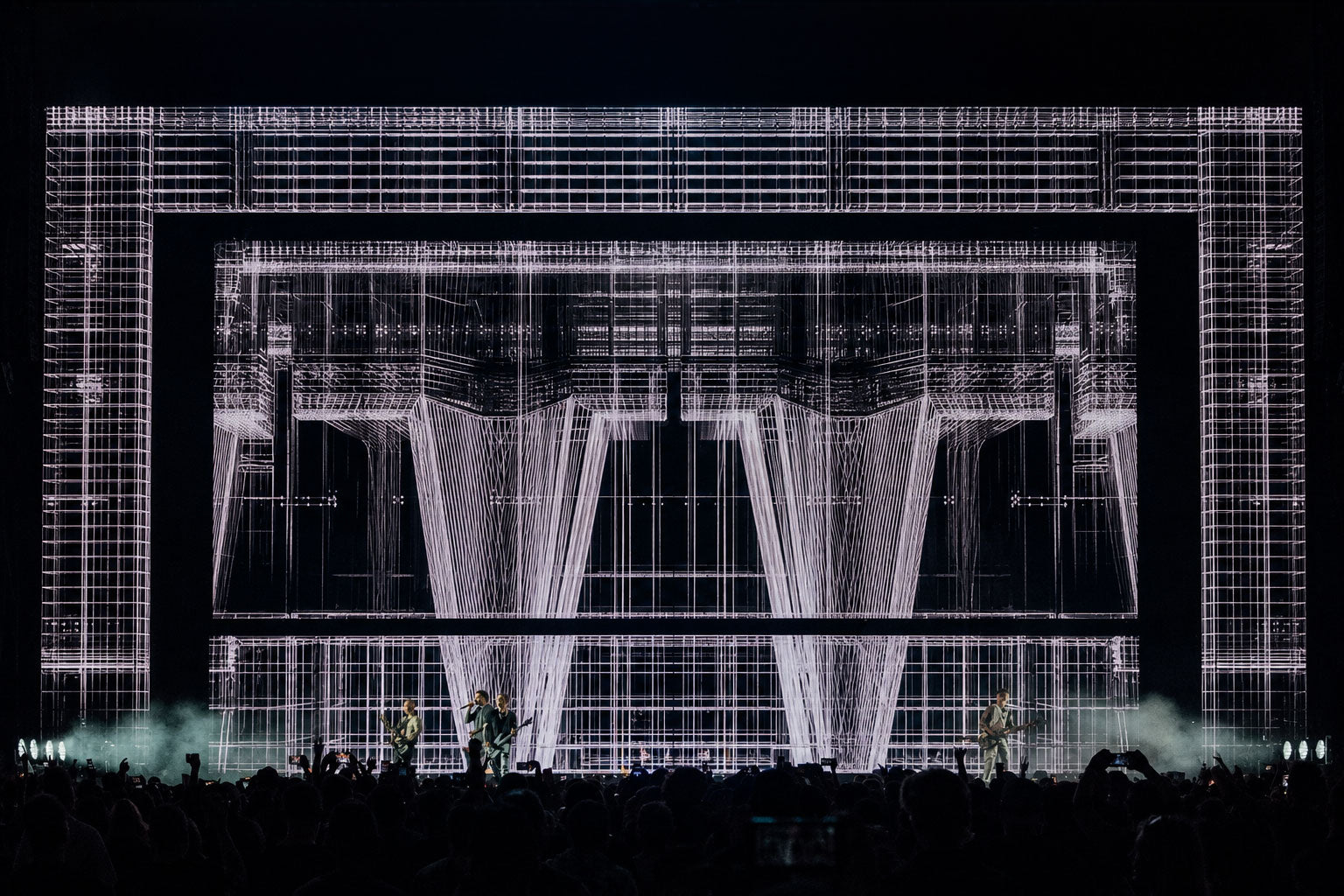
Avenged Sevenfold have never been a band interested in standing still. From their metalcore beginnings through prog-minded experimentation and psychedelic detours, their music has always thrived on collision — different sounds, moods and ideas crashing into each other until something stranger emerges. For their latest North American tour — a joint run with longtime friends Good Charlotte — that restless spirit has found its visual counterpart in a production built around what See You Later co-founders TJ Hoover and Darrius Medina call three “architectural acts”: the Monolith, the Fracture and the Infinite.
Working with stage designer Jordan Coopersmith, Los Angeles creative studio See You Later provided content creative direction for a production that treats the stage not as a backdrop, but as a structure capable of changing shape, collapsing and ultimately disappearing. Act One, the Monolith, establishes a world of rigidity, compression and permanence, with austere architecture, shadow and negative space creating a sense of weight. Act Two, the Fracture, breaks that world apart, revealing fragmented forms and turbulence as the architecture destabilizes around the band. Finally, Act Three, the Infinite, abandons the physical altogether, dissolving into an abstract, dream-like atmosphere that builds toward the emotional release of “Cosmic.”

The progression mirrors the band’s music: restraint giving way to disruption, then expansion and transcendence.
“I think going into this tour we sorta wanted to strip away any sort of individual identity to the songs,” Avenged Sevenfold’s M. Shadows tells Revolver. “There is a time and place to take people through eras of the band and present them with that particular art. But this time we wanted to look at the show as a whole… a show where a new song like ‘Magic’ can sit beside and older song like ‘Unholy Confessions’ and tell a larger story.
He adds: “We also feel that everyone is using the same tricks at live shows these days… Some people love that…. It’s why it works. We want people to leave our shows feeling something different. Just create a bit of wonder and tension. A feeling to unpack well after the show is done.”
In the following Q&A, Hoover and Medina explain how See You Later built each of the show’s architectural acts — and why sometimes the most powerful visual is the one they choose not to show.
How did you hook up with Avenged Sevenfold to design their new stage production?
We were brought onto the project through Jordan, who designed the stage production and gave us a physical canvas to create on top of. From there, our role was to build visual worlds within that framework, so the content could feel integrated with the architecture rather than sitting on top of it

See You Later previously worked with pop artists like Bad Bunny and Sabrina Carpenter. In what way, if any, was it different working with a metal band like Avenged?
The process always begins with the art, not the genre. Avenged have a very particular relationship with atmosphere, tension, and scale, so the show needed space to feel dense, dark, and architectural. The job is to find the visual language that feels native to that artist’s world, then be disciplined enough to follow it.
What were the initial ideas, requests or vision that the band put forth?
The initial direction was intentionally curated and restrained: less about filling every surface, more about mood, negative space, contrast, scale, darkness and release. Light was treated sculpturally, while video extended the stage architecture rather than simply playing on a screen.
To what extent did you reference or try to rebel against the band’s previous stage production?
It was less about reacting to what came before than identifying what this show needed to become. The focus was a distinct visual language for this chapter: an architectural world that moves from restraint and compression through fracture into release.
Where did the idea of three architectural acts come from, and how does it relate to the setlist?
The three acts gave the show a structural, emotional arc rather than a literal story: restraint and compression, then fragmentation, then expansion and transcendence. The stage begins as something rigid and physical, destabilizes into fracture, and finally opens into a more abstract, atmospheric environment. That lets the set unfold with progression without forcing every song into a literal narrative.
On a visceral level, what emotional journey were you trying to take the audience on?
We wanted the audience to feel a world becoming unstable beneath them, then expanding beyond its original form. It begins with restraint and containment, moves through fracture and disruption, and eventually becomes more open, weightless, and immersive. The architecture carries that feeling: It starts as something solid and ends as atmosphere.

What was the thought behind positioning Brooks Wackerman above the platform at times and below it at others, almost in a cage?
The platform, designed by Jordan, gave us a dynamic element to build the content around. We used its shifts in position and scale to help the visuals feel integrated with the world of the stage.
Talk about the projected glyphs and lasers during “Afterlife.” How do those relate to the song and the three acts?
The glyphs were designed to feel abstract and illustrative rather than tied to any specific time period, style or meaning. We wanted to avoid anything that felt ancient or overly literal. The lasers, meanwhile, were conceived as an external force: They etch and burn across the architecture itself rather than activating it from within.
“Cosmic” feels like the first time warm colors appear onstage. Is that the case, and if so, what’s the desired effect?
Yes. “Cosmic” is the only song that moves into full color. As the final song, it comes after everything has been stripped away, leaving the show in its most honest atmosphere. Visually, it gathers the feelings and ideas of the whole show into one final emotional release.
What’s your favorite moment in the production and why?
There are a lot of moments in the show that stand out for us: the heads emerging and everything igniting red during “Buried Alive”; the “Nobody” solo, when the structure has fully collapsed; the laser etching in “Afterlife”; and the color and emotion of “Cosmic.”

What was the most challenging moment to pull off?
One of the hardest parts was creating content with a three-dimensional perspective that could live convincingly within — and in relation to — the stage design. It had to hold its depth and spatial logic from the audience’s point of view rather than reading as flat imagery.
Concert productions often lean maximalist, while your work uses restraint and minimalism. Where does that come from, and what is the power of working in that extreme?
We are interested in making fewer decisions, more precisely. Restraint creates contrast; it lets a single change in scale, light, color or movement actually register. In a live setting, you do not need to explain everything to the audience. If the world is clear enough, you can leave room for them to feel it.