
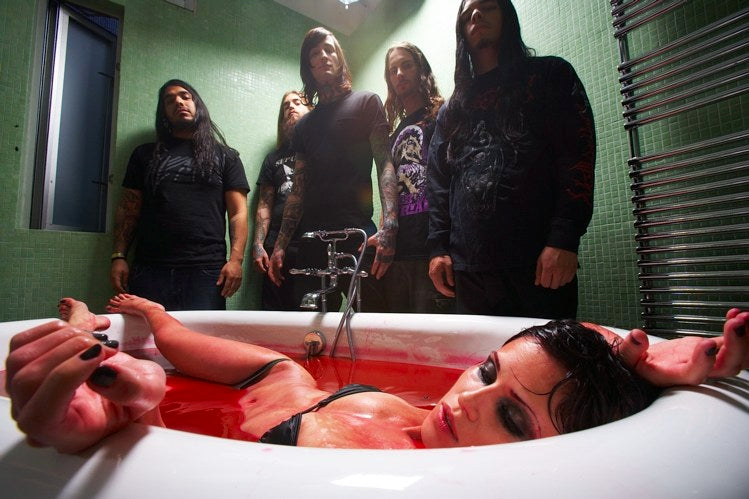
This article originally appeared in a 2009 issue of Revolver Magazine.
Even if you totally love Suicide Silence, you might want to think twice before inviting them over. Just ask the guy in North Carolina who asked them to drop by after a recent show.
The band and crew arrived with a large bottle of Jack Daniel’s and two cases of beer. An hour later, the group’s hairy, overweight drum tech, Fupa, was naked and practicing ninja moves with two kitchen knives. When guitarist Mark Heylmun made the mistake of entering his orbit, he flung one of the blades at him. Heylmum dodged and retaliated by whipping in the tech’s direction a full glass of whiskey, which also missed and shattered against a wall.
“It turned into a fight scene from a Japanese movie,” vocalist Mitch Lucker recalls a few weeks later. “There were more knives flying and chairs getting thrown. Mark picked up a couch and used it like a fucking shield. People were getting cut with the broken glass, and it kept getting worse and worse. And we’re sitting there going, ‘Fuck, this is serious.’ At the same time, though, we’re laughing our asses off.’”
The Riverside, California’s Suicide Silence attack their music with the same kind of destructive joy as they do their fans’ houses. Their songs are furious, brutal, and bleak, but they’re performed with an ever-present grin. And while the band members are for the most part nihilists, they approach their and humanity’s ultimate insignificance with glee. “There’s a song on our new album [No Time to Bleed (Century Media)] called ‘Disengage,’ which is telling people to disengage from reality and do whatever makes them happy,” Lucker says. “I mean, reality sucks. The world is a cancer, and shit’s so bad it’s scary. Everything’s filthy. But you know what? One day it’s not gonna be here. So just be glad you know what life is. You’re alive. Live.”
For fans that came of age with Slipknot and Lamb of God, Suicide Silence are a revelatory kick in the ass. They’re faster and heavier than most of their contemporaries, and their breakdowns are tailor-made to spark frenzied moshpits. Lucker’s vocals are alternately shrill and guttural, and Heylmun and co-guitarist Chris Garza are as skilled as they are vicious, delivering both grind rhythms and haunting, melodic solos.
Success hasn’t been handed to Suicide Silence, though. They have received little support from rock radio as well as MTV, who banned their video for “The Price of Beauty,” because it depicted a doctor carving up a patient’s face. As a result, the band has attracted fans with its explosive and relentless live show. Onstage, Heylmun, Garza, and recently added bassist Dan Kenny (ex-Animosity, Light This City) stomp and shake their noggins in a whiplash-inducing blur of helicopter head swirls and frenzied headbanging. And Lucker—who’s the real showstopper—claws the air, spreads his arms, arches his back, and buries his chin in his chest, often all in the span of a few seconds, all the while spewing a maniacal stream of death-metal growls and blackened yowls.
“Mitch is a big part of the reason I committed to working with Suicide Silence,” says Machine (Lamb of God, Clutch) who produced No Time to Bleed. “In the sea of all the bands that do this, here’s one with a real star. He’s one of the best at what he does.”
“For Mitch, there’s almost an idol worship thing going on because he knows who his predecessors are and what a great stage show looks like,” Heylmun says. “So he wants to push everything to the limit and to put the best show together that anyone can ever see any frontman ever do.”
With Lucker at the helm, Suicide Silence have developed exponentially since their first concert in 2002, which featured two vocalists (the second was fired after the show). At first, they could only play locally because some of the members were in high school. As soon as they graduated, the band piled into a van and crisscrossed the country with only a MySpace video clip to promote them. They released their 2005 self-titled EP, after which Century Media almost immediately snatched them up. By the time their debut album, The Cleansing, came out in September 2007, Suicide Silence were already considered one of the best live bands in the budding deathcore genre, and over the next year they honed their skills even further, playing over 290 gigs with everyone from Angels & Airwaves to Nile.
“I heard their name a lot and realized they had a devoted core following that was extremely passionate,” says Rockstar Energy Mayhem Fest founder Kevin Lyman, who handpicked Suicide Silence to play the Hot Topic stage last year. “They won people over every day, and I can see them moving up to the main stage next year if things keep rolling for them.”
Unless something tragic happens during one of their martial arts-and liquor escapades, Suicide Silence’s winning streak seems unlikely to end soon. The Cleansing has sold over 70,000 copies to date, their new song “Lifted” garnered 100,000 plays its first week on MySpace and accrued more than 800,000 over the following month, and the band is heading into the release of No Time to Bleed not only fresh off taking the Best New Talent trophy at Revolver’s Golden Gods Awards Show but also with major tours supporting Mudvayne and Static-X. Now that Suicide Silence are playing arenas, the members have the space to thrash around without endangering themselves, which is a welcome relief from the cramped club stages of the past.
“I’ve been hit above the eye by our current and former bass player and our guitarists, and I’ve had my teeth chipped from guitar necks,” Lucker says, clicking together his knuckles, each of which bears bars of tattoo ink. (They used to read “For” and “Ever,” until Lucker saw other vocalists who had the same design, so he had his tattoo artist black them out). “But the worst thing was in Utah at the very first show of our very first headlining tour with All Shall Perish. During the first song, I threw the mic to the left and hit Garza—busted his chin open so it looked like a vagina. It was pretty brutal and he still has a scar from it.”
“It was cool,” Garza recalls diplomatically. “There was blood everywhere and I needed stitches after the show. It must have looked great from the audience.”
April 20, 2009 was supposed to be a good day for Suicide Silence. They chose the stoner holiday to release “Lifted” on their MySpace and were getting psyched to tear it up that afternoon in Erie, Pennsylvania, on the second stage of the Music as a Weapon Tour. But soon after they got to the venue, they were told the show was canceled due to rain, and they were stranded…with no marijuana. Much to their relief, at around 6 p.m., one of their crew members was able to hunt down some skunk weed from a local tattoo shop. “It still kinda sucked,” Lucker says. “Last 4/20 we were in Amsterdam and were super-stoned off the best weed. This time we were in the middle of nowhere smoking the worst weed.”
For Lucker’s bandmates, weed may be a good way to unwind and have fun, but for the frontman, who suffers from serious obsessive compulsive disorder (O.C.D.)—an anxiety condition that manifests itself through irrational fear and equally irrational repetitive behaviors performed to help ease the panic—it’s more like a maintenance medication. “Dude, if I’m not high, my O.C.D. goes crazy,” he says. “I just think of how dirty everything around me is and how filthy people are, and I think way too hard and way too much about all the germs on handrails and doorknobs. And if I lock a door or something, I have to count to five or else in the back of my mind I’m like, Oh, something bad’s gonna happen. But then as soon as I smoke, I don’t think about that shit.’”
Lucker traces his O.C.D. back to childhood when he used to constantly count his G.I. Joe dolls, which he’d always replace perfectly on the counter so their feet fit exactly inside the dust marks. He also kept numerically organized comic and football cards in binders neatly packed in boxes on shelves. Then, after a couple confrontations with his mother, Lucker’s condition took an ugly turn. “One time, my mom twisted up all the G.I. Joes and broke them, and another time I came home from school and all my binders were broken and lying by the front door, and all the cards were completely unorganized,” he says. “I think those two experiences fucked my O.C.D. Instead of making sure things were in order, I started feeling like everything’s dirty and don’t touch this and that. And I think seeing people as filthy has completely ruined my outlook on life.”
While it might seem strange for someone with O.C.D. to enjoy performing for sweaty fans in less than sanitary conditions, Lucker insists playing in Suicide Silence actually keeps him sane. Not only does it allow him to vent his negative energy in a positive way, in enables him to temporarily shed his obsessions and compulsions.
“The only time I feel like myself is when I’m onstage,” he insists. “It’s the only time my brain isn’t overwhelming my awake life because my mind has other things to think about and prioritize, like what I’m going to do next. There’s no negative burden there, so all the anxieties go away and I’m completely at ease.”
To manage his condition offstage, Lucker loads the band’s bus and dressing room with Purell, tidies up wherever he goes, and showers as often as he can. Even so, there have been times when all the weed and Purell in the world couldn’t compensate for the squalor Suicide Silence have been subjected to. “We were at a hotel in Spain, and the water coming out of the shower was ice cold and rusty brown. It looked like a bathroom out of Hostel,” recalls Lucker, visibly pained by the memory. “The whole bathroom was full of three-inch deep water, and I had to shower because if I didn’t, I wouldn’t be able to sleep. I was freaking out and having a panic attack.”
Fortunately for Lucker, a little creativity can go a long way. “I got piles of dinner plates from the restaurant and made a path to the shower, so I didn’t have to step in the water,” he says. “Then, when I made it to the shower, I put two dinner plates down, stood on them and watched this ice cold brown water come out of this fucking rusty showerhead. I knew at that point I was fucked. I was like, Dude, this is the worst thing I’ve ever done. I felt dirtier after the shower than I did before.”
For Lucker’s bandmates, coping with their vocalist’s O.C.D. can sometimes be a chore, but they try not to hold his ailment against him, as the benefits of having him around far outweigh the drawbacks. “Mitch is completely out of his mind,” Heylmun says. “But that helps him in the band because our music is very extreme and he pushes everything to the limit.”
Suicide Silence started writing parts for No Time to Bleed while they were touring for The Cleansing. During a month-long break before the 2008 Rockstar Energy Mayhem tour, they assembled the riffs into three new songs and recorded them in Garza’s garage. Whenever they had a week off the road, they returned to the makeshift writing room to compose more material. “It was really organic and easy,” Heylmun says. “Chris and I wrote everything together, which we didn’t do on The Cleansing and all the parts just came from jamming.”
It looked like Suicide Silence would glide right through the end 2008, but in October, right before a scheduled Australian tour, the band hit some unexpected turbulence when bassist Mike Bodkins exited the group. According to his former bandmates, Bodkins had started prioritizing the band’s business over his playing. “When everyone was doing 110 percent above and beyond what they had to do, he was slacking,” explains Lucker. “Everyone was into practicing their instruments and progressing, and Bodkins was more concerned with, ‘Oh, how much are we getting paid for this? And what’s our percentage of that?’”
Rather than cancel their Australian dates, Suicide Silence called their friend Dan Kenny and asked him to try out. “I told them, ‘I’ll be out there in five seconds,’” Kenny says. “My first show was in front of 6,000 people, and I was as nervous as can be.”
“He was like a scared puppy,” Lucker adds. “But we knew he’d be great because he’s a badass player and he has great stage presence.”
Although Kenny earned his spot on the Suicide roster, the band decided to finish writing No Time to Bleed as a four-piece, with Heylmun tackling all the bass parts. The process worked so well, they stuck to the formula when they entered producer Machine’s Weehawken, New Jersey, studio in February 2009. As opposed to producer John Travis (Static-X, Buckcherry), who tracked The Cleansing live, Machine recorded one instrument at a time and worked closely with the band to make their songs tight and the structures chaotic but coherent.
“In the studio, a lot of metal bands sweat the small stuff and are very math-minded and detail-oriented,” Machine says. “But these guys smoke a lot of pot and focus on the big picture, which was awesome for me. They love what they do and go off what feels right to them. They really don’t waste too much time with detail.”
No Time to Bleed is just as heavy as The Cleansing. It’s packed with crushing blast beats, barbed down-tuned riffs, angular licks, and blowtorch vocals. But this time there’s far more cohesion between the vocal passages and the breakdowns, and Suicide Silence are less reluctant to display their nu-metal influences such as Korn and Deftones alongside their death-metal inspirations like Cannibal Corpse and Obituary.
“When The Cleansing came out, we had no idea what we were capable of,” Lucker says. “Once that record did pretty well and we learned what we could do, we worked our asses off to blow it away, and with No Time to Bleed we’ve taken four fucking big leaps ahead. The tempos and all the click tracks were mapped out and everything was precise and perfect, as opposed to, ‘One, two, three, four, go, and if we fuck up, who cares?’ which is what we did last time.”
Lucker named the new record after a line in the Arnold Schwarzenegger film Predator, in which Jesse Ventura’s character exclaims, “I ain’t got time to bleed.” For the vocalist, the title is a criticism of people who would rather feel sorry for themselves than to make the most out of life. “To me, it’s like, ‘Oh, you fell down and you scraped your knee. You got a fuckin’ boo-boo. Now get up and move on,’” Lucker explains. “There’s so much worse shit going on in any city block than what you’ve got going on. You only live once, and it’s a really short amount of time. Do whatever you can to make yourself remembered or do whatever you can to have the most amount of fun while you’re still alive. And if you go out early, then more power to you. You must have been having a real good fucking time.”
If Lucker embraces a “have a good time all the time” philosophy, you’d never know it from his lyrics, which are wrought with personal suffering and angst. “Lifted” addresses heroin addiction; “Your Creation,” which Lucker penned for his daughter, is about watching out for pedophiles; “Wasted” is about being on psychedelics and realizing how insignificant life is; and “Something Invisible” confronts an old Christian friend who was always depressed because she thought that if she sinned and had fun, she would go to Hell.
“I don’t believe in anything,” asserts Lucker, who holds no stock in ideas of life after death, but whose ruminations can sometimes sound almost spiritual. “There could be whole worlds in front of us that we can’t see,” he says. “I look at water like another dimension. When you’re above the ocean looking into it, you can’t see anything below and when you’re in the ocean looking up, all you see is blue light. That’s almost like having two completely different dimensions in one. But you can push yourself through and see the other side. What if there’s shit like that all around us that we just can’t penetrate?”
In a music climate that’s unstable at best, Century Media is banking on Suicide Silence to be a big breadwinner, so they’re pouring as much support as they can into advertising and promoting the band. It’s a calculated risk: As great as Suicide Silence are live, their music will likely never be palatable to the mainstream (even their cover of Alice in Chains’ “Them Bones”—a bonus track on special editions of No Time to Bleed—is ultra-extreme). About his label’s confidence in the band, Lucker says, “I just think it’s flattering as fuck, dude. I know we can get way bigger because we’re getting better all the time as players and songwriters. What I do onstage every night is different from what other people do. And having the music and the performance as a whole package is awesome. I want everyone who shows up to walk away and go, ‘Wow, who could ask for more?’”