
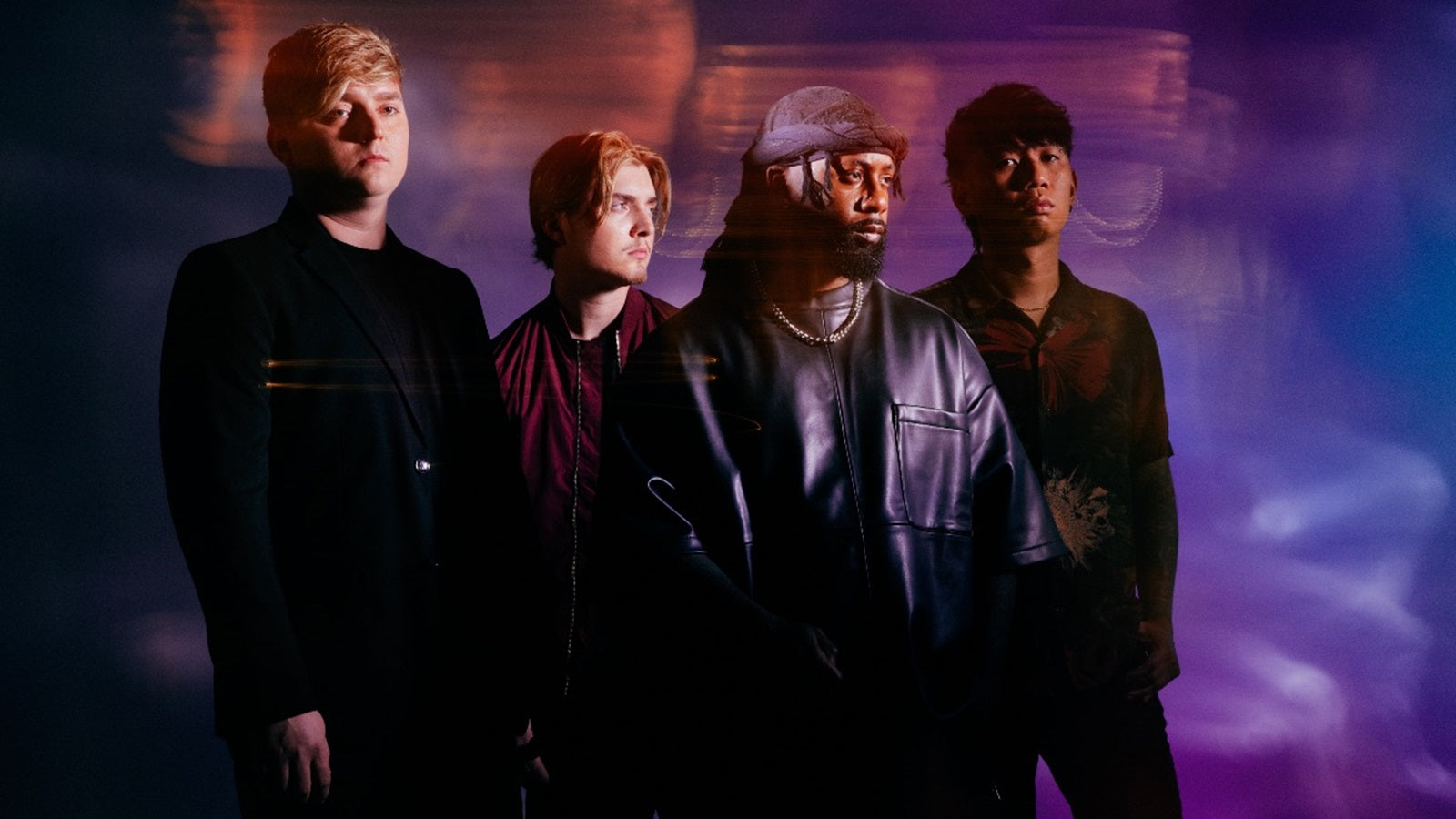
Sleep Theory’s rise has been swift, but frontman Cullen Moore has been training for it his whole life. Growing up the son of an R&B musician and then following his father’s footsteps in the Army, Moore has had years to cultivate the drive, collaborative spirit and creative vision required for a successful musical career — lessons he’s kept close as his band has quickly blown up.
And Sleep Theory have been on a whirlwind ride over the past year. Immediately after the Memphis band dropped their debut single “Another Way” in 2023, the atmospheric, emotional anthem caught fire on TikTok — garnering half a million views in 36 hours.
Their Epitaph Records-released debut EP, Paper Hearts, arrived soon after — gaining them even more followers and famous fans (including David Draiman and Jelly Roll) and leading to profile-boosting gigs alongside Shinedown, Beartooth, Falling in Reverse, Wage War and others. The band’s exciting mix of metalcore, pop and R&B is clearly connecting in a big way — and has positioned Sleep Theory as one of heavy music’s biggest breakouts.
“I don’t even know what genre we are, to be honest,” Moore says of their sound, which recalls genre-blurring bands like Bad Omens and Sleep Token as they confidently weave together beatdown-ready riffs with soulful, heartrending ballads. “We’re gonna keep you guessing. That’s what we like to do.”
While the rest of Sleep Theory — which is rounded out by bassist Paolo Vergara and brothers Daniel Pruitt on guitar and Ben Pruitt on drums — were caught off guard by the sudden attention, Moore had a different reaction. “It wasn’t a surprise,” says the singer. “It was more, ‘OK, it’s happening now.’” The band are currently working on their debut full-length — and if the recent hype is any indication, Sleep Theory’s next chapter just might exceed Moore’s own sky-high ambitions.
Sleep Theory may appear to be an overnight success story — but the journey for Moore to get here took years, and it was not a straight line. Before the vocalist was born, his father dabbled in R&B, writing ballads until parenting took precedence.
Moore’s own passion for music ignited when he was a teenager, and the budding musician was inspired by everything from Linkin Park to Michael Jackson. His dad supported Moore “all the way — from being a 14-year-old kid that didn’t really know where he was going.” But his mother had some practical concerns. “Mom loved it, but she just wanted [me to follow] a for-sure career,” he reflects. “Not knowing which way the music could go is scary for a parent.”
While Moore shared his dad’s passion for music, he was certain he wouldn’t follow his father’s path into military service. But his position shifted as a young adult, and Moore opted for that “for-sure career” and joined the Army.
“I was never a troublesome person, but joining the military was still good for me,” he says. “I learned how to work with other individuals, be open-minded, calm and look at a situation in its entirety.” Moore says his “time in the Army helped shape me in a lot of ways” — but he couldn’t shake his love of music, and ultimately retired from the service to pursue his rock star dreams.
He gave it a go with a local Memphis band, but that partnership fizzled out in 2019 after the group refused to work with producer David Cowell, whom Moore believed could help take their sound to the next level. So, Moore and Cowell spun off their creative partnership and focused on the new outfit Sleep Theory.
For the first few years, Sleep Theory was purely a studio project, with Moore and Cowell as the central elements. But from the beginning, the pair shared lofty dreams for their music. “A lot of people tend to be in competition with local artists,” Moore says, “but we wanted to aim higher.”
Vergara entered the picture after Moore met him at a birthday party (where he witnessed their future bassist pick up a guitar and play Paramore’s “My Heart”). They soon recruited drummer Ben Pruitt, who laid down the skittering, angsty drop into the chorus of “Another Way” — which was featured in the TikTok clip that went viral. “Within two days,” Moore says with an incredulous laugh, “Ben went from being in a local band to being in this band that was everywhere.”
Luckily, as the demand for more Sleep Theory music rapidly grew, the band found a guitar player in Ben’s brother Dan, who could shred and scream in equal measure. The lineup was set.
“People will say we skipped a lot of steps,” Moore says. “But, truthfully, blowing up so fast out of no-where is more stressful than working towards it for years. If you, for a second, let things [fade,] people will get distracted … they will forget you. We had to figure out how to stay relevant.”
A key piece in Sleep Theory’s musical success is their ability to keep even the most seasoned metal listeners on their toes with their mix of genre-hopping sounds. The influence of which, Moore says, can be traced back to the acts he loved growing up like Bring Me the Horizon, Linkin Park, Beartooth and Saosin, as well as contemporary alt-metal groups like Bad Omens and Issues — the latter’s 2019 record Beautiful Oblivion, in particular, is the “no-skip album” benchmark Moore still aims to hit.
Moore also adds that as a kid he was shaped just as much by Boyz II Men and the Temptations. So naturally, those inspirations eventually found their way into Sleep Theory’s music. After Cowell helped Moore produce a recreation of a song made by his father, Moore was asked, “Why have we not tapped into this area of R&B? You’re smooth with it.”
This lack of predictability has come to define Sleep Theory’s creative process — and it’s led to everything from singles like “Gone or Staying,” an experiment in making a lo-fi song with R&B thrown into it, to a just-released new single, “Stuck in My Head,” which Moore emphasizes is “super R&B.”
For Moore, writing his lyrics with a sense of candor and vulnerability was also crucial. “A lot of times, people write in ways that let people interpret how they may want to take the song,” he says. “We want to write songs to tell you how to take it.”
This element of Moore’s lyricism — as well as his desire for emotional directness — plays a big role in Sleep Theory’s “Reimagined” tracks, where alternate recordings give listeners a completely different perspective on the emotions behind his words. He singles out “Numb,” which originated as a Godsmack-esque pit brawler of angered heartbreak — but morphs into a wounded number of hurt and despair as a “Reimagined” acoustic guitar song.
“If Sleep Theory was to take all the guitars away,” Moore explains, “we can make a pop song. That’s what we always want to do: Write a pop song — but make it metal, or rock.”
With all the buzz surrounding them, Sleep Theory are taking care to make their much-hyped debut full-length — due out in 2025 — something that delivers on all the attention they’ve garnered. Moore says the as-yet-untitled album is mostly done, but it’s also a record that they continue to tweak — in part because of his perfectionism and compulsion to make it a “no-skip album” like Beautiful Oblivion.
“We’re gonna throw some things at you that you’re not going to expect,” he says. “We want it to be an experience, top to bottom.”