
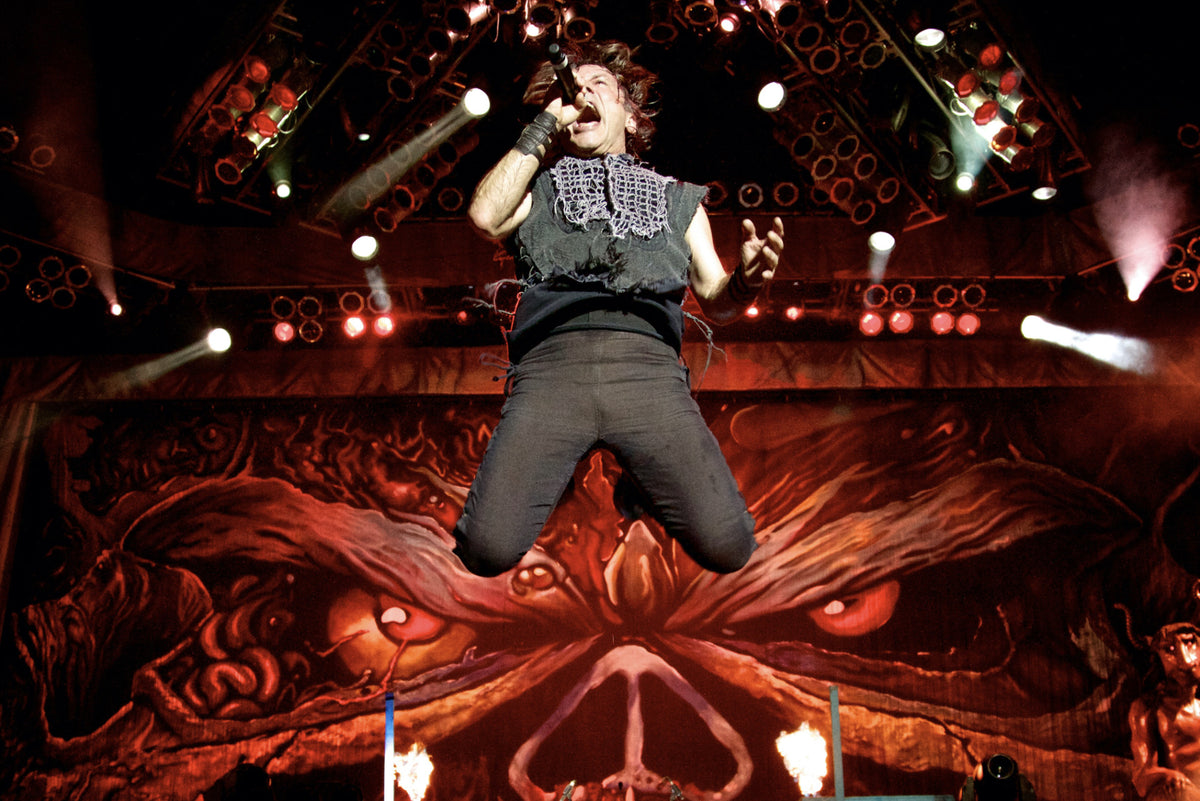
We’ve all done it at one time or another. We’re feeling particularly lousy, or something on our body is looking weirder than usual, and we turn to the Internet in an attempt to get to the bottom of it. Rock gods do this too sometimes, as Bruce Dickinson will freely admit—though the last time he attempted an Internet self-diagnosis, on a fateful day in late 2014, the Iron Maiden frontman wasn’t very happy about the results of his Google searches.
“I had a lump in the side of my neck, and a couple of other little things that were bothering me in my mouth,” the singer tells Revolver. “They weren’t affecting my voice, but I thought they were a little strange. So I kind of Googled everything and had a look, and Dr. Google and me came up with oropharyngeal cancer, with probably a human papilloma virus [HPV] tumor on the back of the tongue. And I went, ‘Hmmm, okay—it might be that. Or I could just be an Internet hypochondriac!'”
Rather than immediately make a doctor’s appointment, Dickinson decided to hold off for the time being—not because he assumed that he was being paranoid, but because he thought he might actually be very sick. And with less than a month of work left to do on The Book of Souls, Iron Maiden’s sixteenth studio album, a life-threatening illness was pretty much the last thing he wanted to think about.
“I thought, ‘You know, there’s a chance that I might actually be right, and I don’t want to know before I finish the album,'” he recalls. “So I told myself, ‘I’m going to finish the album first; that’ll be about three or four weeks, and then I’ll go to the doctor!'”
It had all been going so well up to that point, too. Since September 2014, the iconic British metal band had been holed up at Guillaume Tell Studios in Paris, France, with longtime producer Kevin Shirley; the immensely fruitful sessions had yielded eleven mighty tracks, enough to fill out Maiden’s first double studio album of their nearly forty-year existence. The band was firing on all cylinders, and plans were already being laid for The Book of Souls‘ release, as well as for a worldwide tour to support the album. But as he continued to soldier through the recording of the album’s final vocal tracks, Dickinson became increasingly distracted by the growth on his neck.
“This lump on my lymph node was getting a little bit bigger,” he recalls, “so I called in a local French doctor to have a look. He looked at my neck, said ‘Yeah, okay,’ and then he put his hands down the front of my pants and had a good feel. I thought, ‘He’s not just being friendly. This is a pretty thorough examination!’ And then he said, ‘You need to go and get a CAT scan of your chest, an MRI of your head and neck, and a biopsy of that lump in the next three days.’ So I went, ‘Okay—it’s not just a cold then, huh?'”
Cancer has afflicted several rock stars in recent years, including Tony Iommi of Black Sabbath, Def Leppard’s Vivian Campbell, and of course the late, great Ronnie James Dio, who passed away in 2010 from stomach cancer. But the news that Bruce Dickinson had been diagnosed with cancer was particularly hard for fans to process. After all, “the human air raid siren” had always seemed to be the very picture of rude good health, commanding the stage at Iron Maiden shows with the sort of vigor and athleticism that would shame most men three decades younger than his 57 years. He was always in near-constant motion off-stage, as well, with a résumé that includes successful stints as a commercial airline pilot, competitive fencer, BBC radio host, author, screenwriter, and beer brewer, and a solo discography comprised of six studio albums, including 2005’s Tyranny of Souls. Mortality didn’t ever seem to be part of the plan.
Mortality certainly wasn’t on Dickinson’s mind back in the summer of 2013 when, in the midst of Maiden’s “Maiden England” world tour, he played Maiden bassist and founder Steve Harris some new solo demos that he’d been working on with producer Roy Z.
“Steve and I were chatting about what were going to do in the following summer, and I was really looking forward to getting a new Maiden album together, so I said, ‘Well, here’s some stuff I’ve been doing.’ I played him the five or six tracks I’d done with Roy Z, including ‘If Eternity Should Fail,’ which I was thinking would be the title track of my solo album. And Steve was like, ‘Oh my god! The title track of your solo record—shit, that’s so good! Can we use it for Maiden?’ So I was like, ‘Well, that’s kind of cool; we’ve got one tune down already, and we’re only in the dressing room, backstage at some show!'”
At this point, Harris revealed to Dickinson that he also had some ideas for a new Maiden record. “He said, ‘Yeah, I’m thinking of calling the album The Book of Souls — I’m writing a song about the Mayans.’ And I went, ‘Yeah! We could get a great stage show out of that, and great imagery for the album!’ So we pretty much left it at that. We had a great song that was pretty much finished, and whatever Steve was writing, and then whatever happened next.”
Thus, the ball started rolling on what would become The Book of Souls. Following the tour, Dickinson and guitarist Adrian Smith got together to write two new songs, “Speed of Light” and “Death or Glory,” the latter of which was inspired by Dickinson’s latest aviation obsession—a 1918 Fokker tri-plane replica that he’d recently purchased and begun flying as a member of the Great War Display Team, which performs aerial World War I reenactments across the U.K. “I was writing about what it must have been like getting up in the morning and getting into an aircraft during the first World War and going and dogfighting over the trenches,” he explains. “The strange beauty of the dawn and the frost and the dew, and then going off to do this horrendous combat.”
Now Maiden had three completed songs to work with—and when Dickinson, Smith, Harris, guitarists Janick Gers and Dave Murray and drummer Nicko McBrain convened in Paris last summer to begin rehearsals for the new record, Harris and Gers showed up with another completed song, “Shadows of the Valley.” The initial plan was to tighten up those four songs and finish writing several others in a Paris rehearsal space, then head into the recording studio with Shirley. But that idea was quickly shelved, mostly due to Harris’s concerns that their practice sessions might be bootlegged.
“Steve got kind of worried that people would hang out outside the rehearsal studio and start taping what we were doing, which is apparently what happened when U2 and The Rolling Stones were rehearsing at the same place,” Dickinson explains. “As it turned out, the recording studio, which was right down the road, was available for that same period. So we were like, ‘Well, why don’t we just go into the studio and start rehearsing there! By the time that Kevin shows up in a few weeks, we’ll be ready to go!'”
The decision to head straight to Guillaume Tell completely invigorated the writing and recording process for the album. “We would rehearse a song and record it straightaway,” Dickinson says. “That way, you don’t get bored with it—you get the spontaneity of putting it down straightaway, and if anybody has any fabulously funky ideas for it, you just try it. If it works, you keep it; and if not, you can always do it again. It’s a very exciting way to work…
“With most of the songs, it was really all about sitting together in a circle, learning the tunes, and going in there and playing them,” he continues. “As the instrumental parts were put together and Steve was coming up with the words, the band was learning the stuff and playing it straightaway. I didn’t have much time to learn the vocal parts, so we didn’t even bother with that; they just played the backing track, and I just sat back in the control room and drank coffee and went, ‘Yeah, that’s cool!’ With about 50 percent of the songs, I learned the vocal after the backing track had already gone down.”
The band soon realized they had a double-album’s worth of material on their hands, with several of the tracks—including the 13-and-a-half minute “The Red and the Black” and the album’s 10-and-a-half minute title track—running well past the seven-minute mark. “We got to about six songs, and said, ‘Well, we’re either going to have to stop now, or it’s going to be a double record,'” Dickinson laughs. “The whole thing was really good fun. We were really getting off on just hanging out and playing music. There’s so much musical scenery being moved around on this record, you just don’t notice that a song is 18 minutes long, or whatever it is!”
The 18-minute song in question is the album’s closing track, a multi-part historical epic called “Empire of the Clouds,” which Dickinson gradually pieced together over the course of the recording sessions, and which has the distinction of being the first piano-driven track in the entire Maiden catalog. “I conceived and composed the whole thing on piano,” he says. “There was nothing on it that was designed for guitar—it was all designed for fiddles and bodhrans and French horns and cellos and god knows what. But I knew perfectly well that the Maiden guys would be playing it, so of course guitars would be playing those parts. I finally played it all for Steve, and he said, ‘Wow, that’s unbelievable! Let’s just do it exactly as it is!'”
The completed version of “Empire of the Clouds” makes for a stunning capper to an impressive work by an obviously still-vital band. In fact, The Book of Souls ended up debuting at No. 1 in 24 countries. It’s a high note to Iron Maiden’s career, which didn’t have to end due to Dickinson’s health issues. After 33 radiation sessions, nine weeks of simultaneous chemotherapy, and surgery to remove an HPV tumor from the back of his tongue, the singer’s doctors pronounced him cancer-free in May.
“It was a pretty aggressive treatment, but I’m extremely lucky,” he reflects. “I had a bunch of great doctors and nurses—and because of the technology they’re using now, my radiologist was able to miss lots and lots of organs and glands that, 10 years ago, would have just been fried by the radiation. Ten years ago, it would have been the end of my salivary glands, and the end of my career. But now they’re up and running, and the rest of the sprinkler system that lubricates my throat is all starting to grow back. A bit like the hairs on my chinny chin-chin, which literally all fell out one day at the pub,” he laughs.
The tour for The Book of Souls has been postponed until 2016, giving the singer ample time to get his pipes back into fighting shape. “I’m just waiting now for things to heal up a bit more,” he says. “All the notes are there, but it’s a question of chilling out and letting it heal up before you start trying to do the equivalent of the 100-meter sprint on your voice. My larynx is absolutely fine, but I’ll need to work on the muscles a bit more.”
Despite the temporary setback, Dickinson remains his ebullient, positive self—so much so, it’s easy to picture him onstage singing “The Trooper” and “Run to the Hills” again with his usual gusto. “Well, I might have to go and have a vocal lesson for the first time in my life,” he chuckles. “Shit, maybe I’ll learn something!”