
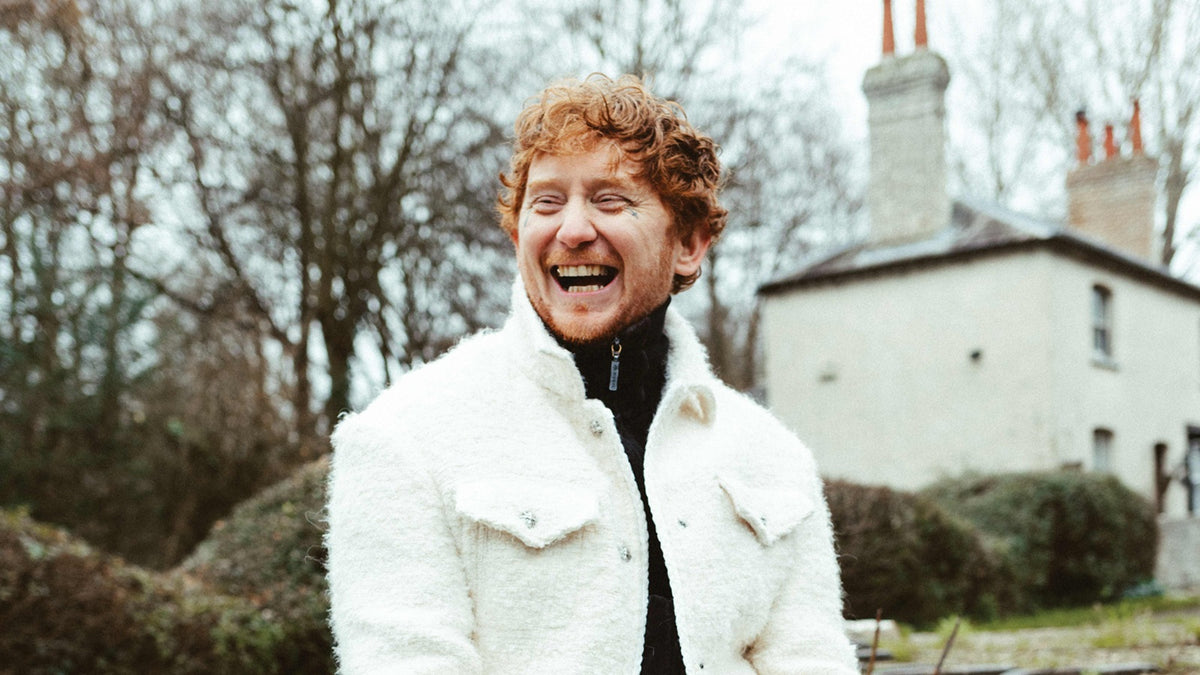
“Younger Frank Carter would punch me in the face.”
Carter laughs at the idea of telling his past self he’d be singing for the Sex Pistols. “He’d probably tell me to fuck off and call me a liar.”
Yet this summer, he’ll be doing exactly that — fronting the Sex Pistols as they celebrate 50 years of punk in honor of their iconic 1976 shows at Manchester’s Lesser Free Trade Hall. The tour will cross Europe and North America with Carter at the mic alongside guitarist Steve Jones, bassist Glen Matlock and drummer Paul “Cookie” Cook, performing the group’s landmark 1977 album Never Mind the Bollocks, Here’s the Sex Pistols in its entirety. The partnership began in 2024, when the Pistols reunited for a pair of charity concerts with Carter on vocals, and continued into additional shows and touring throughout 2025.
“It’s ironic now to sit here and have received the call-up to sing for the Pistols,” Carter tells Revolver. “When Gallows started doing well, there was so many comparisons made between me and Lydon [aka founding Sex Pistols vocalist Johnny Rotten] that I pushed against it. I really wanted to be seen as my own person.”
But these days, he can appreciate the full-circle moment. “Obviously, it’s a very big deal,” says the singer. “It’s hard to put into words. I don’t even know what to say about it because it’s a bit of a dream for me. The band changed my life properly.”
Carter’s connection to the Sex Pistols goes back to his childhood in Hertfordshire, England. After discovering his father’s copy of Never Mind the Bollocks, he and his brothers would open up circle pits in their living room. Carter carried that same ferocity into the music he would later create with Gallows, earning a reputation as a wild-eyed frontman who often ended up bloodied in the pit while leading the band through two gritty, brutal albums: 2006’s Orchestra of Wolves and 2009’s Grey Britain.
After departing Gallows in 2011, Carter formed the more rock-oriented Pure Love before returning to his hardcore roots with Frank Carter & the Rattlesnakes, whose five-album run culminated with 2024’s Dark Rainbow before the band went on hiatus.
As for what comes after the Pistols gigs, Carter is coy. “It’s going to make a lot of people happy,” he says.
He grins, then adds: “I want to find a way where I can go with my friends and we can play some songs in beautiful surroundings. I love little theaters, little crypts, little old churches and chapels. That’s where I see myself down the line, but I’m not quite there yet. So what comes before that, we don’t know.”
First, though, he’s got to get through the Bollocks…

Per Ole Hagen/Redferns
How did you first discover the Sex Pistols?
Frank Carter My dad was a DJ and we had a crazy wealth of music in the house, just loads of records. Never Mind the Bollocks was just always slightly out of reach — for a reason, probably [laughs]. But there were times where my parents would be out and me and my younger brothers were still in the house, and I’d get my hands on it and put it on. We’d have essentially a mosh pit on the couch and floor until someone got hurt. Then I’d have to be frantically trying to console them and say, “You’re fine. Nothing’s broken,” while putting the record back and making sure we weren’t going to get in trouble.
What’s your favorite Pistols song?
“Bodies.” There’s something about that song, I just fucking go feral. I get a rush from my toes to my shoulders, and my head goes nuclear. I’m ready. I just seem to find myself in the mosh pit after it starts. It’s like I teleport there. I don’t remember getting down there.
What’s it been like singing with them?
I love them all dearly. I think they’re brilliant people. They’re an actual force when you’re playing with them. They’re tight as fuck, and when they lock in, it’s an actual joy to be amongst it. There are many, many times when I’ll turn around and just be like, “Oh. My. Fucking. God. That’s Steve Jones.” And he’s my mate. We get on. We put the world to rights. We chat shit and have dinner, but sometimes when he’s playing guitar, I’ll turn around, it’ll catch me off guard, and I’m just like, Fucking hell, what the hell? Then you turn, and you see Matlock, and you see Cookie give you a smile. [Then it’s like,] OK, right. I got a job to do. But I’m so grateful. I’m just so, so grateful.
Seventies punk had such a strong visual identity. As a tattooer and visual artist yourself, how much do you think punk still relies on that today?
It is a big identifier. You can find your people quite easily with punk. I think it’s always been about people that aren’t afraid to go against the grain. That’s why we have people like [designer] Vivienne Westwood who go and do such bold things in a fashion space, which at the time was just finding the underground and making it mainstream and putting it in people’s faces and saying like, “What about bondage makes you upset?” And enjoying the thrill of that conversation. The homogenization of society is to say, “Well, that might be normal for you, but this is normal for me, and what’s normal for me is offensive to you.” But luckily, I don’t give a fuck. So, it’s about the confidence of having that conversation.
Ok, leather jacket or denim vest?
Mmmm. It’s complicated. Probably a leather jacket, but not a motorbike leather jacket. I like a nice, smart leather jacket. You have to wear the clothes. You can’t let the clothes wear you. It’s a fine line between that being right or very wrong. I’ll go with a leather jacket, but if this was 15 years ago, I would’ve said denim jacket all day because that’s what I wore every gig.
Speaking of that era, Gallows’ Grey Britain was a heavy record that tackled politics, class, religion and social unrest. Does it feel more relevant today than it did in 2009?
It’s never been more poignant. I’m heartbroken. Back then we were talking about the civil war of the people. We were talking about the class difference and the damage that was happening to the people that were living on the ground, getting shit on by the elites. Now we’re just watching what happens when you let more and more of them get into power. It’s been insane.
It’s a truly pissed-off sounding record. Do you ever feel the urge to scream like that again?
I was fuming. I was really angry. Yeah, all the time. All the time. Now, more than ever.
When I picked up the mantle to go and do the stuff with the Pistols… when you jump in a mosh pit, you’re reminded of where you’ve come from. With Rattlesnakes and Pure Love, it was just so different. It was about crafting songs, becoming a good songwriter and challenging my voice. I knew I was a good performer. I didn’t necessarily think I was a good singer.
I can say wholeheartedly, 100 percent, if I was to do it again, it would be better than it was in 2007. Gallows started everything for me. That band is the reason that I sing in the Pistols now. I’ve been able to live on my own terms for the past 20 years because of that band. But fuck me, I’d be angry. I got real venom now. I’d be angrier than I was then. That’s for sure.

Josh Beech
What were the highlights of your time in Gallows?
We weren’t scared to make collaborations with people where we felt like it made sense. We did a tune with a grime artist, Lethal Bizzle [a cover of the Ruts’ “Staring at the Rude Bois”]. He’s a musical genius. He’s a great lyricist. He’s a wicked businessman. That was a big moment for us, smashing two worlds together that were essentially so far apart. We brought them together and put them on a stage.
And we played a gig in Finsbury Park with Rage Against the Machine. We covered a Sex Pistols song [“God Save the Queen”] that day, weirdly. It was a big gig and a really beautiful moment.
Yeah, it took us around the world to places that I probably never would’ve been able to go. We were able to, I think, give back to music by making some really interesting collaborations, which I think opened the door for a lot of artists to come. We played some shows that were iconic. I know that’s probably ego talking, but fuck it — if you don’t, you’re dead. [Laughs]
You did the Rattlesnakes for 10 years. What stands out most from that run?
We were pretty fearless, as far as a band goes. When you have a sound, two things can happen: You can repeat it and know that you’re going to make everyone happy, or you can challenge it and you risk losing a lot of your fanbase. But, you gamble on gaining, I don’t know… magic? Every album we risked it and I think there’s still a thread through where you can hear that it’s Rattlesnakes. But in 10 years, we did five albums, and they each had their own bite. That’s something to be really proud of.
When you toured with the Rattlesnakes, you often encouraged women-only mosh pits and spoke openly about mental health. In a genre like punk that’s often seen as tough-guy shit, how important is vulnerability and creating that kind of space for you today?
It’s probably the ultimate freedom, I reckon. If you can be a vulnerable person, then you are free of the constraints of society and the way that you should behave, the way that you should be acting, the way that you should think and feel. Arguably now, we’re more divided than ever. They’re literally implementing the divide-and-conquer strategy that worked so well for Rome in our communities and our neighborhoods and, in some aspects, our homes. So, to say, like, “I don’t fucking feel good. I don’t like the way this is going,” is super fucking brave.
Once you start doing it, you never go back. Once you’re free of the weight of that around you, there’s no point ever where you think, Wait, let me pick up that again. You realize how problematic that is in your life to sit behind a mask of happiness, or whatever, and to have mental health problems, to be an insecure person, to not be able to share about addiction problems or depression. It’s important to be able to share about it with the right people as well.
To be vulnerable in your community is a big risk. It’s always one worth taking, I think, because then you really see who’s out there to help you. And a problem shared is a problem halved.

Josh Beech
You mentioned jumping in mosh pits. How do you maintain that sense of danger without it looking like a stunt?
Well, you can’t. There’s always the risk that it will look like a stunt. But a cynic is going to be cynical regardless. The people that I land with in the pit will take one look in my eyes and understand that it’s not a stunt. At the very bottom of it all, I’m a fan. In fucking 30 years of going to gigs, the best times I’ve had have been on the dance floor. When you take it down there, it’s good to hold people and breathe them in and remind them that they can do what I do.
I saw Deftones play when I was 16 years old, and Chino [Moreno] crawled and stood on the barrier right next to me at a big festival in the rain. I remember feeling like I could touch him. I could high-five him. That’s my hero — this guy changed my life, and he’s fucking next to me now. I felt electric for the whole weekend because I was close to God, or something. So I understand as a fan how important it is to break that barrier of “them and us,” because at the end of the day, anyone can pick up a guitar. Anyone can write a song and be in a band.
What’s the most punk thing you’ve seen a fan do?
Most recently [at a Pistols show] in France at 1 a.m. in the morning, I saw a man in a wheelchair crowd surf. I mean, even going into a mosh pit in a wheelchair, you’re half the height of everyone at that point, which is dangerous. Being able to navigate and communicate — “Lift me the fuck up, I want to crowd surf” — it’s just wild. He saw me and his face had the biggest smile I’ve ever seen on a human. That’s what this is all about.
If you had to describe the state of punk in 2026 in one word, what would it be?
Healthy. There are some incredible bands coming out from all over the world, like Split Dogs, Scowl, Speed and Clobber. When you live at the crossroads of such difficult times when there’s so much going on, it’s inevitable that people will be angry about what they’re seeing. They will write about it, and they will vent their frustration in the only way they know how.
Do you feel a responsibility to the anarchy of your younger self? Or is the most punk-rock thing you can do just outgrow everyone’s expectations?
People will have expectations regardless. Outgrowing them is something you either do or you don’t. The most punk-rock thing you can do is be yourself. Sometimes you might not like who you become. But if you can accept it, it will make your life a lot easier. When I see people radically taking care of themselves, I just think they’re pretty epic individuals, and I want to be around them.
It’s time to change. It’s time to do something different. I want to see a world where we care for ourselves and each other with radical enthusiasm, just to see what happens in the world after that. So, yeah, to answer your question: be yourself and outgrow anyone’s expectations — because that’s true anarchy anyway.