
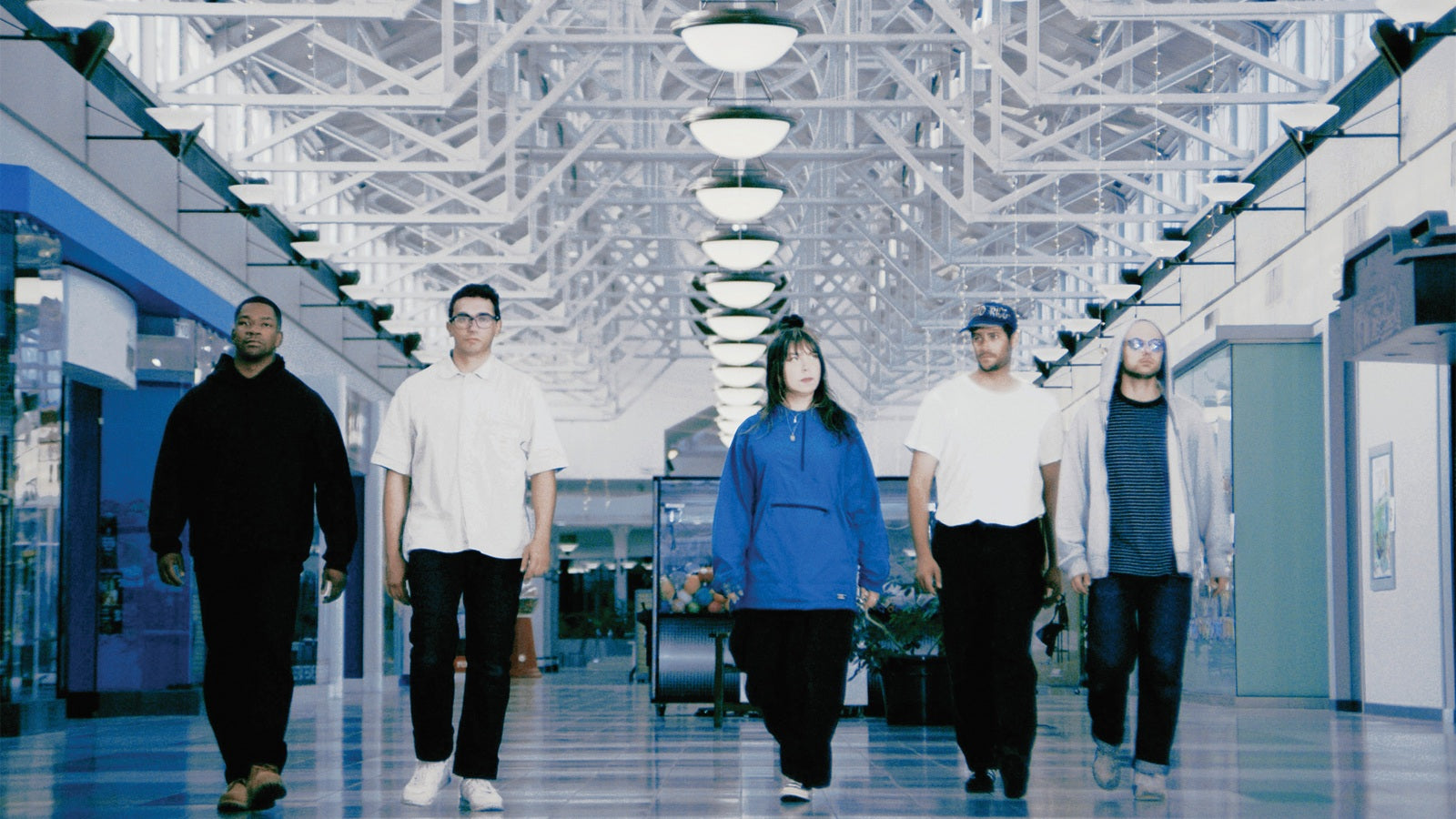
Fleshwater weren’t supposed to be the main event. The project began in the margins — a place for Anthony DiDio and his bandmates in Boston metalcore stalwarts Vein.fm to channel softer, dreamier instincts that didn’t fit their band’s brutal chaos. But We’re Not Here to Be Loved, Fleshwater’s 2022 debut, hit a nerve. Its blend of shoegaze haze, alt-rock melody and hardcore bite turned the act into a cult favorite almost overnight — embraced by TikTok, co-signed by Deftones, Harm’s Way and more, and propelled onto the national stage.
Now, the band are entering a new chapter with 2000: In Search of the Endless Sky — a denser and more atmospheric follow-up, recorded with Converge’s Kurt Ballou, who also produced their debut. It’s an album shaped by personal upheaval, though they won’t spell it all out.
“There was just a lot of change in life,” says DiDio, “and a lot of personal things that we all had to go through. I can’t speak too much on that… But I think if you listen to the record, you can get the gist of it. It doesn’t necessarily matter if you know exactly what key event I’m talking about, because I feel like you could make your own sense of it and resonate with it in your own way.”
That emotional intuition and vulnerability is core to Fleshwater’s creative process. When they step up to record their vocal lines, they let whatever falls out fall out and find meaning in it later. “If it feels right, it feels right,” he confirms. “You might not even fully understand what you’re saying at the time, but there’s a reason for it, and then you can make more sense of that as you go on and build off of that.”
It’s a method that’s grown naturally out of their close-knit lineup. Formed in 2017, the band includes vocalist-guitarist DiDio and his Vein.fm bandmates Jeremy Martin (bass) and Jon Lhaubouet (guitars), plus new drummer Josian Soto-Ramos and vocalist-guitarist Marisa Shirar — who also releases solo music as MIRSY and is DiDio’s longtime partner. That closeness adds another layer to their chemistry.
“We talk so often since we are together, and it just made us bounce off each other a lot faster than I feel like I would with someone I wasn’t dating,” offers Shirar before turning to DiDio for his thoughts.
“It’s easier and harder,” responds DiDio. “But when there’s two people that are putting their brains together, even if it clashes a little bit, you end up coming out with something greater than if it was just coming from one person’s mind. Us being together definitely helped us be more open with each other — fighting to make it the best thing possible and not holding back on how we feel about it. That level of closeness and openness allows for more honesty in how we communicate creatively.”
That chemistry has translated well beyond the studio, fueling a live presence that’s only expanded their reach. And their audience keeps multiplying, thanks in part to a high-profile North American tour opening for Deftones earlier this year. “They’ve been playing shows since the early Nineties. So to see them still killing it and just getting bigger and bigger is very inspiring,” notes Shirar. “It shows that this is something that could be a lifetime thing — if you just continue to be as passionate as them.”
Revolver sat down with DiDio and Shirar to talk about the making of 2000: In Search of the Endless Sky, how Fleshwater are carving out their own place in the nu-gaze conversation and more.

Fleshwater’s quickly become more than just a Vein.fm side project – it’s blown up a lot and it has its own life. What does it take to juggle those two projects simultaneously?
ANTHONY DiDIO I’ve come to realize how much of a healthy thing it is, because one hand sort of washes the other one. It keeps both things fresh and inspiring. I think it’s healthy too, because we just have so many influences as a collective. Vein gets melodic at times, but it’s a different type of melodic. In Fleshwater, we express a lot of other influences — we just express them in a different type of way that doesn’t really fit into Vein, and it’s still stuff that we’re really passionate about. It keeps both things healthy, because it keeps the things we want to express in the right places, as opposed to, like, jamming it all into one thing.
Has the balance had to shift at all now that Fleshwater’s doing so well, and given Vein.fm hasn’t put out an album in a few years?
DIDIO I think about Vein all the time, and there is a right time and place for everything, creatively. When the time is right for certain things, the time will be right. And that’s only dictated by us, as well, and where we were at creatively at the time, where we’re at as people, and things like that. This album was already being worked on before the first one came out, so there was already a creative drive towards it before a lot of outside things started happening.
You’ve worked with Kurt Ballou from Converge again for this album. What is it about his approach to music that gels so well with yours?
DIDIO We’re all big Converge fans and what he does in his bands and with other bands as a recording engineer has always been a really big source of inspiration for us. Also, he’s from Massachusetts, where we’re from. I think that he is really good at making a quality recording, and he’s extremely knowledgeable and cares about what he does, and I think a lot of that resonates with us. And he’s also just a really great person to work with.
You’ve also got David Haik from Pianos Become the Teeth drumming on this album — what did he bring to the table?
DIDIO Our old drummer [Matt Wood] had to part ways due to personal reasons [but] it’s all love. So, we were in between drummers, and I saw Marisa had played a solo show opening up for COLD MEGA.
Dave Haik was playing drums for COLD MEGA, and the way he hit his drums really reminded me of our old drummer, and I could feel it. The fact that he had learned that material in such a short amount of time and played it the way he was playing, it really sent off some sparks in my brain. He was playing a lot of breakbeats and really complex drum beats that were kind of reminiscent of what we had been working on in our new album. So I had thought about it for a little bit, and then I hit him up, and he took a chance on us to do it, which I’m really appreciative of, because I don’t think [the album] would have come out as good as it did without him. He really brought a lot of great playing to the record. He learned the songs very quick and understood the intricacies of it. I’m very thankful for him for making this dream come true.
This new album is more atmospheric — why do you think it ended up panning out that way?
DIDIO It was a little less conscious, and I think it was a natural reaction to what was happening at the time for us. It just felt really good.
MARISA SHIRAR Like you were saying earlier, Anthony, about how we all come from different inspirations and different influences, that’s a big key when we’re writing the vocals for things like this. Because he’ll write some vocal melodies and some ideas, and I’ll write some more atmospheric-type sounding vocal ideas, and then we’ll mesh them together. Then Fleshwater becomes what it is.
There’s lots of talk about a nu-gaze movement in alternative music, similar to hardcore and shoegaze scenes that you sometimes get grouped in with. What do you make of that? Or is that not something that really concerns you?
DIDIO I don’t really pay attention to much of it. I don’t think that this band can be confined to some newly-made genre term. I don’t really think that we’ll ever put ourselves into that type of box. And in terms of other people taking hold of that… that’s fine. It’s not really for me to say, I guess. That’s just how the world works, and I never think about those types of things. I don’t put ourselves in that box at all and if someone else does, I truly don’t care. It’s out of our control and we just do our thing.
SHIRAR It’s always interesting to see people’s take on the band and what genres they group us into. We don’t necessarily need to agree with them — or we don’t judge what they think it is — but it’s an interesting thing to see, and we take it for what it is.
DIDIO It’s always happened throughout time, and so it’s going to keep happening. We just stick to doing our thing. We don’t really pay too much mind to that. It’s out of our control. The only thing we can control is the music and art that we make.
In that sense, do you see Fleshwater as a project with no ceiling? Could your future albums end up sounding completely different from how they do now?
SHIRAR We live together, so I see Anthony writing music constantly all the time. He’ll wake up one day and decide to write a completely different style of song than what we normally have, but then we love to figure out a way to make it sound like Fleshwater.
DIDIO I feel like it’s always gonna be Fleshwater. We’re never gonna switch up so hard that it’s a totally different thing. It’s always going to feel like Fleshwater. It’s like a gene — a thing that we all have collectively that’ll always be inside of everything we do. Things will evolve and I would love to see a longevity, sonically and artistically. We’ll take it step by step as we go.