
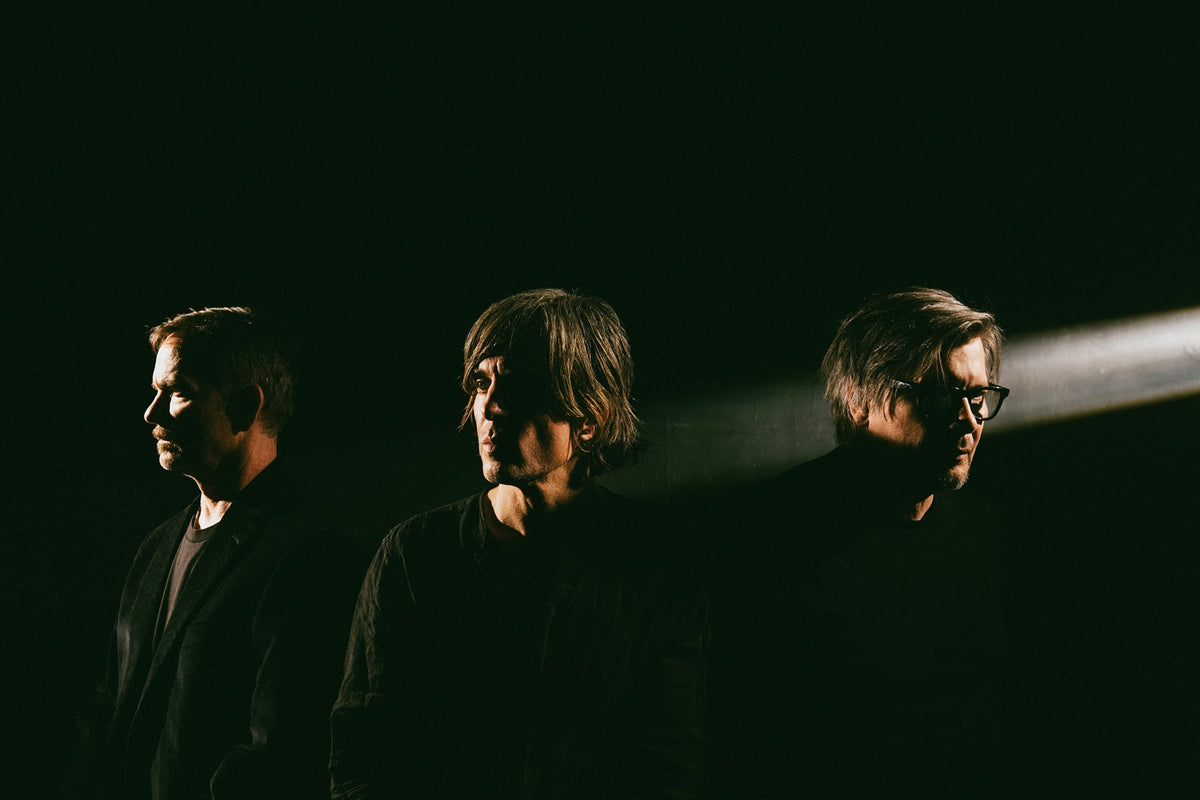
Even under regular circumstances, the arrival of Failure’s Location Lost — the cult alt-rock act’s fourth album since reuniting in 2014 — is a precious thing. That vocalist and multi-instrumentalist Ken Andrews almost died before they could even record it makes this all the more special.
Submerged in shimmering guitar opalescence and windstorm drum work, the band’s seventh album’s first single, “The Air’s on Fire,” alludes to Andrews’ health struggles. A couple of years ago, a freak workout accident at home left the musician with a burst disc in his back. Though the surgery itself went fine, Andrews explains that he came out of anesthesia experiencing extreme physical discomfort and was soon thrown into a hallucinatory waking nightmare.
“You know how sometimes when it’s really hot, you look at something far away and you see those heat waves in the air? That’s what it looked like, almost like an acid trip,” he tells Revolver. “They did manage to stabilize me, and then the next day they were like, ‘We think you’re good to go home.’ I was feeling better, but then a nurse came in to change my IV and said, ‘You should stay a couple more days. You almost died yesterday, man.’”
Formed near the turn of the Nineties, the Los Angeles trio have faced their share of difficulties over the decades — from health problems to a 17-year dormancy period — yet their profile continues to grow. The band’s illuminating 2025 documentary, Every Time You Lose Your Mind, traces their beginnings and dives into its members struggles with addiction. It also details the feverish fandom Failure’s music instilled in mega-stars like Paramore’s Hayley Williams and TOOL’s Maynard James Keenan, while also explaining how waves of new listeners gravitate towards once under-the-radar, yet now-classic records like 1996’s Fantastic Planet. (They’ll celebrate the 30th anniversary of that belatedly beloved effort next month at the inaugural Space Echo Festival in Chicago, Illinois.) More eyes may be on Failure now than ever before.
Location Lost honors the sonic history Andrew holds with co-founding multi-instrumentalist Greg Edwards and longtime drummer Kelli Scott through songs like “The Air’s on Fire,” the post-punk-rumbling “A Way Down,” dramatic space-rock closer “Moonlight Understands” and the floating-point haziness of “The Rising Skyline” — the latter featuring a guest spot from Williams. Andrews admits it was a challenge to get back into the swing of things with Failure after his surgery, but eventually found himself reflecting on and inspired by his traumatic hospital trip.
“I really dug deep into finishing the songs, and it turned out on this record — as opposed to the last three — that I ended up writing more lyrics,” he says, adding, “We’ve never shied away from letting those kinds of personal things come into the songs, both musically and lyrically. I knew early on that [the back surgery] was gonna have an impact, because it was something I had recently survived.”
Speaking with Revolver, Andrews discusses his surgery, collabing with Williams, and the future of Failure.

Lindsey Byrnes
Location Lost is the first Failure album to come out following the release of the Every Time You Lose Your Mind documentary, which was something a filmmaker had begun, but then you ultimately took over. How did fine-tooth-combing your own history through the film — really exploring the songs and experiences you’ve had as Failure, as well as the relationship that others have had with your music — affect the way you wrote this album?
Ken Andrews I’m not sure it had that much to do with this album. It had been a good amount of time since the documentary was done, and I think there were other things that were just more in the forefront of my mind when we were making the record.
Like what?
Well… I had this back surgery in 2024 that ended up taking place when we were originally scheduled to be in the studio. That ended up delaying [the recording] by quite a while, because it ended up [being] more than just a physical recovery.
I’m not sure if it was the medicine they used to put me under, but I ended up having a bit of a mental breakdown after the surgery. So, the recovery took quite a while. Even when we finally did start, I still wasn’t all there mentally.
How did you injure your back?
Working out. I did an inclined sit-up and burst one of the discs in my back — most of it came out into my spinal column and fell down onto the nerve roots of my leg. So, all of a sudden I felt a knife-like pain shooting down both my legs.
How long did it take for you to get into surgery?
I think it was five days. But I knew what happened, so I immediately drove myself to get an MRI, and the guy who handed me [the results] said, “You need to see a surgeon, immediately.”
What do you remember about waking up after the procedure?
I’ve had a few different surgeries before that, so I knew what coming out of general anesthesia normally feels like — this wasn’t like that. This was, like, full-on hallucinations and drifting in-and-out of semi-consciousness.
I was super panicky. I was freezing one minute, and then feeling like the air was on fire the next minute. I saw all these doctors trying to figure out how to stabilize me. It was pretty dramatic, and not a fun experience.
Across Failure’s discography, there are albums where each of you is working through your own kind of physical challenge — with Fantastic Planet, Greg was going through stages of addiction, Kelly was working on 2021’s Wild Type Droid after his cancer surgery, and now this one comes after your back surgery. Can you speak how you dealt with those challenges in the moment, or the way you approached these records because of them?
You can’t help but infuse the work with whatever is top-of-mind, you know? I felt like Kelly had something to prove with his drumming on Wild Type Droid, if nothing else just to show himself that he could do it — that he was back, physically.
When we actually started working on the music, we did it the similar way as we did on Wild Type Droid, where we got together in a studio and improvised for weeks. I wasn’t fully up to that challenge. I participated, but I didn’t feel that I was bringing what I normally was able to bring. They filled in the gaps.
When I brought all the material back to my studio later, I could tell that they had really upped their game in terms of keeping the sessions productive and coming up with cool shit.
“Rising Sky” has that guest vocal from Hayley Williams. Obviously, she’s been a fan for years — Paramore covered “Stuck on You” years ago, and you performed “Daylight” with Hayley last year at an L.A. wildfires benefit concert. Why did this song seem like the right moment for her to officially enter the Failure universe?
Part of it was because of performing “Daylight.” We had progressively had more and more contact with each other — just texting and saying hi since she had done her interview for the documentary — and we had a chance to hang out for a couple days during the rehearsal for that performance. So, she was top-of-mind as we were working on the album, and I had told her I would send her some of the songs so she could hear them in advance of it coming out.
She really gravitated towards that song when she heard it. She was like, “That’s a really different kind of song for you guys,” and I was like, “You know… you would sound really good singing verse two.” So, she took a stab at that. She was making her solo album at the time, so she was in the studio with her producer. I sent her the track, and she sang it and sent it right back. It was super easy, and it felt right.
Outside of Failure’s core trio, it’s rarefied space to have anyone else on these recordings. Troy [Van Leeuwen, former Failure member] contributed to [2015’s] The Heart Is a Monster, obviously, but what was it like opening up the process to someone fully outside of the band?
In a way, I feel like she’s not fully outside of the band, because she knows the albums really well. She’s been a fan since she was really quite young, and she’s covered some of our songs. It felt really natural, to be honest, because she knew the material and has been friends with the band for such a long time.
Somewhat on the idea of fandom, you’d previously mentioned that “A Way Down” was inspired by your love of Siouxsie and the Banshees and the Cure. How do you hear those influences popping up in the song?
I hear it in the riffs themselves — the bass part, the guitar parts, the mood of the song, and the tempo…
Kelli might have a Budgie-type thing going on with his beats…
Especially in the verses, that’s something that Budgie might do. I’m not sure if he would play that kind of four-on-the-floor thing in the chorus, though.
It’s maybe not in the vocals so much, because I’m in a lower register than [the Cure or Siouxsie Sioux] usually sing. But I hear those influences, big time.
Is the “I’m getting a ridе from my best friend” line referencing Depeche Mode’s “Never Let Me Down Again”?
Yeah! I remember thinking that line would fit really well right there, but then Greg was like, “We can’t do that, that’s ripping them off.” It’s not. It’s an homage, a reference. I don’t know if they’ve heard it yet, but I want them to.
It’s a nice continuation, too — a callback to your Nineties cover of “Enjoy the Silence.”
Exactly. That’s the way I perceived it. Like I said, if they hear [“A Way Down”], I hope they realize it’s a nod.
You produced this documentary where musicians, artists and fans are weighing in on their appreciation for Failure’s music. Have you ever had a chance to have those kinds of conversations with an artist you’ve admired?
Because of Failure’s cover of “Enjoy the Silence,” I actually ended up meeting [Depeche Mode co-founder] Martin Gore. And then he did a remix of one of my solo songs in 2000, for this electronic-type solo record I made under the name ON. He invited me up to his house in Santa Barbara to spend the weekend, and I got to hang out and shoot the shit with him. That was fun.
You mentioned Greg and Kelli were taking charge in the making of this record. How did that affect how the songs came out?
Well, that was in the first half of gathering the raw materials — the music, the riffs and the beats. Greg was actually playing synth for a lot of those jams, which definitely steered the music into different directions, even if the original synth part that he was playing ended up not playing a huge role in the finished product. It got everyone thinking differently.
So, yeah, there’s that. But the other thing was that after I started feeling better, when I brought those songs back to my house, I actually had a creative burst.
What was it like using the experience of your surgery as a guiding light for that creativity?
It really gave me a confidence boost, because I was feeling better physically and mentally. Writing lyrics on my own, recording them and mitigating my internal editor really helped me in the recovery process. And listening to what we had recorded — a lot of which I didn’t even remember, or wasn’t even a part of — was [also] super fun and exciting. Putting the vocals on that was part of the healing process for me.
Was there a standout line you wrote on this record that really blew your mind?
I like the first couple of lines of “A Way Down.” And Greg really liked them when I played them for him, he backed me up on that. “Found the note you left for me today underneath those songs you wouldn’t play,” there’s something about that line I really like.

Lindsey Byrnes
Have you fully healed from the surgery? You’re comfortable with the physicality of performing again?
There’s still a part of me that feels like I was knocked a few pegs down, physically and mentally, just because when something like that happens, you’re reminded of your mortality and how fragile the body can be. I don’t trust my body the same way I did before, but, overall, I would say I’m 90 percent there.
Greg questioned aloud in the bio for this record whether this was the last Failure record or a new beginning. The first prospect of that could be scary for fans, new and old. Where are you currently sitting with both the history and future of Failure?
I would be fine if this ended up being the last record. And I’m proud of the record, for sure.
It’s all about whether or not we enjoy the process of making the records together. If we can keep moving forward musically and excite ourselves by what we come up with, then we will keep going. If there’s ever a time where it feels like the process isn’t that enjoyable, I would definitely put my hand up and say, “I don’t know if I want to keep going with this.” But pretty much every album since The Heart is a Monster, as the touring is starting to wind [down], I ask the other guys, “You wanna do this full cycle again.” So far, the answer’s always been yes.
That’s all I know at this point. We won’t even think about another record until next year.
This interview has been edited and condensed for flow and clarity.
Failure tour dates 2026:
4/25 Las Vegas – Sick New World Festival
5/2 Chicago, IL – SPACE ECHO @ Radius
5/3 Cleveland, OH – Grog Shop
5/5 Nashville, TN – Basement East
5/6 Atlanta, GA Masquerade – Hell
5/8 Daytona Beach, FL – Welcome to Rockville Festival
5/9 Asheville, NC – Eulogy
5/10 Carrboro, NC – Cat’s Cradle
5/12 New York, NY – Le Poisson Rouge
5/13 Cambridge, MA – Sinclair
5/14 Hamden, CT – Space
5/15 Washington, DC – Union Stage
5/16 Harrisburg, PA – Arrow at Archer Music Hall
5/17 Philadelphia, PA – Underground Arts
5/19 Detroit, MI – Shelter
5/20 Toronto, ON – Opera House
9/30 San Francisco/Berkeley, CA – tbd
10/2 Vancouver, BC – Rickshaw Theatre
10/3 Seattle, WA – Showbox
10/4 Portland, OR – Revolution Hall
10/7 Minneapolis, MN – Fine Line
10/8 Omaha, NE – Waiting Room
10/9 Milwaukee, WI – The Rave II
10/11 Columbus, OH – A&R Bar
10/13 Brooklyn, NY – Warsaw|
10/14 Providence, RI – The Met
10/16 Buffalo, NY – Town Ballroom
10/17 Louisville, KY – Headliners
10/18 Grand Rapids, MI – The Pyramid Scheme
10/20 Indianapolis, IN – Vogue
10/21 St. Louis, MO – Delmar Hall
10/22 Lawrence, KS – Bottleneck
10/23 Oklahoma City, OK – Beer City Music Hall
10/24 Dallas, TX – Sick New World Dallas
10/26 Denver, CO – Bluebird Theatre
10/28 Phoenix, AZ – Crescent Ballroom
10/29 San Diego, CA – Music Box
10/30 Los Angeles, CA – The Belasco