
“Extreme metal is better known now than it used to be — regular people understand it a little bit more.”
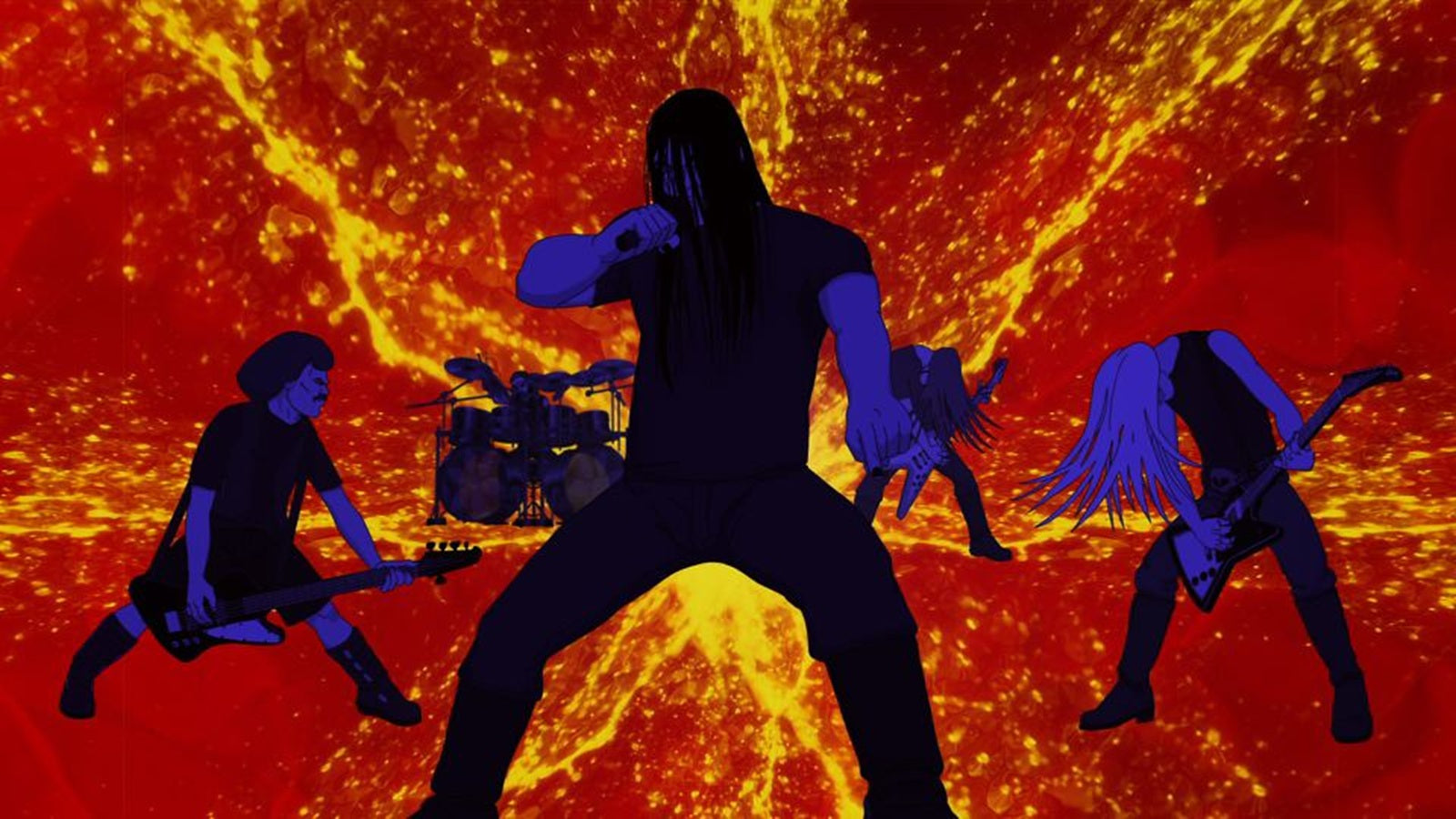
Even before Metalocalypse co-creator Brendon Small leaked the first trailer for the now-iconic animated program in the summer of 2006, through the then-nascent YouTube platform, Dethklok were already “the world’s most popular and successful death-metal band” — at least going by the built-in lore of the show.
In real life, Small believed that the Adult Swim series — concerning the dysfunctional lives of five entertainingly moronic metal musicians and the global cabal closely monitoring their reckless rise — was about to hit big.
To be clear, death metal was already well-established by the Mid-Aughts, building upon decades of devoted fandom in the underground, but it was still relatively niche in the mainstream. Yet between its goofball humor, comically outrageous gore, super-brutal original death-metal tunes — written and performed by Small himself — and Adult Swim’s wide broadcast reach, Metalocalypse was primed to deliver heaviness to people on a whole new level. And sure enough, Metalocalypse near-instantly became one of metal’s biggest crossover success stories.
“I had an inkling that there was an audience that was ready for this, that hadn’t been spoken to yet,” Small tells Revolver. “I thought about myself when I was 14-years-old and discovering guitar — that kid with his arms folded who’s got nothing to watch on TV. But this has guitars in it, so that kid would maybe lean forward and start stroking his chin, going, ‘What is this that I’m looking at?’
“I had a pretty strong feeling that we were gonna connect, and we did. [Metalocalypse] was [Adult Swim’s] highest-rated original premiere at the time. Everyone was high-fiving, and then we were like, ‘Good, now back to work,’ [because] we had 20 episodes to churn through.”
Metalocalypse ended up producing four full seasons of mayhem, along with a special and a direct-to-video movie, steered by the unending foibles of the fictional quintet: grumbly vocalist Nathan Explosion, the Scandinavian guitar tandem of Skwisgaar Skwigelf and Toki Wartooth, dick-swingin’ bass degenerate William Murderface, and Pickles, a skulleted glam-metal singer turned death-metal drummer.
“It’s this ensemble of dipshits, total idiots that are trying to get through their day,” Small explains, adding that while their story became progressively more fantastical as the series went on, Metalocalypse remains an exploration of ego, masculinity, celebrity and anything “brutal.”
“Death metal is about brutality… Cannibal Corpse will list the ways that you’re gonna die,” he says, “But I thought there were many brutal things that aren’t just death. Flying coach is brutal. Going to the dentist is brutal. Getting broken up with, or having to break up with somebody, is fucking brutal.
“All that stuff is pretty funny, and [using] a mush-mouthed [character like] Nathan Explosion is interesting to try to navigate all that.”
Of course, Dethklok didn’t only breakthrough on TV. Since the start, Small has been building up a real-deal songbook of expertly intense, genre-revering death-metal tunes. The band’s series of Dethalbums yielded numerous tongue-in-cheek, yet fully-beloved bangers like “Murmaider” — a song about mermaid-on-mermaid violence — and “Thunderhorse.” Small hits the gutturals under the guise of Nathan Explosion and handles all the riff-based extremity on-record, while monstrous beats are delivered by his longtime partner in crime, Gene Hoglan (Death Angel, Death, Strapping Young Lad). Over the years, the full live band have toured with everyone from Mastodon and Converge to Machine Head, Black Dahlia Murder and BABYMETAL.
This spring, Small and Co. celebrate Dethklok’s 20th anniversary by teaming up for a tour with Viking-metal greats Amon Amarth, as well as rising fantasy-metal troupe Castle Rat. A comedic promo starring Dethklok and Amon vocalist Johan Hegg hints at live shows full of “berserkers, longships, fjords [and] fire.” As you might expect, things are going to get especially brutal out there.

There’s something quite intimate about billing the tour under the “Amonklok” portmanteau. Why did you feel like they were the right band to “power couple” yourselves with?
BRENDON SMALL We knew the 20th anniversary was coming up… at some point we were going, “We should do something,” and then I got a call saying, “What about Amon Amarth and Dethklok?”
In my mind, the perfect Venn diagram is heavy, theatrical bands that basically make each other look better. We build each other up in some way. That’s what it was like on the BABYMETAL tour [2025’s “BabyKlok” tour]. And Amon Amarth makes a lot of sense with Dethklok.
At some point there was a boardroom meeting where I was talking to Amon Amarth’s management and their marketing team. They were pitching stuff, and I thought, “All these pitches are all so crazy. I should do an animated version of this… I bet people will find it funny.” So, we did this little animation clip of Dethklok interacting with Johan.
Amonklok is a great name, and all, but do you regret not OKing this being the “Fire Blood Tits Balls Show Tour,” as it’s phrased in the tour promo animation?
I don’t, because that is out there in the zeitgeist… and you can bet that that’s going to be printed on merch.
Amon are a Swedish band, which makes them countrymen of Skwisgaar, yet Toki Wartooth arguably has the more Viking-sounding name. Between the two of them, who do you think is more stoked to be touring with Amon Amarth?
Well… I think Skwisgaar is in competition with every guitar player out there. When Jason Richardson was opening our show [in 2025], Skwisgaar would get jealous of his guitar playing quite often. I think Toki is probably more of a berserker at heart than Skwisgaar. He’s so soft and playful and sweet, but underneath there’s a darkness.
“Toki Wartooth” is funny — we derived that name through a Viking name generator site. I don’t know if it was my name or [co-creator] Tommy [Blacha]’s name, but one of our names got turned into Toki Wartooth.
How did you connect with Castle Rat, another theatrical metal band?
Honestly? I have friends that are very interested in modern heavy metal, and people were nudging me and saying, “You know about Castle Rat?”
In fact, I got a text from Kim Thayil from Soundgarden, and he was like “I got this band you should check out.” I was like, “Dude, nobody knows this yet, but we’re going to be touring with them!”
Again, there’s a lot of theatricality. [Castle Rat are] bringing something to the stage. They definitely fit that bill. Their music is super, super cool. They’re dramatic and fun at the same time.

You mentioned making that new animated scene with Amon Amarth. Is there any new Dethklok music shaping up behind the scenes for a Dethalbum 5?
The thing with Dethklok as it stands, currently, is we’ve got a big oeuvre to choose from [for the live show]. We’re not like a regular band where we just throw [together] a set list and go, “Learn these songs,” and we’ll switch them up [each] night — you know, like how Metallica goes, “Let’s just do a different thing,” and they get their old tab books, and they sit there and figure out their songs. We need to have visuals in order for us to fulfill our pact with the audience.
What we try to do is shuffle the deck within reason, where we give people that haven’t seen us before the songs that we think they need to hear, and then build in some new content. It’s possible that we could add more to the oeuvre, but there’s so much that we haven’t even gotten to do yet [onstage] that we’re kind of at that crossroads… but I’m personally always writing music.
I’m recording stuff. I’ve always got some project I’m working towards. I’ve always got a guitar in my hand in my studio.
Are you building towards any new episodes or is there another film in your blood?
Because the movie [2023’s Metalocalypse: Army of the Doomstar] was such a big, huge, epic, heavy piece that was just bullshit bonkers, dipshit comedy would be where I would want to go with the series. I’m kind of looking at what we did with Johan as a potential proof-of-concept for the band hanging out and talking to other bands.
You’re not the first person to ask me that. People saw that and went, “Is there more here?” I think as long as we’re having fun, there can be more. I got to complete that bigger story, now I can just have fun.
What’s the one Dethklok song someone new to the band needs to know before coming to the show?
I don’t know if we can do a show without “Go Into the Water.” It’s the ballad. It’s our closing song for the first season. The second half of the first season was us realizing how much meat was on the bone in this show, and then the music started signifying a subterranean lore underneath the show — You know, where the music is world-building.
Those lyrics were pulled from a small scene from the first season where we’re in a class-action lawsuit where people are drowning themselves, because they’re listening to this underwater record that’s supposed to be only for fish. We saw [Dethklok] recording that. That lore all starts in the second episode of the show… This underwater thing continues all the way until the movie.
So, I’d say “Go Into the Water” is definitely one of those songs. It’s fun, but it’s also epic and powerful. Even though this song is about de-evolution, it’s played very straight. That’s a fun place to put the audience … [where] they don’t know how serious to take this.
What is the best episode to show someone in order to understand the characteristics and quirks of the members of Dethklok?
That was the challenge of the first episode.
Murderface and Pickles didn’t have the right voices the first time we tried the pilot. Pickles’ voice didn’t really have a Wisconsin accent or anything like that. He was more like an irritated version of me — and everyone was like, “We don’t want to hear that.”
And then Murderface was kind of lethargic [originally]. At some point in the second episode, he was eating food, and we stuffed all these paper towels in Tommy’s mouth, and I was like, “That’s the character! That kind of crazy, loud, aggressive [person] trying to speak through a mouthful of food — let’s find that.” And then we gave him that lateral lisp. That all came out of having a mouthful of food. So, we went back and re-recorded the first episode with Pickles and Murderface’s [new voices].
Nathan was like, “OK, he’s the lowest-talking kind of quarterback.” Skwisgaar… I went to music school, and I heard Eastern European guys hanging out and making loud jokes in class, being like Skwisgaar. Toki, to me, kind of sounds like my Lithuanian grandmother.
The first episode establishes that Nathan is the center of the band, Pickles is irritated, Murderface is self-loathing — I mean, he is filled with hatred, but nothing does this man hate more than himself. At some point, he’s talking to a reflection of himself, just dressing himself down. So, you get the idea of the characters early on.
Part of the pitch was that we open in Båtsfjord, Norway, which is up in the Arctic Circle. There’s a pilgrimage, hundreds of thousand people tracking through the snow. This is an area where you have to have a license to be able to shoot a polar bear, if they come at you. This is treacherous. People are dying along the way. So, what is this pilgrimage? What are they gonna go see? They’re going to see their favorite band in the world, and the band is playing one song — and it’s a coffee jingle.
It’s gonna be treacherous, things are gonna go wrong, everything’s gonna go bad, and [Dethklok] are just gonna be worried about how they feed themselves after their six-star chef gets blown to pieces. Myopic. Selfish.

As high-concept and ludicrous as the world of Metalocalypse can be, a lot of the humor comes out of smaller moments, like the irritating things you notice about each other while being part of a tight-knit unit. Was any of that inspired by working as the real-life Dethklok?
I think that’s the fun stuff — to build this whole thing and dress it all up, just so you can get the quiet little moments. My sense of humor is very quiet. I have to think like Nigel Tufnel and turn it up to 11 to add all that bombast and ludicrousness you were talking about.
The truth is, if you’re going to be in a band and do this for a living, you have to be able to be low-key during crises. What could those be? Being in a long line [at the airport], getting in and out of Mexico and trying to get your guitars passed through customs. That could take three hours. You could miss your flight, [but] you just have to hang and be cool. There’s nothing you can do. If you’re frustrated, put your mind somewhere else.
In the second episode, where they go into a studio and it’s in the Marianas Trench — so [they’re] recording underwater, because they’re making this album for fish — I remember a recording engineer [in the scene] was like, “Hey guys, start thinking about what you want to eat for dinner.” That was the most human moment of the show, because all you’re doing is combing through menus and thinking about the next time you get to eat food when you’re going through the mundane lethargy of watching someone else track their parts. It’s about being able to capture those things.
That’s also part of [being in the] the writer’s room — from the animators to the writers to the actors. It’s creative people having to interact and irritating each other. It’s the brotherhood and sisterhood of creativity, you know?
When in doubt, I would look at how we were making [the show] to make those decisions that you were talking about, because Metalocalypse was happening in front of my face every single day.
With regards to creative teams, you’ve got Gene fucking Hoglan sitting behind you on the drums. Being that you’re faced with that day in day out, have there ever been moments where you lost the appreciation for how cool that is?
It has been such a fun, creative relationship I’ve had with Gene over the years, and it truly is not lost on me that he is a powerhouse of a person — and a musician!
I get to know the Gene that I think a lot of people don’t get to know. He’s so thoughtful. Anytime we’re talking, I go, “You’ve got something on your mind? I want to hear what it is.” And every time he’s got some good idea or note, because he’s been around the block.
He’s got really good musical taste. He’s always discovering new music, and he shows it to me. I mean, he makes me mixtapes and I go, “Holy shit!” I am reevaluating bands and guitar players based on these mixtapes. He’s gotten me into so much stuff that I don’t know I would have gotten into [otherwise].
And, seriously, he’s the conductor of our live show. He knows every part. He takes his job very seriously.
We played on a [cruise] one time with Lamb of God. The boat was rocking and it was crazy. I’m on one foot trying to switch pedals, hopping around like I’m in Jethro Tull, just trying to get my bearings. I get offstage and I go, “Gene, how was your show?” He goes, “Probably one of the worst shows I played — imagine you’re starting a drum fill here, and then the whole boat moves and I don’t know where the drums [physically] are anymore.”
I love to hear those stories, because he’s such a perfectionist. It is such an oddity that anything would [go wrong] out of what he planned, and if it does, he takes it in stride and makes us all laugh.
Did anything Gene put on those mixtapes ever influence where Dethklok went with their own music?
This happened recently, where he was like, “I know you know Opeth, but you may not know these Opeth songs.” And holy fucking shit, they’re the best band in the world. I always thought they were cool, but I didn’t know they were the band. They’re so fucking great, and their bigger pieces are just ridiculous. I wish I had heard that so much earlier, because they’re such a monumentally creative band. It’s so musical. That was something where it just blew me away.
It’s always wonderful to have your mind awoken in some way, [to be] thrown something that really makes your brain start sparkling and feel dazzled.

What is the most important part, to you, about celebrating this 20th anniversary? Like, what are you reflecting upon the most?
I mean, look… a TV show is a crazy endeavor. It’s a lot of responsibility. But the main thing was that I’m trying to shoot a laser beam into the brain of kids that were like me, who were very engaged in and excited by music.
I have a friend… if he hadn’t shown me Slayer and King Diamond and Metallica one day after school, I don’t know who I would have become. I think of that often.
These kids who were in junior high when the show came out, now they’re adults in their 30s — [Metalocalypse] colored or contoured their interest of music. That, to me, is a nice gift, because I don’t know who I would have been had I not discovered heavy metal and the guitar.
This interview has been edited and condensed for flow and clarity.